Perspective (Leaving Cert DCG): Revision Notes
📚Revision Notes
Perspective
What is perspective?
Perspective is a unique pictorial projection system that creates representations of objects which closely match what we see through our human eyes. This projection method stands apart from all other drawing systems because it uses a fundamentally different approach to how projection lines work.
Unlike other projection systems where the projection rays remain parallel to each other, perspective projection uses rays that radiate outward from or converge towards a single point. This creates the distinctive visual effects that make perspective drawings look so realistic and natural to us.
Note
The key difference between perspective and other projection systems lies in the behaviour of projection rays. While orthographic and other technical drawing systems use parallel rays, perspective uses converging rays that meet at specific points, creating the realistic depth effects we naturally perceive.
Key characteristics of perspective
The most important feature of perspective is how it handles the relationship between distance and apparent size. Objects that appear in the foreground of a perspective drawing will look much larger than identical objects positioned in the background. This mirrors exactly how we experience the world around us.
When you observe the same object from different distances, it appears to change size even though we know it remains the same. For example, a person standing close to you appears much larger than someone the exact same height standing far away. Perspective projection captures this natural visual phenomenon.
Important
This size-distance relationship is not a limitation of perspective—it's actually its greatest strength. Perspective deliberately shows objects as they appear to our eyes, making it the most realistic drawing system for visualisation purposes.
The street scene example
Example
Understanding Perspective: The Street Scene
Imagine looking down a straight street lined with houses. Even though you know all the houses are built to similar sizes, the house nearest to you appears enormous compared to the houses in the distance, which look tiny by comparison.
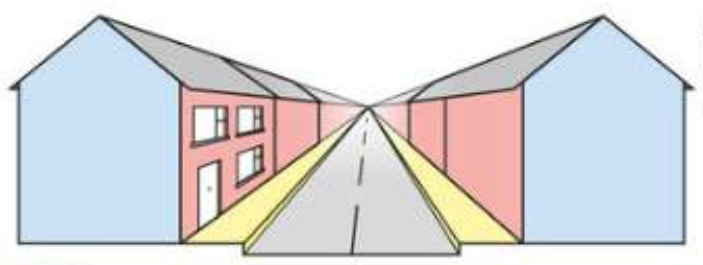
The sides of the street also demonstrate another key principle. Although you know the street maintains the same width throughout its length, the edges appear to narrow and converge as they extend into the distance. This convergence towards a vanishing point is a fundamental characteristic of perspective drawing.
Advantages and limitations
Advantages:
- Creates highly realistic visual representations
- Matches natural human vision
- Excellent for presentation drawings and visualisation
- Helps viewers easily understand 3D forms and spaces
Limitations:
- Cannot be used for accurate measurement
- Does not show true lengths or sizes
- Objects appear distorted based on their distance from the viewer
- Not suitable for technical or manufacturing drawings where precision is required
Important
Critical Limitation: Never use perspective when you need accurate measurements or true proportions for construction or manufacturing purposes. The realistic appearance comes at the cost of measurable accuracy.
Practical applications
Perspective is particularly valuable when you need to:
- Present design ideas to clients or audiences
- Create realistic visualisations of buildings or products
- Communicate how a space or object will actually appear in real life
- Produce illustrations that feel natural and familiar to viewers
However, remember that perspective should never be your choice when accurate measurements or true proportions are needed for construction or manufacturing purposes.
Note
Think of perspective as the "presentation" drawing system—perfect for showing how something will look, but not for showing how to build it. For construction and manufacturing, stick to orthographic projections that preserve true measurements.
Summary
Key Points to Remember:
- Perspective uses radiating projection rays, not parallel ones like other systems
- Objects appear larger in the foreground and smaller in the background
- This projection system mimics natural human vision perfectly
- It's ideal for realistic presentation but unsuitable for precise measurement
- The street scene analogy helps explain how parallel lines converge towards vanishing points