Worked Examples (Leaving Cert DCG): Revision Notes
📚Revision Notes
Worked Examples
This section demonstrates practical applications of pictorial projection techniques through step-by-step worked examples. These examples will help you understand how to construct accurate perspective drawings of various objects and structures.
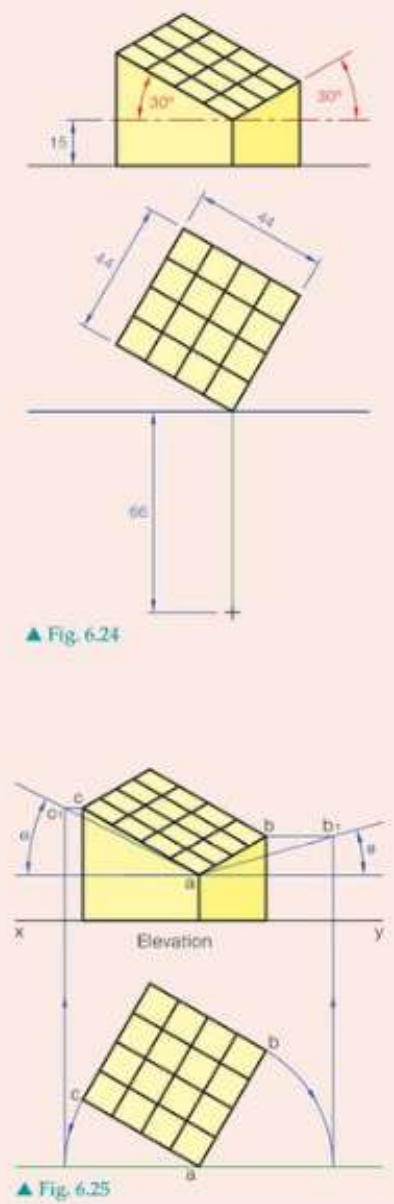
Solar panel perspective construction
When drawing objects like solar panels in perspective, it's essential to understand the difference between true angles and apparent angles. The construction process involves creating both orthographic and perspective views to achieve accurate results.
Important
Critical Concept: True vs Apparent Angles
Always use the true angle rather than the apparent angle when constructing perspective drawings. This means measuring the actual angle of the object, not how it appears to your eye. This is one of the most common mistakes in perspective construction.
Example
Worked Example: Solar Panel Construction Steps
- Begin with orthographic views (elevation and plan)
- Establish the picture plane and viewing position
- Locate vanishing points for horizontal lines
- Use auxiliary vanishing points for angled surfaces
- Transfer measurements accurately from orthographic to perspective views
The construction shows how edges that appear parallel in the horizontal plane will converge to the same vanishing point, whilst vertical edges remain vertical in two-point perspective.
Perspective construction framework
Understanding the basic framework for perspective construction is vital for creating accurate drawings. This involves establishing key reference elements before beginning your perspective drawing.
Note
Essential Framework Elements
The framework consists of several essential elements:
- Picture plane: The imaginary vertical surface on which your drawing appears
- Horizon line: Represents eye level and contains primary vanishing points
- Ground line: The base reference line for your drawing
- Vanishing points (VP1, VP2): Points where parallel lines appear to converge
- Auxiliary vanishing points (Aux VP): Additional points for angled lines
This systematic approach ensures your perspective drawings maintain proper proportions and realistic appearance.
Complex architectural structure perspective
More complex structures require careful planning and the use of multiple vanishing points to handle various orientations and angles within the same drawing.
Example
Worked Example: Complex Shape Construction
When dealing with hexagonal prisms or similar complex shapes:
Step 1: Establish primary vanishing points for the main horizontal directions
Step 2: Create auxiliary vanishing points for angled surfaces (often at 30° to the horizontal plane)
Step 3: Use the station point to determine viewing distance and angle
Step 4: Construct height lines that vanish to points on the horizon line
The key insight is that edges at 30° to the horizontal plane will have their own vanishing point, separate from the main horizontal vanishing points. This principle applies to any consistently angled surfaces in your drawing.
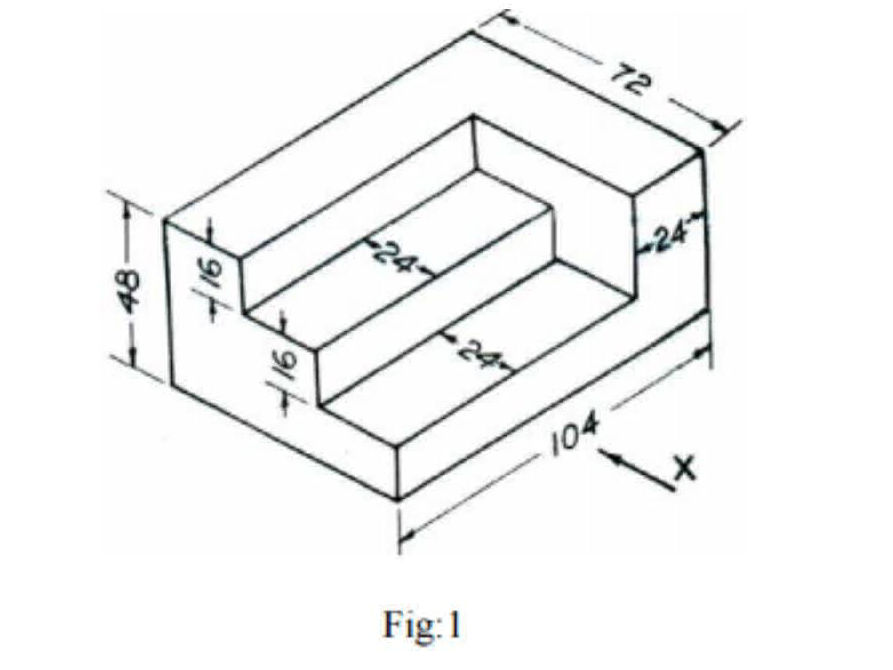
Stepped structure construction
Architectural drawings often involve stepped or tiered structures that require careful attention to proportions and measurements.
The construction demonstrates how to handle multiple levels in perspective while maintaining accurate proportions across different heights.
Note
Working with Scaled Drawings
Notice how each step maintains consistent depth relationships, even though they appear to get progressively smaller due to perspective effects. When working with a specified scale (like 1:100 in this example), ensure all measurements are converted appropriately.
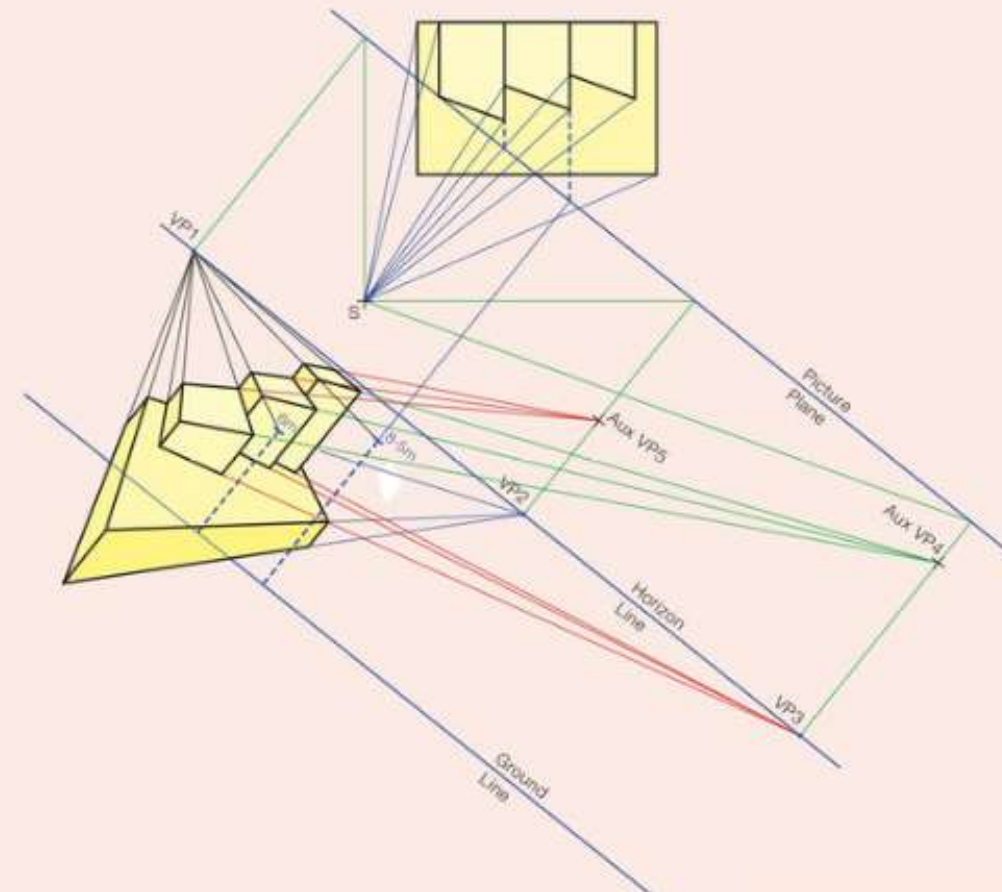
Multi-vanishing point construction
The most complex perspective constructions involve multiple vanishing points to handle objects with various orientations and angles.
Example
Worked Example: Advanced Multi-Point Construction
This advanced construction demonstrates:
- Using three or more vanishing points (VP1, VP2, VP3)
- Employing auxiliary vanishing points for specific angles
- Managing construction lines from the station point
- Creating accurate representations of complex three-dimensional forms
The construction lines radiate from the station point to establish proper viewing relationships, whilst different coloured lines help distinguish between various construction elements.
Important construction principles
Throughout all these examples, several key principles emerge that are essential for accurate perspective construction:
Important
Fundamental Rule: True vs Apparent Angles
Always measure and use the actual angle of surfaces, not how they appear visually. This is critical for accuracy in technical drawing and is the foundation of proper perspective construction.
Note
Vanishing Point Rules
- Horizontal lines that are parallel in reality will converge to the same vanishing point in perspective
- Vertical lines remain vertical in two-point perspective
- Height measurements can be taken directly from the picture plane, but must be projected correctly to show proper perspective diminishing effects
Note
Construction Sequence
Always establish your picture plane, horizon line, and primary vanishing points before beginning detailed construction. This systematic approach prevents errors and ensures accuracy.
Exam tips
Summary
Key Strategies for Perspective Drawing Exams:
- Practice identifying true angles in complex shapes
- Remember that height lines always vanish to points on the horizon line
- Keep construction lines light and organised
- Use different line weights to distinguish between construction lines and final object edges
- Check your work by ensuring parallel lines converge to the correct vanishing points
Remember!
Summary
Essential Points to Remember:
- Always use true angles, not apparent angles when constructing perspective drawings
- Height lines vanish to points on the horizon line - this is a fundamental rule of perspective
- Auxiliary vanishing points are needed for surfaces that aren't horizontal or vertical
- Multiple vanishing points may be required for complex objects with various orientations
- Systematic construction using picture plane, horizon line, and ground line ensures accuracy