Holding the Pencil (Leaving Cert DCG): Revision Notes
📚Revision Notes
Holding the Pencil
Preparing your pencil point
Before you can hold your pencil effectively, you need to ensure it has the right type of point for your drawing work. The tapered point created by a pencil sharpener works well for most tasks, but you can achieve much better control by refining the point further.
To create the ideal drawing point, use a sandpaper pad or sheet of medium-grade glasspaper after sharpening. This technique allows you to shape a fine tapered point that gives you maximum versatility. The wood around the lead should be whittled away carefully with a sharp knife, taking care not to break the lead or reduce its size too much.
Important
When you hold the pencil in a normal drawing position and rub the point on the sandpaper, you can control whether you create a broad stroke or a fine line depending on how the pencil is held. This preparation step is crucial for achieving professional-looking freehand drawings.
Understanding pencil grip fundamentals
How you position your hand significantly affects the type of drawing you can produce. Your grip determines whether you can create bold, sweeping strokes or execute more carefully controlled lines. The key principle is that different drawing tasks require different hand positions and movements.
Most typically, the pencil should be held so it rests lightly on the hand, avoiding excessive pressure that could cause tension in your wrist or fingers. The goal is to let your hand perform the necessary motions smoothly and naturally.
Note
Remember that tension in your grip will translate directly to your lines, making them appear stiff and unnatural. A relaxed grip allows for more expressive and confident drawing.
Basic pencil holding positions
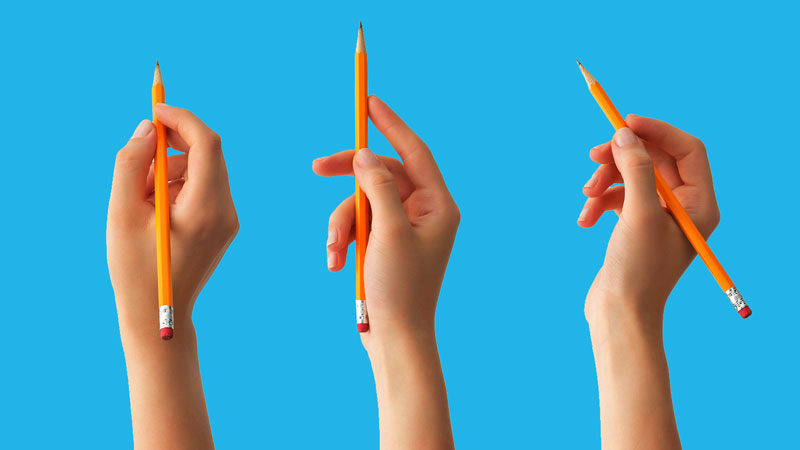
There are three main ways to hold your pencil, each suited to different types of drawing work:
Position for detailed work
For precise, careful lines and detailed drawing, hold the pencil closer to the point. This grip gives you maximum control over small movements and allows for intricate work. Your fingers do most of the movement in this position, with minimal wrist action.
Position for medium strokes
When you need moderate control but want to cover more area, hold the pencil further back from the point. This position allows your wrist to move more freely whilst maintaining good control over your lines.
Position for bold, free strokes
For longer strokes and broader work, hold the pencil well back from the point. In this position, your entire forearm and hand move freely from the elbow, creating flowing, confident lines. There should be minimal wrist and finger movement - instead, let your whole arm guide the pencil.
Example
Practice Exercise: Mastering the Three Positions
- Start with detailed work position - draw small circles and short lines using only finger movements
- Switch to medium stroke position - create medium-length controlled lines using wrist movements
- Move to bold stroke position - draw long, sweeping curves using your entire forearm
Practice switching between these positions until the transitions feel natural and automatic.
Movement techniques for different effects
The type of movement you use directly affects the quality and character of your lines:
- Finger movements: Best for very detailed work and short, precise lines
- Wrist movements: Ideal for medium-length controlled strokes
- Forearm movements: Perfect for long, flowing lines and broad sketching
Note
Understanding when to use each type of movement will help you develop better control and create more varied, interesting drawings. The key is matching the movement to the desired line quality and drawing scale.
Practical tips for better pencil control
- Keep your grip relaxed to avoid hand fatigue during longer drawing sessions
- Practice switching between different holding positions to build muscle memory
- Experiment with the angle at which you hold your pencil - this affects line width and texture
- Remember that bold lines require confident movements, whilst careful detail work needs steadier, more controlled motions
Remember!
Summary
Key Points to Remember:
- Prepare your pencil point properly using sandpaper for the best control and line variation
- Different grips serve different purposes - close to the point for detail, further back for flowing strokes
- Use appropriate movements - fingers for precision, wrist for medium control, forearm for bold work
- Keep your grip relaxed to maintain control and prevent fatigue during drawing
- Practice switching between positions to develop versatility in your freehand drawing technique