Techniques Used to Create Tonal Value (Leaving Cert DCG): Revision Notes
📚Revision Notes
Techniques Used to Create Tonal Value
Understanding tone in drawing
Tone is a fundamental element that brings drawings to life by creating the illusion of three-dimensional form and depth. While lines are essential for outlining shapes and contours, they cannot fully capture the visual qualities of surfaces such as texture, volume, and the way light interacts with objects.
Note
Mastering tonal techniques is what separates basic line drawings from convincing, realistic representations. The ability to show how light falls on surfaces transforms flat drawings into dimensional artwork.
To create convincing representations of real objects, you must develop skills in rendering tonal values. This involves understanding how light falls on surfaces and using various drawing techniques to show the transition from light to dark areas. Mastering tonal techniques allows you to transform flat line drawings into realistic, dimensional representations.
The four main tonal techniques
When working with traditional pencil drawing, there are four primary techniques for creating tonal values:
- Hatching - using parallel lines
- Crosshatching - intersecting sets of parallel lines
- Scribbling - loose, random marks
- Stippling - dots and points
Each technique offers different advantages and can be combined to achieve various visual effects. Let's explore each method in detail.
Important
The key principle underlying all tonal techniques is that closer marks create darker tones and spaced marks create lighter tones. This applies whether you're using lines, dots, or scribbled marks.
Hatching technique
Hatching involves drawing a series of parallel lines to create areas of tone. These lines are drawn freehand and can vary in length, spacing, and direction to achieve different tonal effects.
How hatching works
The fundamental principle of hatching is that the spacing between lines determines the tonal value:
- Lines drawn close together create darker tones
- Lines spaced further apart produce lighter tones
- The density of hatching can be gradually varied to show smooth tonal transitions
Key characteristics of hatching
Note
Essential Hatching Principles:
Lines should generally follow the form of the object being drawn to enhance the sense of three-dimensional structure. This technique works particularly well when the hatching direction reinforces the surface contours.
- Lines should generally follow the form of the object being drawn
- Most effective when using relatively short, rapid diagonal strokes
- Can be applied as single layers or built up gradually
- Works well for both curved and angular surfaces
- Allows precise control over tonal gradation
Example
Practical Hatching Application:
Step 1: Start at the edges and work inwards, following the contours of your subject
Step 2: Apply light pressure initially - you can always add more layers to darken areas
Step 3: Practice maintaining consistent line weight and spacing for smooth, even tones
Remember: it's difficult to make dark areas lighter, so build up gradually!
Crosshatching technique
Crosshatching builds upon basic hatching by using two or more sets of parallel lines that intersect at various angles. This creates more complex tonal effects and allows for achieving very dark values.
How crosshatching works
The technique involves layering different sets of parallel lines:
- First layer: basic hatching in one direction
- Second layer: hatching at a different angle, typically diagonal to the first
- Additional layers: can be added at various angles for darker tones
Controlling tone with crosshatching
The degree of intersection determines the final tonal value:
- Light crosshatching with minimal overlap creates medium tones
- Dense crosshatching with multiple layers produces very dark areas
- Varying the spacing between different layers allows fine control over gradation
Note
Crosshatching Angles:
While there are no strict rules about angles, many artists find that intersecting lines at 45-90 degree angles creates the most effective tonal patterns. Experiment with different angles to find what works best for your drawing style.
Applications of crosshatching
Crosshatching is particularly effective for:
- Creating strong contrast in drawings
- Rendering complex forms with multiple shadow areas
- Building up very dark tones that cannot be achieved with single hatching
- Adding texture and surface interest to geometric forms
 Scribbling technique
Scribbling is the most spontaneous and flexible of the tonal techniques. It involves making loose, random marks that can quickly establish areas of tone and texture.
Characteristics of scribbling
This technique offers several advantages:
- Speed: fastest method for establishing initial tonal areas
- Flexibility: can be adapted during the drawing process
- Organic quality: creates natural, less mechanical-looking textures
- Versatility: works well for both rough sketches and finished drawings

Different scribbling approaches
The technique can be varied to suit different purposes:
- Tight scribbling: small, controlled marks for detailed areas
- Loose scribbling: larger, flowing movements for broader tonal areas
- Directional scribbling: following the form and surface contours
- Random scribbling: completely freeform for textural effects
Note
When to Choose Scribbling:
Scribbling works particularly well for quick sketches and preliminary studies, adding texture to organic forms like foliage or fabric, creating atmospheric effects and soft shadows, and loosening up overly rigid technical drawings.
Stippling technique
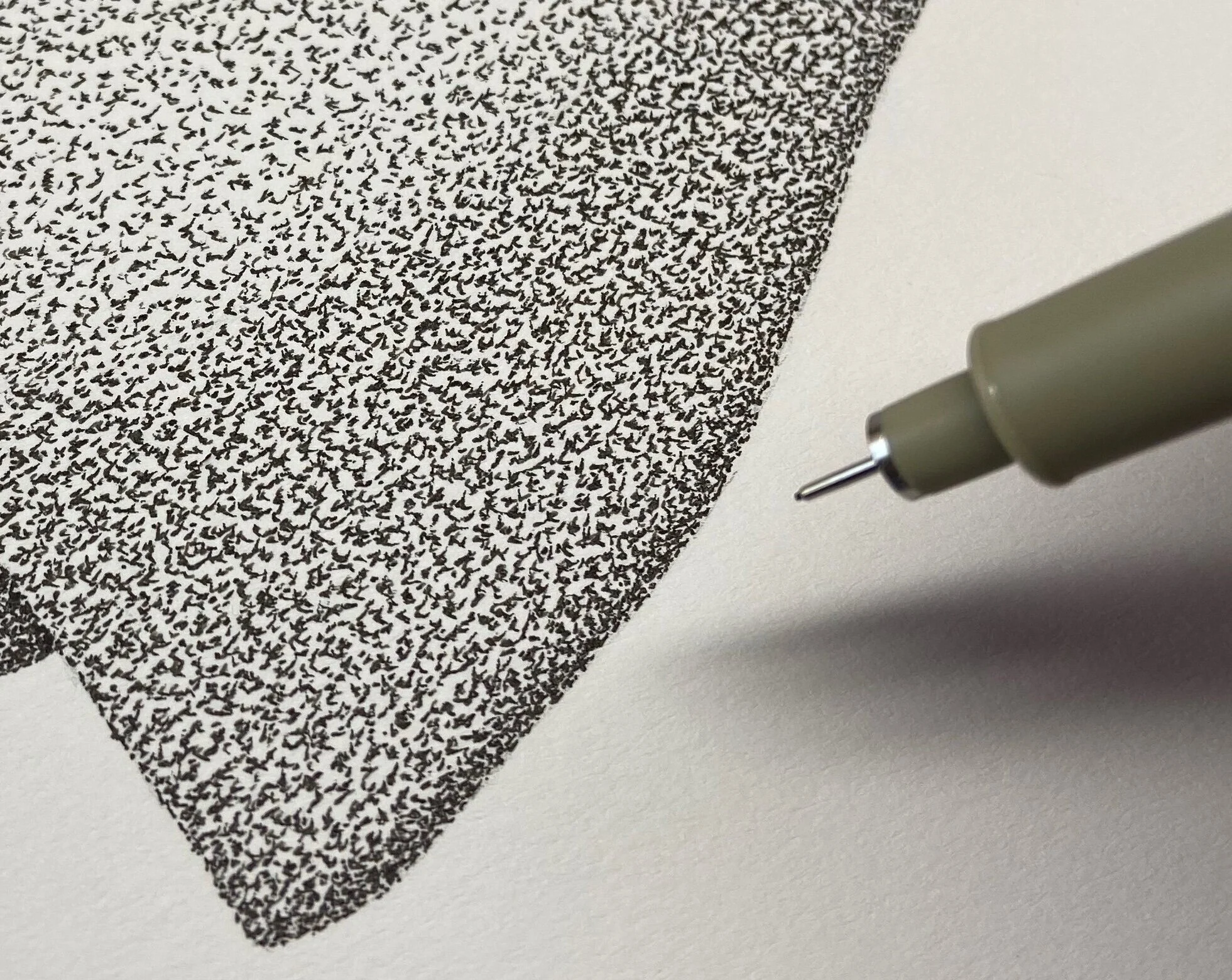
Stippling uses individual dots or small marks to build up areas of tone. This technique requires patience but produces unique textural qualities that cannot be achieved with line-based methods.
Understanding stippling
The core principle of stippling is dot density:
- Closely spaced dots create dark tones
- Widely spaced dots produce light tones
- Gradual changes in spacing create smooth tonal transitions
- The size of individual dots also affects the overall tone
Stippling application techniques
Example
Effective Stippling Process:
Step 1: Start with light pressure to create small, uniform dots
Step 2: Gradually build up density in shadow areas
Step 3: Use larger dots sparingly as they can dominate the drawing
Step 4: Work systematically to avoid patchy, uneven results
Effective stippling requires careful control and patience. The technique demands consistent dot placement and gradual density building for professional results.
Advantages of stippling
This technique offers unique benefits:
- Creates distinctive textural effects
- Allows very precise control over subtle tonal gradations
- Produces clean, mechanical-looking finishes
- Works well for technical illustrations and detailed studies
Combining techniques effectively
The most successful drawings often combine multiple tonal techniques. Understanding when and how to use each method strategically will elevate your artwork significantly.
Important
Strategic Technique Combination:
- Use hatching for basic form definition
- Add crosshatching for deep shadows
- Apply scribbling for textural areas
- Include stippling for fine detail work
Practice each technique individually before attempting combinations. Understanding the strengths and limitations of each method will help you choose the most appropriate technique for different parts of your drawing.
Each technique has its own character and visual impact. Combining them thoughtfully allows you to create drawings with rich variety and visual interest while maintaining technical control throughout the rendering process.
Summary
Key Points to Remember:
- Tone creates the illusion of three-dimensional form - it's essential for realistic drawing
- Closer marks make darker tones - whether using lines or dots, spacing controls value
- Each technique has unique qualities - hatching for control, crosshatching for depth, scribbling for speed, stippling for texture
- Practice builds skill - regular practice with each technique improves your ability to create smooth tonal transitions
- Combine techniques strategically - use different methods in the same drawing to achieve various effects and maintain visual interest