Partial Envelopments (Leaving Cert DCG): Revision Notes
📚Revision Notes
Partial Envelopments
What are partial envelopments?
A partial envelopment occurs when a label or sticker is wrapped around a three-dimensional solid object. This is a common real-world application you see every day - from labels on bottles and jars to decorative patterns on cylindrical containers. In technical drawing, we need to understand how these labels appear when they're "unwrapped" or developed flat, as this is often very different from how they look when wrapped around the object.
Note
The key insight is that when a label is developed (unfolded flat), it can appear much more complicated than it looks when wrapped around the jar or bottle. This is because the curved or angled surfaces of the 3D object distort the appearance of the label.
Key characteristics of partial envelopments
When working with partial envelopments, you need to consider several important factors:
Important
Understanding these characteristics is essential for accurate technical drawing of partial envelopments:
- Surface geometry: The shape of the underlying solid determines how the label will distort
- Projection methods: You must use proper orthographic projection to show all views accurately
- Development techniques: The label must be "unwrapped" mathematically to show its true shape
- Dimensional relationships: Measurements must be preserved correctly between the 3D form and flat development
Types of shapes and partial envelopments
Prismatic shapes
When labels wrap around prismatic shapes like pentagonal prisms, the development process involves several key steps. You need to draw the complete orthographic projections including front elevation, end elevation, and plan view of the solid object.
For prismatic shapes:
- The label edges must align properly with the prism faces
- Projection lines help transfer measurements between views
- The development shows how the label would look if unfolded flat
- Points on the label can be projected between different views to ensure accuracy
Cylinders
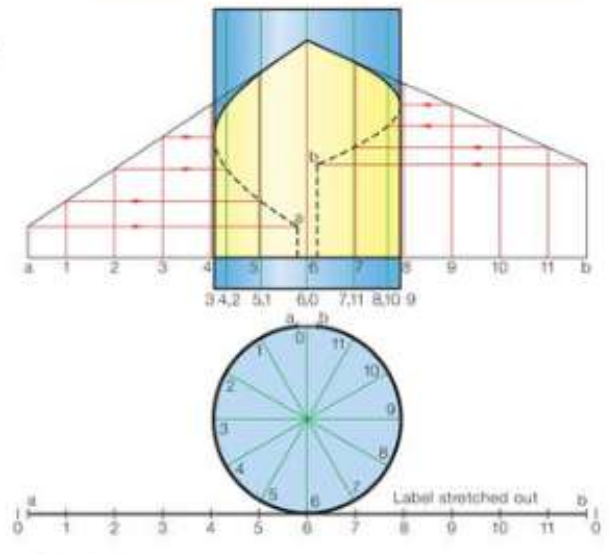
Cylindrical shapes present unique challenges because of their curved surfaces. When a label wraps around a cylinder, you must calculate the circumference correctly to ensure proper development.
Important
The fundamental relationship for cylinders is that the length of the development must equal the circumference of the cylinder.
Example
Worked Example: Calculating Cylinder Circumference
The circumference formula is:
For a cylinder with radius = 28.6 mm:
- Circumference = mm
- Therefore, any label wrapping around this cylinder must have a width of 180 mm in its developed form.
Cones
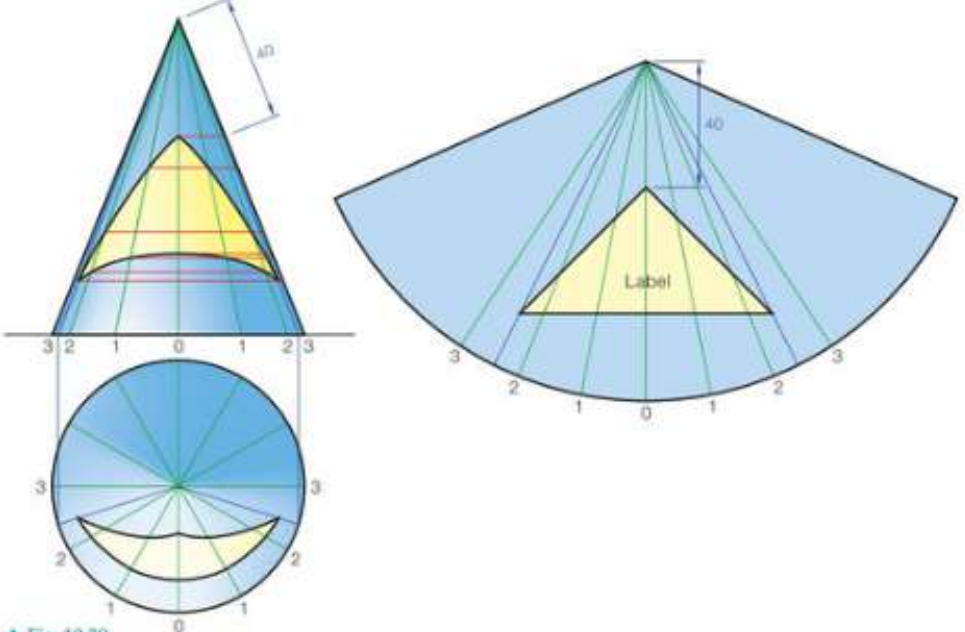
Conical surfaces require special consideration because they involve both curved surfaces and varying diameters. When a triangular label is wrapped around a cone, it follows the cone's generators (straight lines from the apex to the base circle).
Note
Key points for cone envelopments:
- The label crosses generators at true lengths
- These generators transfer to the development as radial lines
- The cone development appears as a sector of a circle
- The label shape transforms significantly from 3D to developed form
Construction techniques
When creating technical drawings of partial envelopments, follow these essential steps:
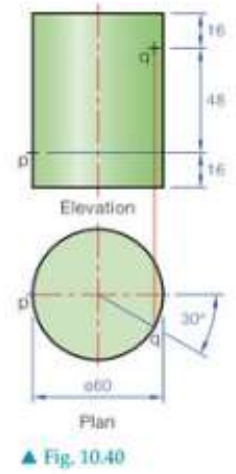
Step 1: Draw the basic solid Create accurate orthographic projections showing front elevation, end elevation, and plan view of the underlying solid object.
Step 2: Position the label Show how the label sits on the solid in each view, ensuring proper alignment and proportions.
Step 3: Develop the surface Create the flat development pattern, carefully transferring measurements and maintaining geometric relationships.
Step 4: Project the label Transfer the label from the 3D views onto the development, showing its true shape when unfolded.
Practical applications
Understanding partial envelopments is essential for:
- Package design: Creating labels for bottles, cans, and containers
- Manufacturing: Developing templates for curved surfaces
- Engineering: Designing components that wrap around pipes or cylindrical structures
- Architecture: Creating decorative elements for curved building surfaces
Exam tips
Important
Critical Exam Success Points:
- Always start with complete orthographic projections
- Check that circumference calculations are correct for cylindrical shapes
- Remember that the developed label shape is often very different from its appearance when wrapped
- Use construction lines to maintain accuracy when projecting between views
- Pay attention to which parts of the label are visible in each orthographic view
Remember!
Summary
Key Points to Remember:
- Partial envelopments involve wrapping labels or patterns around 3D solids, requiring careful development techniques
- Circumference calculations are crucial for cylindrical shapes - always use to find the development width
- Orthographic projection is essential - you need front elevation, end elevation, and plan views for complete solutions
- Development patterns show the true shape of labels when unfolded flat, which often looks very different from the wrapped appearance
- Real-world applications include bottle labels, packaging design, and manufacturing templates for curved surfaces