Shortest Distance (Leaving Cert DCG): Revision Notes
📚Revision Notes
Shortest Distance
When working with technical drawings and surface developments, understanding how to find the shortest distance between two points is essential. This concept becomes particularly important when dealing with curved or complex surfaces where the shortest path is not immediately obvious.
Understanding shortest distance
The shortest distance between two points depends entirely on the surface they lie on. When both points exist on the same flat plane, the solution is straightforward - a straight line connects them and represents the shortest possible path. However, when points lie on different surfaces of a three-dimensional object, finding the shortest route requires a different approach.
Note
The key distinction here is the surface constraint. In free space, the shortest distance is always a straight line, but when we must travel along a surface, the path may need to follow the contours of that surface.
Shortest distance on different surfaces
When two points are located on different surfaces of the same solid object, we cannot simply draw a straight line through the air between them. Instead, we must find the shortest path that travels along the actual surface of the object. This is where the technique of 'opening out' or developing the surface becomes crucial.
The process involves unfolding or developing the curved or complex surface into a flat pattern. Once the surface is laid out flat, we can draw a straight line between the two points on this developed surface. This straight line represents the shortest distance along the original curved surface.
Important
The fundamental principle is that the shortest distance on a developed surface is a straight line. This straight line, when transferred back to the original curved surface, gives us the true shortest path along that surface.
Method for finding shortest distance
The systematic approach for finding shortest distance on curved surfaces follows these key steps:
Example
Step-by-Step Method: Finding Shortest Distance on Curved Surfaces
Step 1: Identify the surface path Determine which surfaces the shortest route will travel across. This might involve moving from one face of an object to an adjacent face.
Step 2: Develop the surfaces Create a flat development or 'net' of the surfaces involved. This means unfolding them so they lie in the same plane.
Step 3: Plot the points Mark the positions of both points on the developed surface, ensuring their relative positions are accurate.
Step 4: Draw the straight line Connect the two points with a straight line on the developed surface. This line represents the shortest distance.
Step 5: Transfer back to the original Project this shortest path back onto the original three-dimensional object to show how it appears in the standard orthographic views.
Application to cylinders
Cylinders present a common example where shortest distance calculations are needed. When finding the shortest distance between two points on a cylinder's surface, the curved surface must be developed into a rectangular pattern.
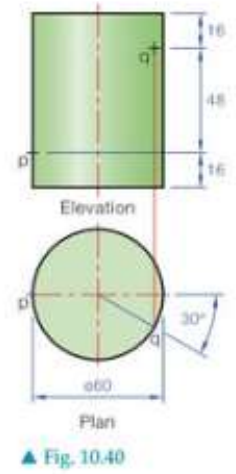
The cylinder's curved surface, when developed, becomes a rectangle. The points that were originally separated by the curve of the cylinder can now be connected with a straight line on this rectangular development. This technique is particularly useful in engineering applications where you need to determine the length of material required to connect two points on a cylindrical surface.
Note
When a cylinder is developed, its curved surface unfolds into a rectangle where the width equals the circumference of the cylinder ( where is the diameter) and the height equals the cylinder's height.
Drawing projections
When creating technical drawings that show shortest distance paths, it's essential to present multiple views. The elevation view shows how the path appears when viewing the object from the side, while the plan view demonstrates the path from above. These orthographic projections help communicate the three-dimensional reality of the shortest path to anyone reading the technical drawing.
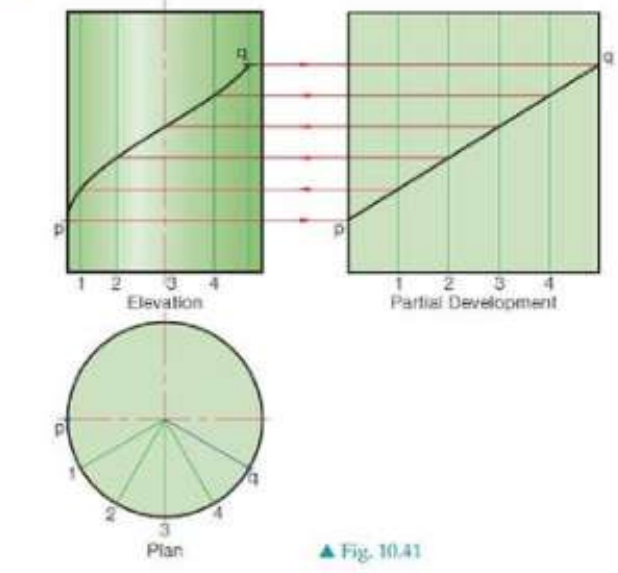
The key principle to remember is that while the shortest distance may appear curved or complex in the standard orthographic views, it represents a straight line when the surface is developed or unfolded. The construction lines shown in technical drawings help establish the geometric relationships between different views.
Practical applications
Understanding shortest distance on developed surfaces has several important applications in various fields:
- Manufacturing: Calculating material lengths for wrapping or covering curved surfaces
- Engineering design: Determining optimal routing paths for cables or pipes around curved structures
- Construction: Planning the most efficient placement of structural elements
- Technical drawing: Creating accurate orthographic projections that show true distances
Summary
Key Points to Remember:
- The shortest distance between two points on the same plane is always a straight line
- When points are on different surfaces of the same solid, develop the surfaces first before finding the shortest path
- The 'opening out' technique transforms curved surfaces into flat patterns where straight lines can be drawn
- Always transfer the shortest distance path back to the original orthographic views for complete technical documentation
- Cylinder surfaces develop into rectangles, making shortest distance calculations more manageable