Method Four: Vertical Sections (Leaving Cert DCG): Revision Notes
📚Revision Notes
Method Four: Vertical Sections
Understanding vertical sections
The vertical sections method is a powerful technique used to find the line of interpenetration between two intersecting solids. This method works on exactly the same principle as horizontal sections, but the cutting planes are positioned vertically instead of horizontally.
When using vertical sections, you take a series of vertical cutting planes at regular intervals through both intersecting solids. Each vertical section reveals where the two shapes meet, and by connecting these intersection points, you can build up the complete line of interpenetration.
Note
The vertical sections method is particularly effective when the geometry of the intersecting solids makes horizontal sections difficult to visualise or when vertical cuts provide clearer cross-sectional views.
How the method works
The process involves cutting through both solids with imaginary vertical planes. Each cut shows a cross-section of both shapes at that particular position. Where these cross-sections overlap or intersect, you find points that lie on the line of interpenetration.
By taking multiple vertical sections at different positions and finding the intersection points for each section, you can plot enough points to draw the complete curve where the two solids meet.
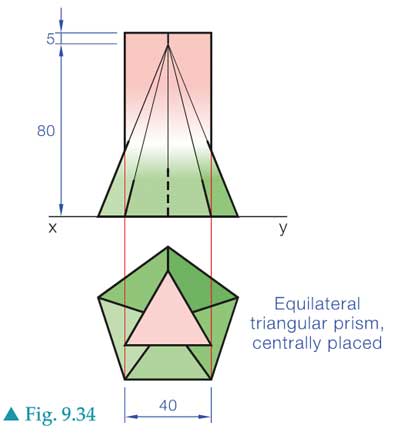
Step-by-step process
Example
Worked Example: Applying the Vertical Sections Method
Step 1: Set up your views
- Draw the plan and elevation views of both intersecting solids
- Ensure both views are properly aligned using projection lines
Step 2: Position the vertical sections
- Decide where to place your vertical cutting planes
- Space them evenly across the area where the solids intersect
- More sections will give you a more accurate result
Step 3: Find intersection points
- For each vertical section, determine where it cuts through both solids
- Mark the points where the cross-sections of the two solids meet
- These points lie on the line of interpenetration
Step 4: Connect the points
- Transfer all intersection points to both your plan and elevation views
- Draw smooth curves through these points to complete the line of interpenetration
Practical applications
Note
Common Applications of Vertical Sections
This method is particularly useful when dealing with:
- Cylinders intersecting with prisms - The vertical sections cut through the cylinder creating circular cross-sections, while cutting through the prism creates polygonal sections
- Spheres intersecting with other shapes - Vertical sections through a sphere always create circular cross-sections of varying sizes
- Complex geometric combinations - Any situation where horizontal sections might be difficult to visualise or construct
Key principles to remember
Important
Accuracy depends on section quantity - The more vertical sections you use, the more accurate your final line of interpenetration will be. However, too many sections can make the drawing cluttered.
Important
Section positioning matters - Place your vertical sections where they will reveal the most information about the intersection. Focus on areas where the shapes change direction or where the intersection curve is most complex.
Important
Both views must match - The points you find in one view must correspond correctly with the points in the other view. Always use proper projection techniques to ensure accuracy.
Important
Smooth curves are essential - The line of interpenetration should be drawn as a smooth, continuous curve. Avoid creating angular or jagged lines unless the geometry specifically requires them.
Exam tips
Note
Examination Success Tips
- Practice identifying which method (horizontal or vertical sections) will be easier for each type of intersection
- Always start with a clear, accurate drawing of both solids before beginning the sectioning process
- Use a consistent spacing between your vertical sections
- Check your work by ensuring the intersection line makes geometric sense in both views
Summary
Key Points to Remember:
- Vertical sections work exactly like horizontal sections, just oriented differently
- Take sections at regular intervals through both intersecting solids
- Each section reveals intersection points that help build the complete line of interpenetration
- The method is especially useful for cylinders, spheres, and complex geometric combinations
- Accuracy improves with more sections, but don't overcrowd your drawing