The Cube (Leaving Cert DCG): Revision Notes
📚Revision Notes
The Cube
Basic properties of the cube
A cube is one of the most familiar three-dimensional shapes and belongs to a special group called regular polyhedra or Platonic solids. Understanding the cube's fundamental characteristics is essential for technical drawing and geometric analysis.
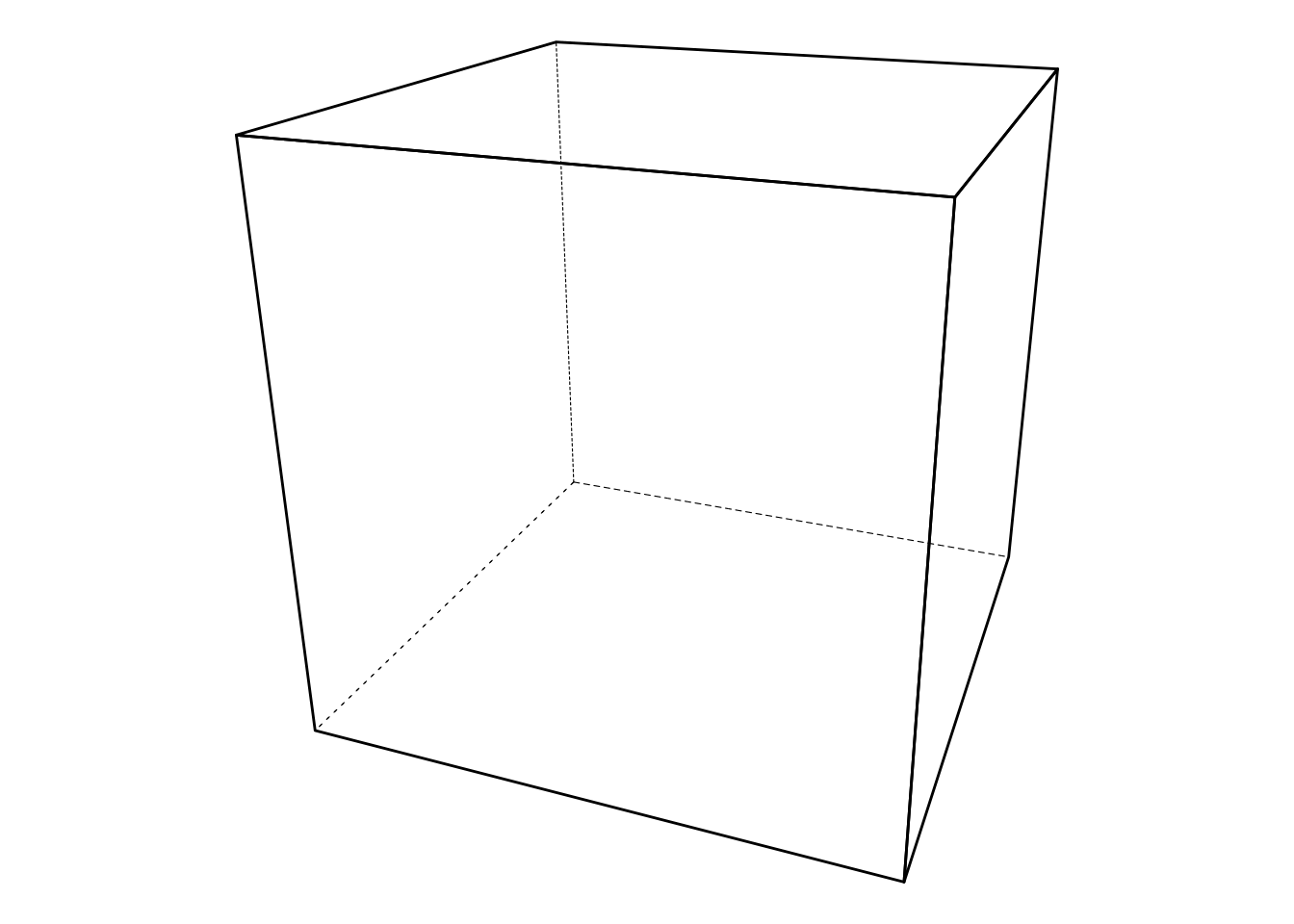
The cube possesses several key features that make it unique:
- Six faces: All faces are identical squares
- Eight vertices: Corner points where three faces meet
- Twelve edges: Lines where two faces connect
Important
What makes the cube particularly special among all regular polyhedra is its versatility in sectioning. When you slice through a cube in any of the three main directions (length, width, or height), you always create square cross-sections. This property makes it the only regular polyhedron that can be sectioned to produce squares in all three dimensional planes.
Orthographic projections
When creating technical drawings of a cube, we use orthographic projection to show different views. This method helps us understand the three-dimensional object by looking at it from different directions.
The three main orthographic views of a cube are:
- Front elevation: Shows the cube as viewed from the front
- End elevation: Shows the cube as viewed from the side
- Plan view: Shows the cube as viewed from above
Note
Since all faces of a cube are identical squares, each orthographic projection appears as a perfect square. This consistency makes the cube relatively straightforward to draw and analyse in technical drawings.
Duality relationships
One of the most interesting geometric concepts involving cubes is duality. This relationship exists between certain pairs of polyhedra where the properties of one shape correspond to the properties of another.
Cube and octahedron duality
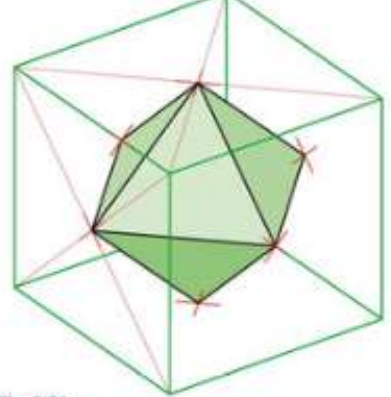
The cube has a special dual relationship with the octahedron (an eight-faced polyhedron). This relationship works in both directions:
- Dual of a cube is an octahedron: When you connect the centre points of each face of a cube, you create an octahedron
- Dual of an octahedron is a cube: When you connect the centre points of each face of an octahedron, you create a cube
Important
This duality relationship demonstrates how geometric shapes can be interconnected. Notice that the cube has 6 faces and 8 vertices, while the octahedron has 8 faces and 6 vertices - the numbers are swapped, which is a characteristic of dual polyhedra.
Tetrahedron inside a cube
Another fascinating geometric relationship involves fitting a tetrahedron (four-faced pyramid) inside a cube. This construction demonstrates how different regular polyhedra can be related to each other.
Note
When a tetrahedron is placed inside a cube:
- All four faces of the tetrahedron are equilateral triangles
- The vertices of the tetrahedron touch alternating corners of the cube
- The edges of the tetrahedron correspond to the face diagonals of the cube
- There are two possible arrangements of tetrahedra that can fit inside a single cube
This relationship is particularly useful in understanding how complex three-dimensional forms can be constructed from simpler geometric relationships.
Inscribed and circumscribed spheres
The cube also has important relationships with spheres, which helps us understand spatial geometry and measurement principles.
Inscribed sphere
An inscribed sphere fits perfectly inside the cube, touching all six faces at their centres:
- The sphere and cube share the same centre point
- The radius of the inscribed sphere equals half the length of the cube's edge
- The sphere touches each face of the cube at exactly one point
Circumscribed sphere
A circumscribed sphere passes through all eight vertices of the cube:
- The sphere and cube share the same centre point
- Diagonally opposite corners of the cube touch the sphere's surface
- The diameter of the circumscribed sphere equals the long diagonal of the cube
- The long diagonal connects two opposite vertices of the cube

Note
These sphere relationships are particularly important for understanding geometric constructions and for calculating measurements in three-dimensional problems. Both spheres share the same centre point as the cube, but serve different geometric purposes.
Summary
Key Points to Remember:
- A cube has 6 faces, 8 vertices, and 12 edges - it's the only regular polyhedron that creates square sections in all three dimensions
- Orthographic projections of a cube show three identical square views: front elevation, end elevation, and plan view
- The cube and octahedron are dual polyhedra - each can be constructed from the other by connecting face centres
- A tetrahedron can be inscribed in a cube using alternating vertices, creating equilateral triangular faces
- Two types of spheres relate to cubes: the inscribed sphere touches all faces, while the circumscribed sphere passes through all vertices