Solids in Contact: Worked Examples (Leaving Cert DCG): Revision Notes
📚Revision Notes
Solids in Contact: Worked Examples
Introduction to solids in contact
When studying orthographic projection, understanding how solids interact and touch each other is crucial for accurate technical drawing. Solids in contact refers to geometric objects that physically touch at specific points or along lines. These contact relationships must be carefully constructed in both plan and elevation views to create accurate projections.
Important
Critical Principle: Contact points appear in all orthographic views and must be projected correctly between plan and elevation. When two solids touch, they share common geometry at the point of contact, which helps determine their relative positions.
Note
The fundamental concept here is that contact relationships create geometric constraints that must be maintained across all projection views. This consistency is what ensures accuracy in technical drawings.
Problem 1: Sphere with point projection
This problem demonstrates the fundamental technique for projecting points on a sphere and understanding rotational movement around the sphere's surface.
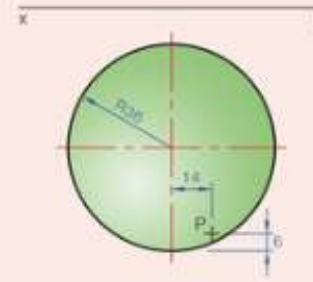
The construction method involves several key steps that build upon each other to create accurate projections.
Example
Worked Example: Sphere Point Projection and Rotation
Step 1: Basic sphere projection Draw the sphere in both plan and elevation views. The plan shows a circle representing the sphere's outline when viewed from above, while the elevation shows the same circle from the side.
Step 2: Point location and rotation Find point P on the sphere using standard projection methods. The point P can be rotated around the sphere's circumference whilst maintaining its relationship to the sphere's centre C.
Step 3: Locus construction Create a locus (path) of points that are equidistant from the sphere's circumference. This locus intersects with the extended line CP to establish the sphere's final position after rotation.
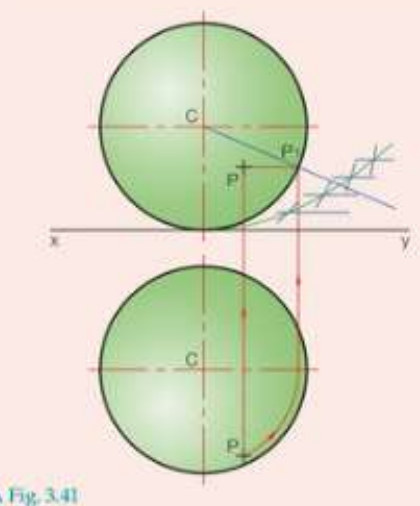
The rotation technique allows you to move points around the sphere's surface while preserving their geometric relationships, which is essential for understanding complex solid interactions.
Note
A locus is the path traced by a moving point under specific conditions. In this case, it represents all possible positions where the sphere can be located while maintaining the required geometric constraints.
Problem 2: Cone and sphere in contact
This problem explores how a cone and sphere interact when they touch each other, requiring careful analysis of their contact relationships.
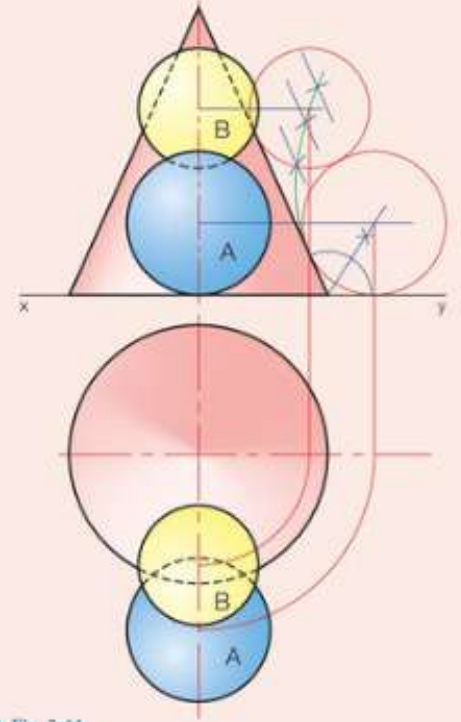
Understanding the contact geometry is fundamental to solving these types of problems. When a sphere contacts a cone, the point of contact occurs where the sphere's surface touches the cone's slanted face. The location of sphere A in plan view is determined by sliding the sphere to the side of the cone until contact is achieved.
Example
Worked Example: Cone-Sphere Contact Construction
Construction sequence The elevation view shows the cone with sphere B positioned to touch it. To find the contact points:
- Locate the sphere position by bringing it to the cone's side until they just touch
- Project the contact points using perpendicular lines from the rotated sphere centres to the cone's edge
- Transfer measurements between plan and elevation to maintain accuracy
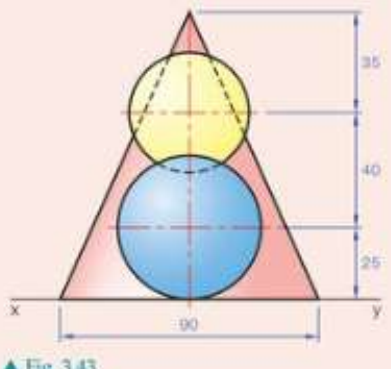
The contact point analysis reveals that the three points of contact can be projected back into the plan view, showing exactly where the sphere touches the cone's surface. This technique is fundamental for understanding how curved and angular solids interact.
Important
Always ensure that contact points are accurately transferred between views. Any discrepancy will result in incorrect solid positioning and inaccurate technical drawings.
Problem 3: Sphere and cylinder contact
This example demonstrates contact between a sphere and cylinder, both common geometric solids in technical drawing.
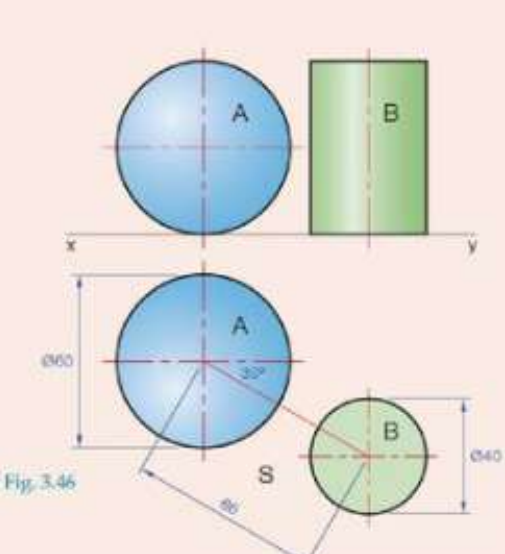
Setting up the problem correctly is crucial for accurate results. The sphere A and cylinder B must be drawn in both plan and elevation views. The critical aspect is determining where these solids make contact when positioned on the horizontal plane.
Note
Contact Mechanics Explained When the sphere and cylinder contact on the horizontal plane:
- Their circular plans will touch but not overlap
- The point of contact can be located by dropping the cone centre and contact point down to the plan view
- The cylinder's axis remains perpendicular to the horizontal plane
Example
Worked Example: Sphere-Cylinder Contact Method
Construction methodology
- Draw both solids in elevation first to establish their heights and positions
- Project down to plan view to show their circular outlines
- Position the solids so their edges just touch at the point of contact
- Verify the contact relationship in both views
The key insight is that contact between curved solids creates precise geometric relationships that must be maintained across all projection views.
Problem 4: Elevated sphere contact
This problem deals with more complex scenarios where spheres are positioned at different heights while maintaining contact relationships.
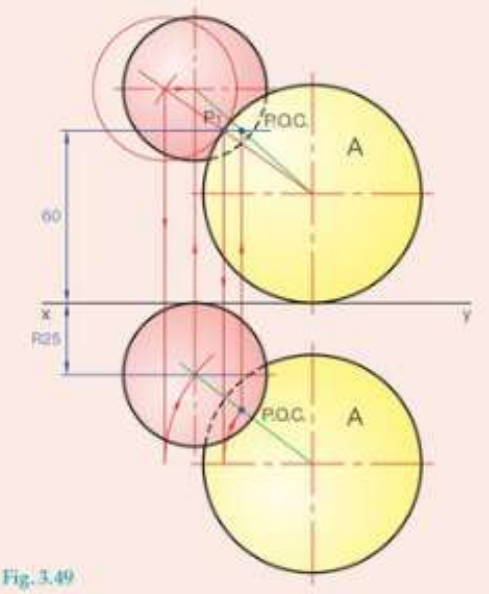
Multi-level positioning introduces additional complexity to contact analysis. Sphere A rests on the horizontal plane, while another sphere is positioned 40mm above the horizontal plane and also touches the vertical plane. This creates a three-dimensional contact scenario requiring careful projection.
Example
Worked Example: Multi-Level Sphere Contact
Contact analysis The construction involves:
- Establishing the base sphere position on the horizontal plane
- Calculating the elevated sphere position 40mm above the base plane
- Finding contact points where the spheres touch each other
- Showing contact with the vertical plane for the elevated sphere
Projection accuracy Both plan and elevation views must accurately show the contact points. The height difference between spheres creates different contact geometries that must be carefully constructed.
Important
When working with spheres at different elevations, pay special attention to the height relationships and ensure they are consistently represented in both plan and elevation views.
Problem 5: Two spheres on horizontal plane
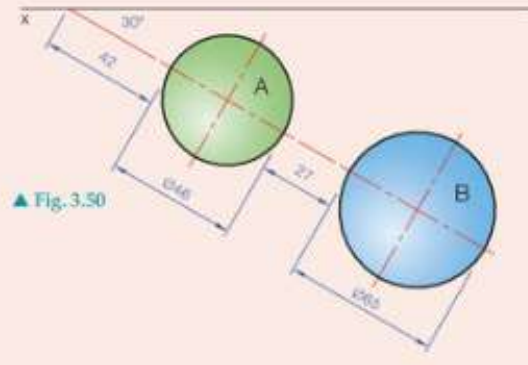
This example shows two spheres A and B resting on the same horizontal plane while maintaining contact with each other.
Equal elevation contact simplifies the analysis compared to elevated scenarios. When both spheres rest on the horizontal plane, their centres are at the same height above the plane.
Example
Worked Example: Equal-Level Sphere Contact
Construction principles
- Draw both spheres in plan and elevation with their centres at equal heights
- Position spheres so they just touch at their surfaces
- Locate contact points using geometric construction techniques
- Project contact relationships accurately between views
The contact point between the spheres lies on the line joining their centres, and this relationship must be maintained in both plan and elevation projections.
Tangent planes to solids
Understanding tangent planes is essential for advanced solid geometry problems. A tangent plane touches a solid at exactly one point without intersecting the solid's interior.
Tangent plane to sphere

Example
Worked Example: Tangent Plane to Sphere Construction
Construction method To draw a plane tangential to a sphere at point P:
- Locate point P on the sphere's surface in plan view
- Project an auxiliary view having the XY plane parallel to CP
- Position point P in the auxiliary view on the sphere's circumference
- Draw the edge view of the tangent plane in elevation
- Find the traces to complete the plane construction
Important
Key principle: The tangent plane at any point on a sphere is perpendicular to the radius at that point. This geometric relationship guides the construction process.
Tangent plane to cone
Cone tangency requires a different approach compared to spheres. Drawing a plane tangential to a cone at point P involves understanding that the contact occurs along a line rather than at a single point.
Example
Worked Example: Tangent Plane to Cone
The construction requires:
- Draw the generatrix from the cone apex through point P to the base
- Establish perpendicular relationships between the tangent plane and cone surface
- Find P in elevation and project to the vertical trace
- Complete the plane construction using standard geometric methods
Note
The tangent plane to a cone touches along a straight line (the generatrix) rather than at a single point like with a sphere. This fundamental difference affects the construction method.
Remember!
Summary
Key Points to Remember:
-
Contact points must appear consistently in all orthographic views - plan, elevation, and any auxiliary views
-
Locus construction is a powerful technique for finding sphere positions when points rotate around circumferences
-
Tangent planes touch solids at exactly one point (spheres) or along one line (cones) without penetrating the solid's interior
-
Projection accuracy between plan and elevation views is critical for correctly showing contact relationships
-
Geometric relationships like perpendicularity and equidistance are fundamental tools for solving contact problems