Tangent Planes to Solids (Leaving Cert DCG): Revision Notes
📚Revision Notes
Tangent Planes to Solids
What are tangent planes to solids?
A tangent plane to a solid is a flat surface that touches the solid at exactly one point without cutting through it. Think of it like placing a piece of paper against a ball - the paper touches the ball at one point but doesn't go inside it. In technical drawing, we need to show these tangent planes using orthographic projection methods.
Note
The analogy of placing a piece of paper against a ball is a helpful way to visualise tangent planes. Just as the paper only touches the ball's surface without penetrating it, a true tangent plane maintains contact at exactly one point while remaining external to the solid.
When working with tangent planes to solids, we use auxiliary views and projection techniques to accurately represent where the plane touches the solid and how it appears in different views.
Drawing tangent planes to spheres
When you need to draw a plane tangential to a sphere at a given point P on its surface, follow this systematic approach:
Important
The key principle is that a tangent plane to a sphere is always perpendicular to the radius at the point of tangency. This means if you draw a line from the centre of the sphere to point P, your tangent plane will be at right angles to this line.
Example
Construction Method: Tangent Plane to Sphere
Step 1: Start by locating the sphere's centre in your plan view
Step 2: Project auxiliary views to show the true relationship between point P and the sphere
Step 3: Locate point P in the auxiliary view where it will be on the circumference
Step 4: Draw the edge view of the tangent plane in the auxiliary view
Step 5: Project this information back through your views to find the complete representation
Drawing tangent planes to cones
Creating a tangent plane to a cone at a given point P requires understanding the cone's geometry and using its generatrix lines effectively.
Note
Key concept: A tangent plane to a cone will be tangential to the base circle of the cone. This relationship helps us construct the plane accurately.
Example
Construction Steps: Tangent Plane to Cone
Step 1: Draw the generatrix from the cone apex through point P to the base of the cone
Step 2: Project auxiliary views showing the cone's true base angle
Step 3: Locate the point where the generatrix meets the base circle
Step 4: Find point P in the auxiliary view and construct the tangent plane
Step 5: Use the vertical trace to complete the construction in all views
The horizontal trace of the tangent plane will be tangential to the base circles of the cones, which is a crucial relationship to remember when constructing these drawings.
Finding traces of tangent planes
Traces are the lines where a plane intersects the horizontal and vertical reference planes. When working with planes tangential to cones that also contain a specific point P, you need to find both horizontal and vertical traces.
Example
Construction Process: Finding Traces
Step 1: Set up the question by drawing plan and elevation views of the cone
Step 2: Ensure point P is correctly positioned in both views
Step 3: Use the fact that the horizontal trace will be tangential to the base circles of the cones
Step 4: Find where the vertical trace intersects with the cone's surface
Step 5: Check that the tangent plane makes contact with the cone along a whole generatrix line
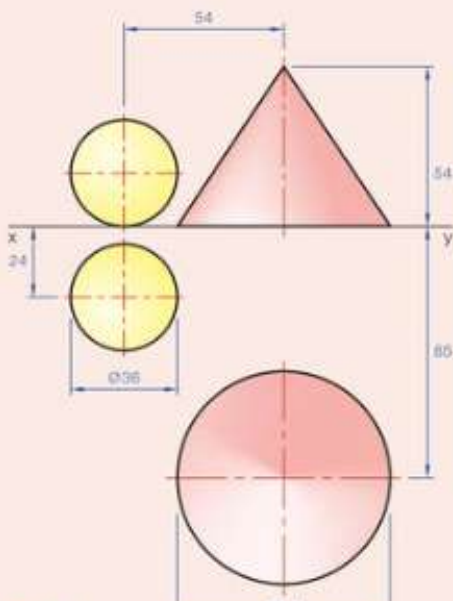
This technical drawing shows the precise dimensional relationships that must be maintained when constructing tangent planes, with proper centerlines and dimensional annotations following standard drafting conventions.
Complex tangent plane problems
The most challenging problems involve finding planes that are tangential to multiple solids simultaneously, such as both a cone and a sphere.
Problem approach: When a cone is placed over a sphere with the same base angle, the cone's generatrix lines are tangential to the sphere. This creates special geometric relationships that you can use in your construction.
Important
Key considerations:
- There are typically four possible solutions to problems involving tangent planes to both cones and spheres
- The plane must satisfy the tangency condition for both solids simultaneously
- Use the geometric relationship between the cone's generatrix and the sphere's surface
- Work systematically through auxiliary views to find all valid solutions
Example
Construction Strategy: Multiple Solids
Step 1: Start with the simpler solid (usually the sphere)
Step 2: Use the geometric constraints imposed by both solids
Step 3: Check your solution works for both the cone and sphere
Step 4: Verify the plane touches both solids without cutting through either
Exam tips
Summary
Key Points for Success:
- Always start by clearly identifying what type of solid you're working with
- Use auxiliary views to show true relationships and measurements
- Remember that tangent planes to spheres are perpendicular to radii
- For cones, use the relationship between tangent planes and base circles
- Check your construction by ensuring the plane only touches, never cuts through, the solid
- Practice identifying traces in both plan and elevation views
Remember!
Summary
Essential Principles to Remember:
- Tangent planes touch solids at exactly one point - they never cut through the solid's surface
- Auxiliary views are essential for showing true relationships between planes and solids in complex orientations
- Sphere tangent planes are perpendicular to radii - use this geometric principle to guide your construction
- Cone tangent planes relate to base circles - the horizontal trace will be tangential to the cone's base circle
- For complex problems involving tangent planes to several solids - work systematically to find all possibilities