Fiscal Policy and the Budget (Leaving Cert Economics): Revision Notes
📚Revision Notes
Fiscal Policy and the Budget
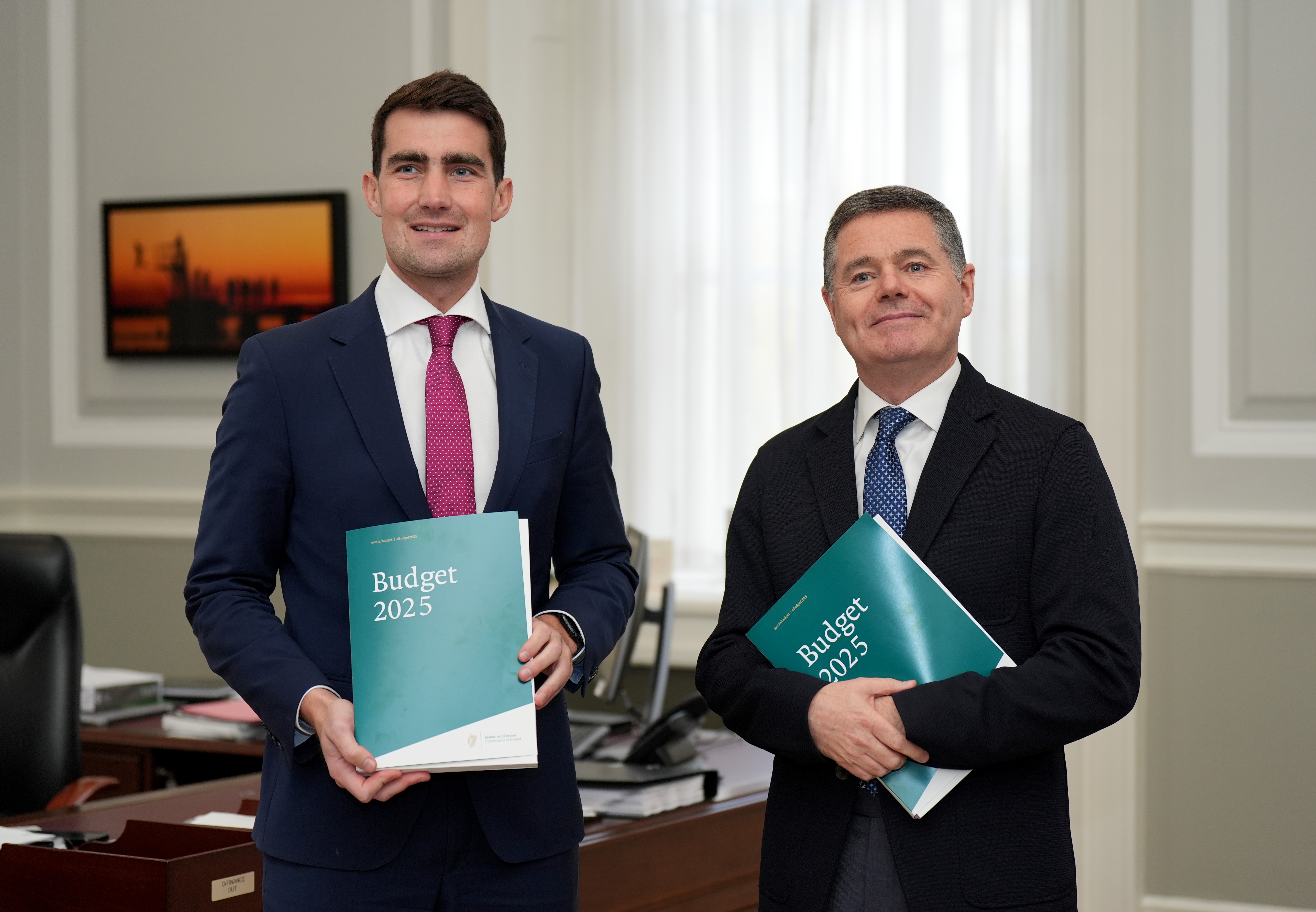
Government revenue and expenditure
Fiscal policy involves the government using its spending and taxation powers to influence the economy. Understanding how governments raise money and spend it forms the foundation of fiscal policy analysis.
Revenue sources
Government revenue comes from several key sources that can be divided into main categories:
Direct taxes are levied directly on income and wealth. These include Income Tax, which takes a percentage of people's earnings, USC (Universal Social Charge), Corporation Tax on company profits, and Capital Gains Tax on investment profits.
Note
Corporation tax is particularly significant for Ireland, generating over €24 billion in 2022, which represents approximately 27% of total tax revenue. This highlights Ireland's dependence on corporate tax receipts from multinational companies.
Indirect taxes are charged on goods and services rather than income. The main examples are VAT (Value Added Tax) on most purchases, excise duties on specific products like alcohol, tobacco, and fuel, and the Carbon Tax designed to discourage emissions. These taxes affect everyone who purchases these goods, regardless of their income level.
Other income sources supplement tax revenue. These include PRSI contributions from employees and employers for social insurance, stamp duty on property transactions, and EU transfers and dividends from state investments. These provide additional funding streams for government operations.
Government expenditure
Government spending falls into two distinct categories that serve different economic purposes:
Current expenditure covers day-to-day running costs of government services. This includes public sector wages for teachers, nurses, civil servants and other state employees, social welfare payments to support unemployed and vulnerable citizens, and running costs of essential services like schools and hospitals. This spending maintains existing services and supports current consumption in the economy.
Capital expenditure represents long-term investment in the country's future productive capacity. Government invests in infrastructure projects such as roads, rail networks, housing developments, and hospitals. It also funds broadband expansion to improve connectivity and renewable energy projects to support environmental goals. This type of spending aims to boost the economy's long-term growth potential.
Example
Current Policy Example: Budget 2024
The Irish government's Budget 2024 demonstrates this balance, with major increases planned for:
- Health services and hospital capacity
- Education funding and teacher recruitment
- Housing supports and social housing development
This shows how fiscal policy responds to current national priorities.
The budget balance
The relationship between government revenue and expenditure determines the budget balance, which has important implications for economic management.
Types of budget balance
A balanced budget occurs when government revenue exactly equals expenditure. This represents a neutral fiscal position where the government neither adds to nor reduces economic demand through its financial operations.
A budget deficit arises when expenditure exceeds revenue. This means the government spends more than it collects in taxes and other income, requiring additional financing to cover the shortfall.
A budget surplus happens when revenue exceeds expenditure. The government collects more money than it spends, creating excess funds that can be used for various purposes.
Managing different budget positions
When facing a deficit, governments have several management options:
- Reduce spending by cutting programmes or services, though this may impact service quality or economic growth
- Raise taxes to increase revenue, but this might reduce consumer spending and business investment
- Borrow money by issuing government bonds, though this increases national debt
- Focus on stimulating economic growth, as higher output typically generates more tax revenue naturally
Important
Managing Budget Deficits
Governments must carefully balance deficit management strategies. While borrowing provides short-term flexibility, excessive debt can constrain future policy options and increase interest payment burdens.
When experiencing a surplus, governments have more positive choices:
- Increase spending on priority areas like social housing or infrastructure, benefiting citizens and potentially boosting economic growth
- Cut taxes to leave more money in people's pockets, encouraging private spending and investment
- Pay down existing debt, reducing future interest payments
- Build reserves for future economic challenges
Example
Worked Example: Ireland's Surplus Management
Ireland has used surplus periods to save money in its "rainy-day fund" (the National Reserve Fund), providing resources for future economic challenges. This demonstrates prudent fiscal management during economic good times.
A balanced budget often represents a policy goal, though it may not always be practical during economic recessions when increased spending and reduced tax revenue naturally create deficits.
Fiscal policy and the business cycle
Governments use different types of fiscal policy to respond to changing economic conditions and stabilise the business cycle.
Types of fiscal policy
Expansionary fiscal policy involves increasing government spending or cutting taxes to boost aggregate demand in the economy. This stimulative approach is typically used during recessions when economic activity needs encouragement. By putting more money into the economy through higher spending or leaving more money in people's pockets through tax cuts, governments can help counteract economic downturns.
Neutral fiscal policy maintains a balance where government revenue approximately equals spending, creating no major impact on the economic cycle. This approach is suitable during periods of stable economic growth when no significant intervention is needed.
Contractionary fiscal policy involves cutting government spending or raising taxes to slow down aggregate demand. This tightening approach is used during periods of inflation or economic boom when the economy needs cooling down to prevent overheating.
Note
These policies work by shifting the aggregate demand curve. A Keynesian economic model would show government spending directly shifting the AD curve, demonstrating how fiscal policy influences overall economic activity.
Irish examples of fiscal policy in action
Ireland's recent economic history provides clear examples of each type of fiscal policy responding to different economic conditions.
Example
Worked Example: Expansionary Policy During COVID-19
Ireland implemented massive expansionary measures during the pandemic:
Step 1: Introduced the Pandemic Unemployment Payment (PUP)
- Supported workers who lost income due to lockdowns
- Maintained consumer spending during economic shutdown
Step 2: Provided wage subsidies for businesses
- Helped employers retain staff during closure periods
- Prevented mass unemployment and business failures
Step 3: Increased health spending dramatically
- Enhanced hospital capacity and testing capabilities
- Supported economic confidence through health security
Result: These measures prevented deeper economic collapse by supporting both businesses and workers.
Contractionary policy followed the 2008 financial crisis when Ireland implemented austerity budgets. The government raised taxes and cut spending to stabilise the country's debt position, though these measures contributed to economic hardship during the recovery period.
Neutral policy characterised Ireland's approach during stable growth periods from 2015-2019, when budgets involved modest changes rather than dramatic fiscal shifts, allowing the economy to grow steadily without significant government intervention.
Limitations of fiscal policy
While fiscal policy can be a powerful economic tool, several constraints limit its effectiveness in practice.
Important
Time Lags Challenge
Time lags create significant challenges for fiscal policy implementation. Planning and implementing budget changes takes considerable time, meaning fiscal policy responses often come too late to address immediate economic problems. By the time new spending programmes or tax changes take effect, economic conditions may have already changed.
Political pressures can interfere with economically optimal fiscal policy decisions. Politicians may choose policies based on electoral considerations rather than economic necessity. Popular tax cuts or spending increases might be preferred over necessary but unpopular measures, leading to suboptimal economic outcomes.
Important
Crowding Out Effect
Crowding out occurs when high government borrowing raises interest rates throughout the economy, making it more expensive for private businesses to borrow and invest. This can reduce the effectiveness of expansionary fiscal policy by discouraging private sector activity even as government activity increases.
EU and Eurozone rules impose external constraints on Irish fiscal policy. Ireland must comply with fiscal limits set by European institutions, limiting the government's freedom to respond to economic conditions as it sees fit.
Open economy effects mean that extra government spending may "leak out" of the domestic economy through increased imports, reducing the multiplier effect of fiscal policy. This is particularly relevant for small, open economies like Ireland that import many goods and services.
Ireland in the EU and Eurozone
Ireland's membership in European institutions significantly shapes its fiscal policy options and constraints.
European fiscal rules
Note
The Stability and Growth Pact (SGP)
The SGP sets strict limits on government finances:
- Budget deficits must stay below 3% of GDP
- Countries must work towards a debt target of 60% of GDP
- These rules aim to ensure fiscal responsibility across the eurozone but can limit countries' ability to respond to economic crises
Monetary policy constraints
Eurozone membership means Ireland cannot set independent monetary policy since the European Central Bank (ECB) controls interest rates for all eurozone countries. This makes fiscal policy more important for Ireland as it's the main tool available for economic stabilisation, given that monetary policy must suit the entire eurozone rather than Ireland's specific conditions.
EU oversight and support
EU oversight allows European institutions to review Irish budgets for compliance with fiscal rules, potentially requiring changes if rules are breached. However, EU support provides benefits through access to funds like the Recovery and Resilience Facility that helped finance Ireland's post-COVID economic recovery.
Purpose and impact of taxation
Taxation serves multiple purposes beyond simply raising government revenue, and its effects ripple throughout the economy.
Purposes of taxation
The primary purpose is to raise revenue for government services like healthcare, education, and infrastructure. Without tax revenue, governments cannot provide essential public services that markets might not deliver effectively.
Taxation can redistribute income from higher earners to lower earners through progressive tax systems. Higher income tax rates on wealthy individuals combined with welfare spending can reduce income inequality in society.
Governments use taxation to discourage harmful behaviour through taxes on activities with negative social consequences. Carbon taxes aim to reduce emissions, while sugar taxes target unhealthy consumption patterns.
Finally, taxation can encourage investment and saving through tax reliefs and incentives. Tax breaks for pension contributions or business investment can channel economic activity towards socially beneficial goals.
Impact on different groups
Households experience taxation differently depending on their income levels. High income taxes reduce disposable income directly, affecting spending patterns and living standards. Indirect taxes like VAT and excise duties are regressive, meaning they hit low-income groups harder as these taxes represent a larger proportion of their total income.
Firms face corporate taxes that can influence their investment decisions. High corporate tax rates may discourage business investment and expansion. However, Ireland's relatively low corporation tax rate (12.5%, rising to 15% under OECD reforms) has successfully attracted foreign direct investment from multinational companies.
The economy as a whole feels taxation's effects on inflation, employment, and inequality. Progressive taxation can improve fairness by reducing inequality, but it may also reduce incentives for people to work additional hours or seek higher-paying positions.
Irish case studies
Example
Worked Example: Ireland's Corporate Tax Strategy
Ireland's low corporate tax rate demonstrates strategic use of taxation:
Policy: Maintained 12.5% corporate tax rate (lower than EU average)
Results:
- Attracted substantial foreign direct investment
- Created employment in high-tech sectors
- Generated significant tax revenue despite low rate
Trade-offs:
- International criticism over tax competition
- Pressure from OECD for minimum 15% rate on large multinationals
Recent carbon tax increases in the 2020s show how taxation can address environmental challenges, though these measures have been criticised for raising living costs, particularly affecting rural and lower-income households who have fewer alternatives to carbon-intensive activities.
Remember!
Summary
Key Points to Remember:
-
Fiscal policy uses government spending and taxation to influence economic activity and stabilise the business cycle
-
Budget positions (deficit, surplus, balanced) require different management strategies and have varying economic impacts
-
Irish examples like COVID-19 supports, post-2008 austerity, and corporate tax policy demonstrate fiscal policy in practice
-
EU membership constrains Irish fiscal policy through rules like the Stability and Growth Pact but also provides access to European funding
-
Taxation purposes extend beyond revenue collection to include redistribution, behaviour modification, and economic incentives that affect households, firms, and the broader economy