Monetary Policy and Prices (Leaving Cert Economics): Revision Notes
📚Revision Notes
Monetary Policy and Prices

Understanding inflation and deflation
Inflation refers to a sustained increase in the general price level across an economy. When inflation occurs, money loses its purchasing power - meaning you can buy less with the same amount of money than before. This represents a significant economic phenomenon that affects everyone from individual consumers to large businesses.
Deflation is the opposite - a sustained decrease in the general price level. During deflation, money actually gains purchasing power, allowing you to buy more with the same amount. While this might sound positive, deflation can create serious economic problems.
Disinflation describes a situation where inflation is still positive but slowing down. For example, if inflation falls from 8% to 3%, this represents disinflation rather than deflation.
Core inflation is a refined measure that excludes particularly volatile items like energy and unprocessed food prices. This gives economists and policymakers a clearer picture of underlying price trends without the distortions caused by temporary price swings in these volatile categories.
Note
Understanding the distinction between these four concepts is essential for policy analysis. Inflation and deflation represent opposite directions of sustained price movement, while disinflation shows slowing (but still positive) inflation. Core inflation provides a cleaner measure by removing temporary volatility.
Measuring price changes
Consumer price index (CPI)
Ireland uses the Consumer Price Index (CPI) as its national measure of inflation. The CPI tracks changes in the cost of a fixed "basket" of goods and services that represents typical household spending patterns. These spending patterns are determined through detailed Household Budget Surveys.
The Irish CPI includes items like food, energy, and rent. Importantly, Ireland's CPI includes mortgage interest payments - this is a crucial detail that distinguishes it from some other price measures.
Harmonised index of consumer prices (HICP)
The Harmonised Index of Consumer Prices (HICP) is used across the European Union to enable consistent comparisons between member states. The European Central Bank relies on HICP data for its monetary policy decisions.
Important
The key difference is that HICP historically excludes owner-occupied housing costs. This means that when mortgage interest rates change significantly, CPI and HICP can show different inflation rates for the same period.
How price indices work
Creating a price index follows four essential steps:
- Choose a base year where the index equals 100
- Fix a basket with weights based on household spending shares by category
- Track prices regularly and calculate price relatives (current price divided by base year price)
- Aggregate using weights to create the overall index
Calculating inflation rates
The inflation rate formula is:
Example
Worked Example: Calculating CPI and Inflation
Imagine a simple basket with two categories: Food (weight 40%) and Energy (weight 60%). If the base year index = 100, and this year's category indices are Food = 110 and Energy = 120:
Step 1: Calculate overall CPI Overall CPI = 0.4 × 110 + 0.6 × 120 = 44 + 72 = 116
Step 2: Calculate year-on-year inflation Year-on-year inflation =
Measurement limitations
Price indices face several important limitations that students should understand for evaluation purposes:
Important
Key Measurement Limitations:
- Substitution bias occurs when consumers switch to cheaper alternatives, but the fixed basket cannot capture this behavioural change
- Quality changes are difficult to adjust for accurately when products improve over time
- New goods that emerge between surveys cannot be immediately included
- Coverage differences between CPI and HICP can create confusion
- Sampling and weights lag because spending patterns are only updated periodically
Causes of inflation
Understanding what drives inflation requires examining both demand-side and supply-side factors.
Demand-pull inflation
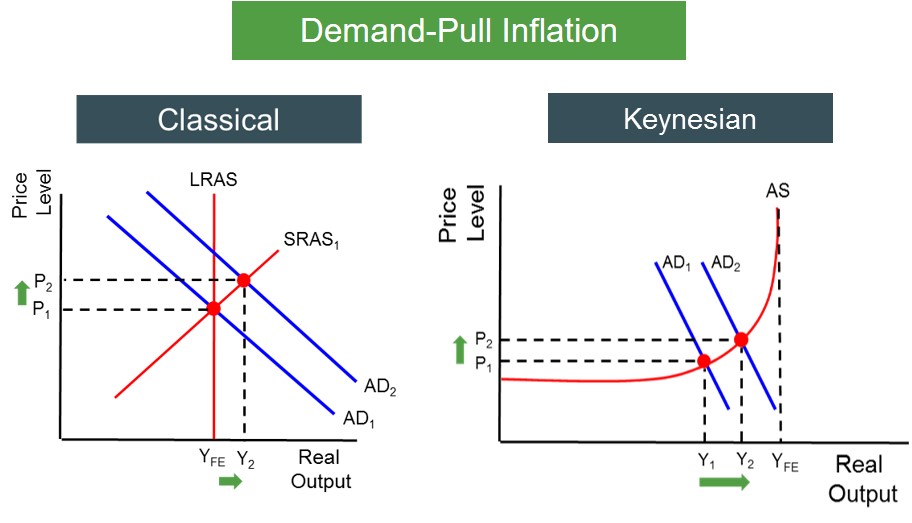
Demand-pull inflation occurs when aggregate demand grows faster than aggregate supply. This can result from strong income growth, expansionary fiscal or monetary policies, or export surges. In AD-AS analysis, this shows as a rightward shift of aggregate demand, leading to higher prices and output in the short run.
Cost-push inflation
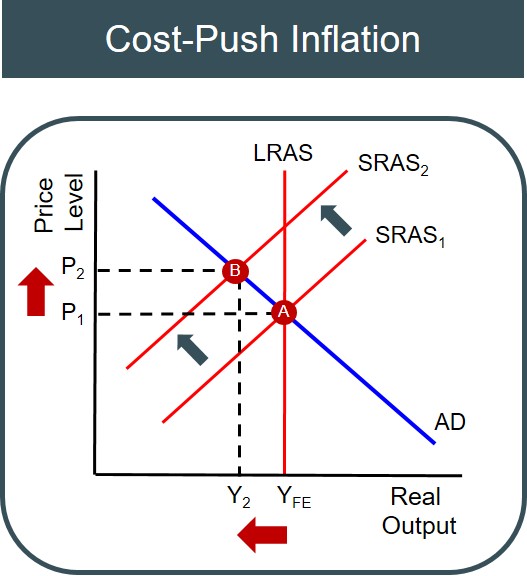
Cost-push inflation arises when rising input costs shift the short-run aggregate supply curve leftward. Common causes include energy price shocks, wage increases, rising prices for imported inputs, or currency depreciation. This creates the challenging situation of higher prices combined with lower output - known as stagflation.
Built-in expectations
When firms and workers expect higher inflation, they often raise prices and wages preemptively. This creates a self-fulfilling prophecy where inflation persists even after the original cause has disappeared.
Imported inflation
For Ireland, imported inflation occurs through higher global prices or euro depreciation against non-euro currencies. Since Ireland imports many goods and commodities, international price movements significantly affect domestic inflation.
Note
Ireland's small, open economy makes it particularly vulnerable to imported inflation through both direct price effects and exchange rate movements. This highlights the importance of external factors in domestic price determination.
Consequences of price-level changes
Impact on consumers
Inflation creates several challenges for households. It erodes real incomes, particularly affecting those on fixed incomes like pensions. Inflation also redistributes wealth from savers to borrowers when nominal interest rates don't fully adjust. Additionally, rising prices create menu and search costs as consumers spend time and effort finding the best deals, while uncertainty about future prices complicates major purchase decisions.
Impact on firms
Businesses face price and cost uncertainty that makes investment planning more difficult. When relative prices change rapidly, it becomes harder for customers to compare offerings across firms. If domestic prices rise faster than those of trading partners, competitiveness deteriorates, potentially harming export performance.
Impact on the economy
High and volatile inflation distorts resource allocation throughout the economy and may require restrictive policies that slow growth. Deflation risks include households postponing spending in expectation of lower future prices, while debt-deflation can occur where real debt burdens increase, further weakening spending and potentially raising unemployment.
Important
Critical Economic Risks:
Deflation can be particularly dangerous because it can create a vicious cycle: falling prices → delayed spending → reduced demand → further price falls → increased real debt burdens → weaker economic activity.
Central bank objectives and tools
Primary objectives
The European Central Bank and Central Bank of Ireland have price stability as their primary goal, defined as low and stable inflation. Secondary objectives include supporting financial stability, ensuring smooth payment system functioning, and supporting general economic policies without compromising price stability.

Monetary policy tools
Central banks implement policy through several key instruments:
Policy interest rates (like ECB deposit and refinancing rates) influence borrowing costs throughout the economy. Open market operations and liquidity provisions help steer short-term interest rates.
Quantitative easing (QE) involves purchasing assets like government bonds to lower long-term yields and ease financial conditions. Quantitative tightening (QT) works in reverse, allowing the balance sheet to shrink and tighten conditions.
Forward guidance involves communicating future policy intentions to shape market expectations. Reserve requirements influence bank lending capacity, while macroprudential measures (like mortgage lending rules in Ireland) support financial stability and can dampen economic cycles.
Transmission mechanisms
Monetary policy affects the economy through multiple transmission channels:
- Interest-rate channel - affecting mortgages, business loans, and credit card costs
- Credit channel - influencing bank lending standards and volumes
- Exchange-rate channel - impacting the euro area as a whole
- Asset-price and wealth channel - affecting equity and house prices, which influence spending
- Expectations channel - where credible central bank communication anchors inflation expectations
Note
Time lags are crucial - monetary policy effects typically unfold over 12-24 months, meaning policy must be forward-looking.
Eurozone membership implications for Ireland
Benefits of euro membership
Ireland gains credibility and stability through access to a strong, credible central bank, historically enjoying lower and more stable inflation. There's no exchange-rate risk within the euro area, which boosts trade and investment. Ireland also benefits from crisis management tools developed since the 2010s, including facilities like the OMT and PEPP programmes, plus Banking Union supervision.
Drawbacks of euro membership
Important
Key Constraints of Euro Membership:
The one-size-fits-all interest rate may be inappropriately loose during Irish economic booms (like housing bubbles) or too restrictive during local downturns. Ireland cannot devalue its currency to regain competitiveness after economic shocks. This places heavier reliance on fiscal policy and macroprudential measures to handle Ireland-specific economic challenges.
Institutional arrangements
The ECB sets euro-wide policy, while the Central Bank of Ireland implements ECB decisions domestically, operates macroprudential tools like LTV/LTI mortgage lending limits, and oversees financial stability and consumer protection.
For exam evaluation, remember that Ireland benefits from euro credibility and integrated markets but loses independent monetary policy flexibility - making fiscal policy and structural reforms more important for addressing country-specific issues like housing supply constraints.
Worked exam applications
Example
Worked Example: Calculating Inflation from CPI Data
If CPI (June 2024) = 118.0 and CPI (June 2025) = 122.1:
Step 1: Apply the inflation formula
This shows prices increased by approximately 3.47% over the year.
Example
Worked Example: Explaining Core Inflation Importance
Headline inflation can fluctuate significantly due to energy and food price volatility. Core inflation strips out these volatile components, providing a better guide to underlying price pressures. Central banks focus on core inflation for medium-term policy decisions because it better reflects persistent inflation trends.
Example
Worked Example: Understanding Deflation Risks
During deflation, households may delay purchases expecting lower future prices, while firms cut prices and wages. As real debt burdens increase, spending weakens further. Central banks may face zero lower bound constraints on interest rates, often requiring fiscal support to stimulate the economy.
Key diagrams for exams
Note
Essential Diagrams for Analysis:
AD-AS with demand-pull inflation: Starting at equilibrium, aggregate demand shifts right (AD₀→AD₁), leading to higher prices (P₁) and output (Y₁) in the short run.
AD-AS with cost-push inflation: Short-run aggregate supply shifts left (SRAS₀→SRAS₁), resulting in higher prices (P₁) but lower output (Y₁) - creating stagflation.
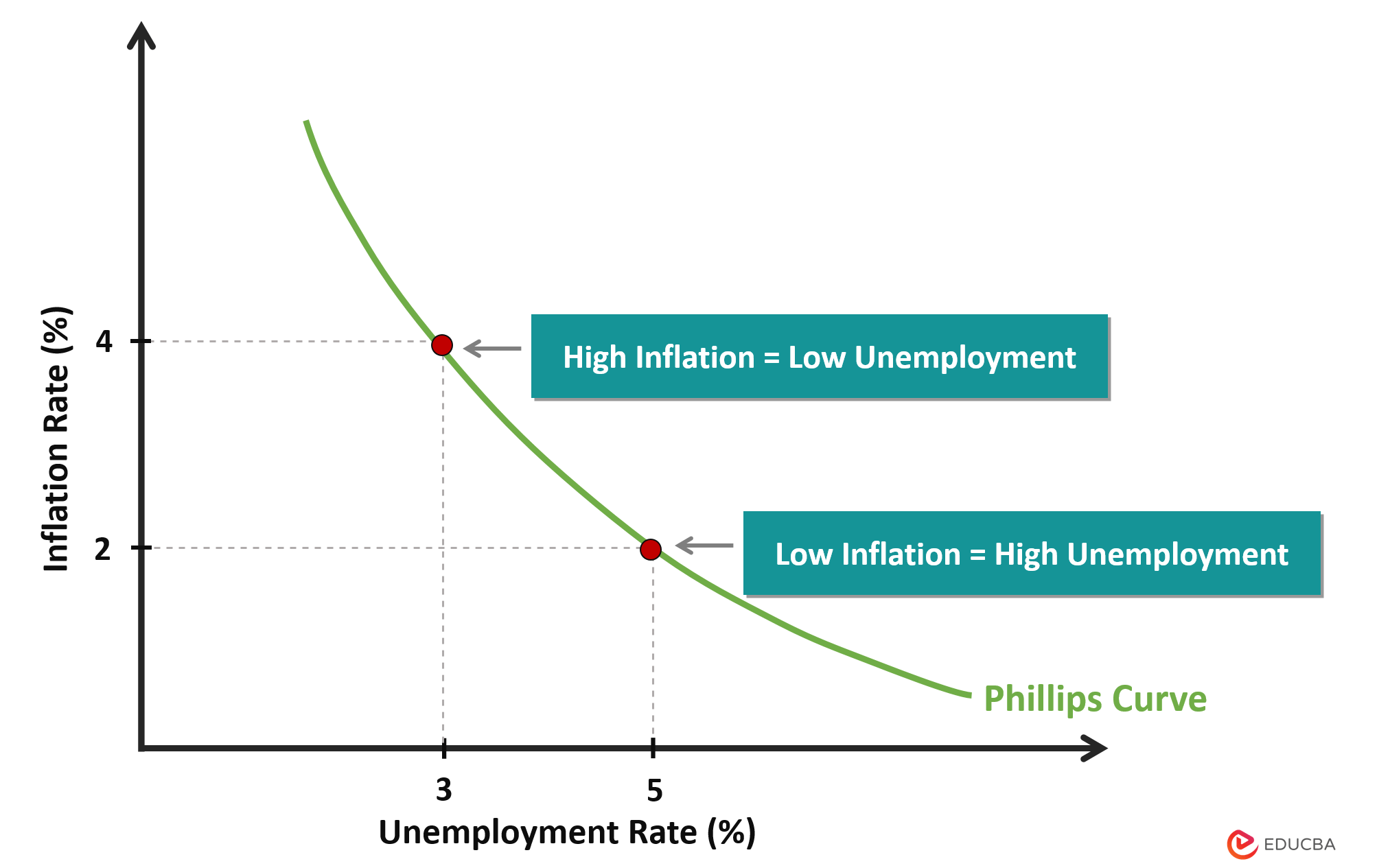
Phillips curve relationship: Shows the short-run inverse relationship between inflation and unemployment, with the long-run curve vertical at NAIRU (natural rate of unemployment).
Summary
Key Points to Remember:
-
Inflation represents sustained price rises measured through weighted basket indices like CPI and HICP, with core measures excluding volatile items
-
Multiple causes drive inflation including demand-pull factors, cost-push pressures, expectations, and imported price changes - each affecting consumers, firms, and economic competitiveness differently
-
Central banks target price stability using interest rates, quantitative policies, and forwards guidance, with effects transmitted through multiple channels over 12-24 month time lags
-
Eurozone membership provides Ireland with monetary credibility and integrated markets but requires greater reliance on fiscal and macroprudential tools for addressing local economic challenges
-
Measurement limitations including substitution bias, quality changes, and coverage differences are important evaluation points for demonstrating critical understanding