Graphics and Design (Leaving Cert Engineering): Revision Notes
📚Revision Notes
Graphics and Design
What is engineering graphics?
Engineering graphics is the foundation of visual communication in engineering and design. It focuses on developing visual representations and technical drawings that communicate design ideas, concepts, and specifications effectively. This visual language serves as a bridge between engineers, designers, architects, manufacturers, and other stakeholders.
Engineering graphics transforms abstract concepts into concrete visual representations. It connects imagination with reality by providing detailed drawings, schematics, and models that guide complex projects from initial concept through to final production.

Note
Engineering graphics has evolved significantly with digital technology, but the fundamental principles of clear visual communication remain constant across all platforms and tools.
Core purposes of engineering graphics
Engineering graphics serves multiple essential functions in the design and manufacturing process:
Facilitating conceptualization and ideation
During early product development stages, engineers need methods to visualise their ideas and transform abstract thoughts into tangible representations. Conceptualization through sketching, drafting, and illustration gives shape to innovation and allows designers to explore different approaches before committing to specific solutions.
Enhancing communication
Successful engineering projects depend on clear communication between team members. Engineering graphics provides a universal language that overcomes barriers and enables professionals to share intricate design details, measurements, and specifications. This visual communication ensures all stakeholders understand project requirements and expectations.
Important
Engineering graphics serves as a universal language that transcends cultural and linguistic barriers, making it essential for global engineering collaboration.
Enabling precise documentation
Engineering projects require accurate documentation for seamless execution. Design drawings, schematics, and blueprints serve as comprehensive guides that ensure every team member understands their role and contribution. These documents minimise errors and discrepancies, leading to more cost-effective and efficient project completion.
Supporting problem-solving
Complex engineering challenges require creative problem-solving approaches. Graphics enable engineers to examine problems visually, explore multiple solutions, and evaluate feasibility before implementation. This iterative visual process streamlines decision-making and encourages innovation.
Fostering collaboration
Modern engineering relies heavily on collaboration between interdisciplinary teams. Engineering graphics facilitate teamwork by providing shared visual references that allow experts from different fields to contribute insights and refine designs collectively.
Essential skills for engineering graphics
Success in engineering graphics requires a combination of technical abilities and interpersonal skills:
Strong foundation in mathematics and geometry
Mathematics and geometry form the cornerstone of engineering graphics. These subjects support the principles of scale, proportion, and spatial relationships. Mathematical skills are essential for calculating dimensions, visualising 3D models, creating precise drawings, and producing accurate renderings.
Proficiency in computer-aided design (CAD) software
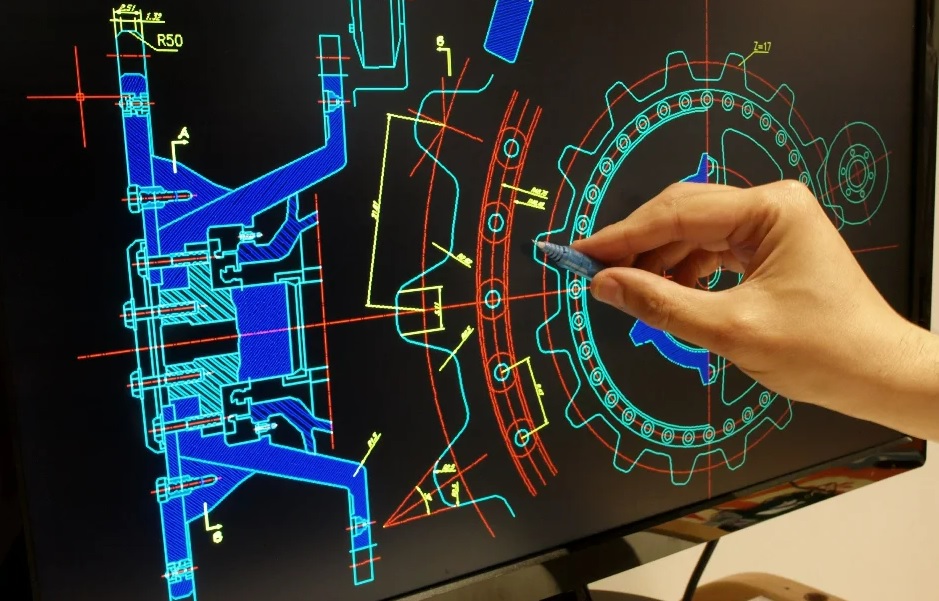
Computer-Aided Design (CAD) software has become indispensable in modern engineering. These digital tools enable professionals to create, modify, and analyse designs efficiently. Popular CAD platforms include AutoCAD, SolidWorks, and Fusion 360, which are crucial for generating detailed and realistic engineering drawings.
Example
Practical CAD Application:
A mechanical engineer designing a gear system would:
- Create initial 2D sketches using CAD software
- Develop 3D models with precise measurements
- Run stress analysis simulations
- Generate technical drawings for manufacturing
- Share files with team members for review and modification
Understanding of technical drawing standards
Engineers must follow technical drawing standards to communicate design intent clearly. This includes knowledge of dimensioning, tolerances, symbols, and annotations. Understanding these standards ensures that manufacturers and collaborators can accurately interpret designs and specifications.
Visual communication skills
Clear visual communication is fundamental to engineering graphics success. Professionals must convey complex ideas through drawings, schematics, and diagrams effectively. The ability to create visuals that are concise, informative, and easily understood is vital for project success.
Note
Visual communication skills extend beyond technical drawings to include presentation abilities, as engineers often need to explain their designs to non-technical stakeholders.
Knowledge of materials and manufacturing processes
Understanding materials and manufacturing processes is essential for designing functional and feasible products. Engineers must consider material properties, fabrication methods, and assembly processes when creating designs to ensure practical implementation.
Attention to detail
Precision is crucial in engineering graphics. Small errors in dimensions or annotations can lead to significant problems during manufacturing or construction. Developing meticulous attention to detail ensures accuracy and prevents costly mistakes.
Important
A single misplaced decimal point or incorrect dimension can result in manufacturing errors costing thousands of dollars and significant project delays.
Collaboration and communication skills
Engineering graphics professionals often work in multidisciplinary teams. Strong collaboration and communication abilities are essential for conveying ideas, understanding feedback, and integrating contributions from various team members effectively.
Career opportunities in engineering graphics
Engineering graphics professionals enjoy diverse career opportunities across numerous industries:
Industry sectors
Career paths span multiple sectors including:
- Medical devices and healthcare technology
- Entertainment and gaming industries
- Advertising, marketing, and animation
- Virtual reality (VR) and augmented reality (AR)
- Fashion and interior design
- Web design and development
- Film and television production
- Manufacturing and industrial design
- Architecture and construction
- Aerospace and automotive industries
- Electronics and civil engineering
- Product design and development
Leading companies
Major companies recognising the importance of engineering graphics include Autodesk, Dassault Systèmes, Siemens PLM Software, SolidWorks, Adobe Systems, PTC, ANSYS, Bentley Systems, Altair Engineering, and NVIDIA.
Note
The demand for engineering graphics professionals continues to grow as industries increasingly rely on digital design tools and visual communication for product development and innovation.
Summary
Key Points to Remember:
- Engineering graphics serves as a universal visual language that bridges imagination and reality in engineering projects
- The field encompasses five core purposes: conceptualization, communication, documentation, problem-solving, and collaboration
- Success requires both technical skills (mathematics, CAD software, drawing standards) and interpersonal abilities (communication, teamwork)
- Career opportunities span numerous industries from healthcare to aerospace, reflecting the versatility of graphics skills
- Attention to detail and precision are paramount - small errors can lead to significant manufacturing or construction problems