Work Holding (Leaving Cert Engineering): Revision Notes
📚Revision Notes
Work Holding
Work holding methods are essential for securing workpieces during turning operations on a laith. The choice of holding method depends on the component's shape, size, and the type of machining required. Several options are available, each with specific advantages for different applications.
Note
The selection of the appropriate work holding method is critical for machining success. Consider factors such as workpiece geometry, required accuracy, production volume, and the specific turning operations to be performed.
Types of chucks
Self-centring chucks
Self-centring chucks are the most common work holding devices found on lathes. These chucks automatically centre the workpiece as the jaws close.
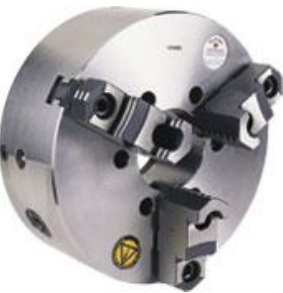
The standard version uses three jaws that move together simultaneously when the chuck is opened or closed. This design ensures the workpiece remains perfectly centred during clamping. Three-jaw chucks work best for standard cylindrical components where concentric turning is needed.
Note
Key features of self-centring chucks:
- All jaws move together automatically
- Perfect for round bars and cylindrical work
- Solid bars can be held externally by the jaws
- Pipes or tubes can be supported internally by spreading the jaws open
- Six-jaw versions are available for larger or more delicate components
Four jaw independent chuck
Four jaw independent chucks require each jaw to be adjusted individually, giving greater flexibility for unusual workpiece shapes.
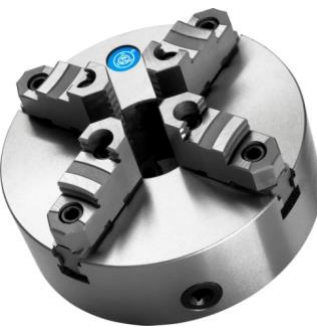
This chuck type is specifically designed for eccentric turning operations or holding square bars and irregular shapes. Unlike self-centring chucks, each jaw operates independently, allowing precise positioning of off-centre work.
Note
Applications include:
- Eccentric turning for producing cams and camshafts used in engines
- Holding square profile materials
- Supporting components where sections need to be turned cylindrical
- Any work requiring deliberate off-centre positioning
A dial gauge may be used to measure how far off-centre the component should be positioned for accurate eccentric turning.
Collet chucks
Collet chucks provide secure clamping with quick release mechanisms, making them efficient for repetitive operations.
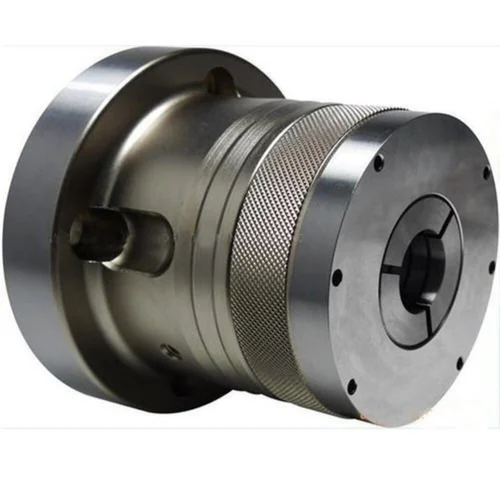
These systems use precision collets that compress around the workpiece when tightened. They work on both centre lathes (for holding workpieces) and milling machines (for holding cutting tools).
Important
Critical Limitation of Collet Chucks:
Each different diameter requires a specific collet size. This makes them unsuitable for workshops with frequently changing work diameters, but perfect for high-volume production where workpiece sizes remain consistent.
Advantages:
- Provide very secure holding with quick release
- Ideal for mass production applications like automotive manufacturing
- Perfect for high-volume production scenarios
Support systems for longer workpieces
Revolving centre
The revolving centre provides additional support for longer materials during turning operations.
This device sits in the tailstock and supports one end of the workpiece while the chuck holds the other end. The revolving centre rotates with the workpiece, reducing friction and vibration. This dual support system ensures the work remains stable throughout the machining process, preventing deflexion that could cause poor surface finish or dimensional inaccuracy.
Note
The revolving centre is essential for maintaining accuracy when turning long, slender workpieces that would otherwise deflect under cutting forces.
Fixed steady
The fixed steady offers an alternative method for supporting longer materials during turning.
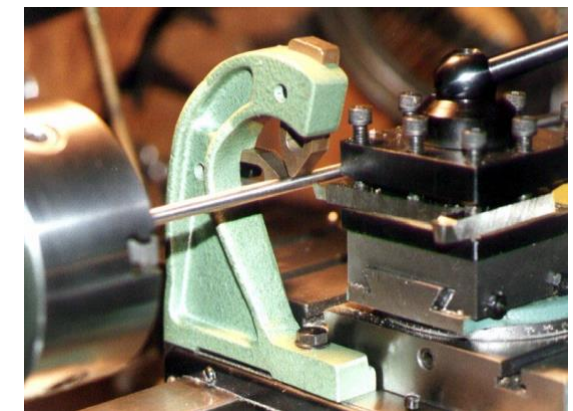
This tool attaches securely to the laith's slideways and supports the workpiece at the opposite end from the chuck. The tailstock can be removed when using a fixed steady, providing clear access to the work area.
Note
Key features:
- Bolted firmly to the laith slideways
- Three adjustable fingers support the rotating workpiece
- Grease can be applied to reduce friction between the fingers and rotating material
- Allows complete machining of long components without tailstock interference
Travelling steady
The travelling steady provides additional support directly behind the cutting tool for extra-long or flexible materials.
This support system attaches to the cross slide and moves with the cutting tool along the workpiece. It prevents the cutting forces from causing the work to bend or vibrate, which could result in poor surface finish or dimensional errors.
Note
Benefits include:
- Travels with the cutting tool during operation
- Essential for very long or thin workpieces
- Prevents cutting tool deflexion effects
- Maintains workpiece stability throughout the entire length
Tool positioning
Tool height - on centre alignment
Proper tool height is critical for effective turning operations. The cutting tool must be positioned on centre with the workpiece centreline.
Tool on centre means the cutting tool tip aligns exactly with the centre of the rotating workpiece. This positioning is essential because:
- Rake angle and clearance angle are optimised when the tool is on centre
- Cutting efficiency is maximised
- Tool wear is minimised
- Surface finish quality is improved
- Cutting forces are properly distributed
Important
Effects of incorrect tool height:
- Too low: Tool becomes blunt and ineffective
- Too high: Tool becomes weak and may break
- Correct height: Only the cutting edge contacts the workpiece, reducing friction and wear
The clearance angle ensures only the cutting edge touches the work, while the rake angle determines cutting efficiency and chip formation.
Summary
Key Points to Remember:
- Self-centring chucks (3-jaw) automatically centre round workpieces and are ideal for standard turning operations
- Four jaw independent chucks allow individual jaw adjustment for eccentric turning and square materials
- Collet chucks provide quick, secure holding but require specific sizes for different diameters
- Support systems (revolving centre, fixed steady, travelling steady) are essential for longer workpieces to prevent vibration and deflexion
- Tool height must be on centre for optimal cutting performance and tool life