Characters: Macbeth (Leaving Cert English): Revision Notes
📚Revision Notes
Macbeth
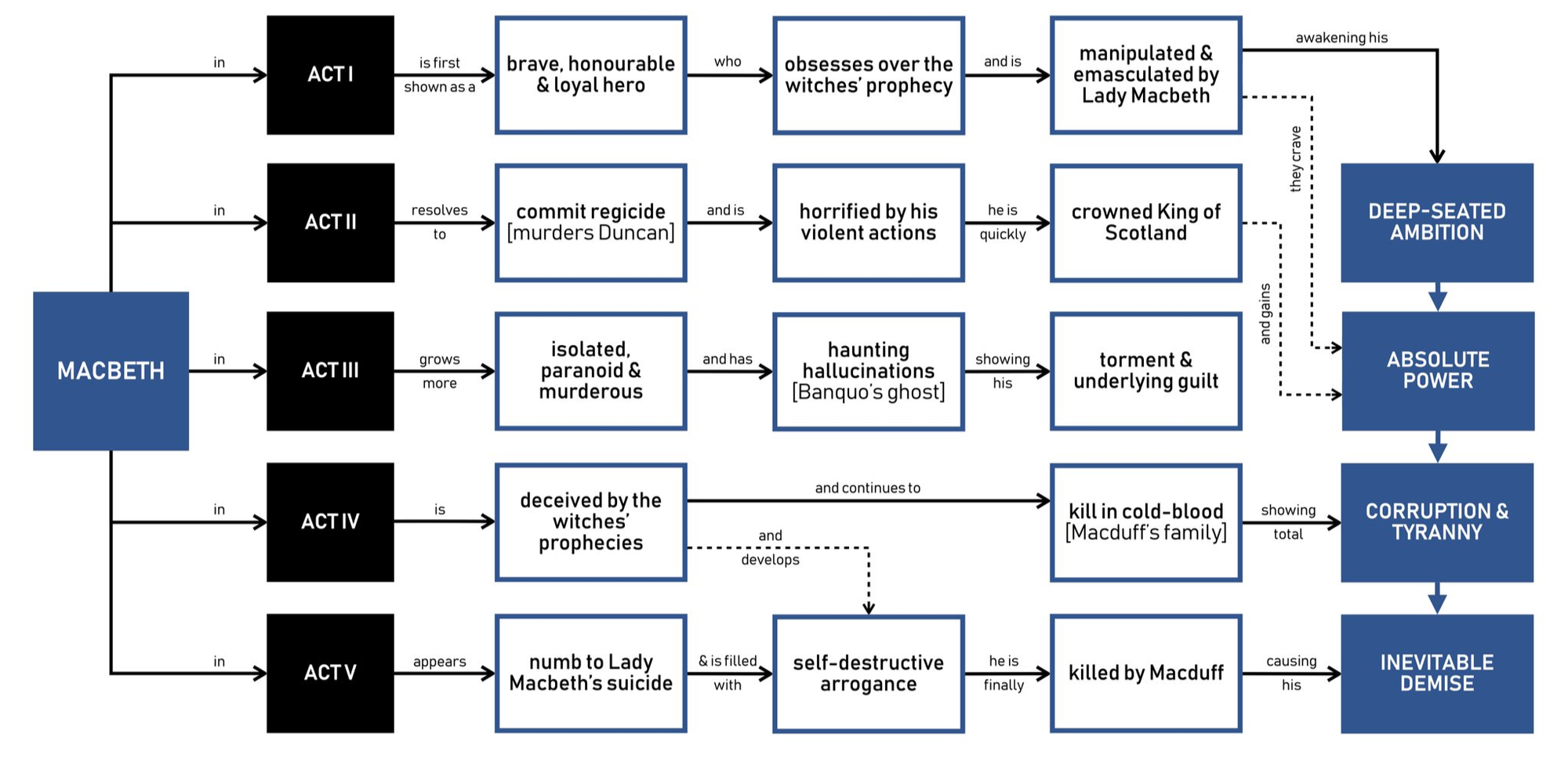
Macbeth's Character Journey
- Macbeth's character journey is a tragic descent from a noble hero to a paranoid tyrant. His deep-seated ambition, manipulated by external forces, leads him to commit heinous acts.
- This ambition ultimately brings about his downfall and death, highlighting the destructive power of unchecked ambition and moral corruption.
Act I: The Brave Hero and Awakening Ambition
1. Introduction as a Hero:
- Macbeth is first shown as a brave, honourable, and loyal hero.
- His courage and valour in battle earn him high praise and the title of Thane of Cawdor.
"For brave Macbeth—well he deserves that name" (Act 1, Scene 2)
"O valiant cousin! Worthy gentleman!" (Duncan, Act 1, Scene 2)
"Noble Macbeth" (Ross, Act 1, Scene 2)
2. Encounter with the Witches:
- Macbeth obsesses over the witches' prophecy that he will become king.
- This encounter plants the seed of ambition in his mind.
"All hail, Macbeth, that shalt be king hereafter!" (Witches, Act 1, Scene 3)
"Stay, you imperfect speakers, tell me more." (Macbeth, Act 1, Scene 3)
3. Manipulated by Lady Macbeth:
- Lady Macbeth manipulates and emasculates Macbeth, urging him to seize the throne.
- She questions his manhood and resolve, pushing him towards committing regicide.
"When you durst do it, then you were a man." (Lady Macbeth, Act 1, Scene 7)
"False face must hide what the false heart doth know." (Macbeth, Act 1, Scene 7)
Act II: Committing Regicide and Immediate Consequences
1. Resolution to Commit Murder:
- Macbeth resolves to murder King Duncan, spurred by Lady Macbeth's manipulation.
"I go, and it is done; the bell invites me. / Hear it not, Duncan; for it is a knell / That summons thee to heaven or to hell." (Macbeth, Act 2, Scene 1)
2. Horror and Guilt:
- Macbeth is horrified by his violent actions immediately after killing Duncan.
- He experiences intense guilt and fear.
"Will all great Neptune's ocean wash this blood / Clean from my hand?" (Macbeth, Act 2, Scene 2)
"Methought I heard a voice cry 'Sleep no more! / Macbeth does murder sleep." (Macbeth, Act 2, Scene 2)
3. Crowned King of Scotland:
- Despite his initial horror, Macbeth is quickly crowned king.
- This new power begins to corrupt him, further driving his ambition.
Act III: Paranoia, Isolation, and Haunting Guilt
1. Growing Paranoia:
- As king, Macbeth grows more isolated, paranoid, and murderous.
- He becomes increasingly distrustful of those around him, particularly Banquo.
2. Haunting Hallucinations:
- Macbeth is haunted by hallucinations, such as Banquo's ghost, reflecting his deep guilt.
"Thou canst not say I did it: never shake thy gory locks at me." (Macbeth, Act 3, Scene 4)
3. Relationship with Lady Macbeth:
- The power dynamics in Macbeth's relationship with Lady Macbeth shift.
- He becomes more dominant, acting independently and keeping secrets from her.
"Be innocent of the knowledge, dearest chuck, till thou applaud the deed." (Macbeth, Act 3, Scene 2)
Act IV: Tyranny and Cold-Blooded Murder
1. Deceived by the Witches:
- Macbeth is further deceived by the witches' prophecies, gaining a false sense of invincibility.
"Beware the Thane of Fife."
"None of woman born shall harm Macbeth."
_"Macbeth shall never vanquish'd be until Great Birnam wood to high Dunsinane Hill shall come against him." (_Act 4, Scene 1)
2. Cold-Blooded Murder:
- Macbeth orders the brutal murder of Macduff's family, showing his total corruption and tyranny.
"The castle of Macduff I will surprise." (Macbeth, Act 4, Scene 1)
Act V: Numbness, Defiance, and Inevitable Demise
1. Numb to Lady Macbeth's Suicide:
- Macbeth becomes numb and indifferent, even to the news of Lady Macbeth's suicide.
"She should have died hereafter; / There would have been a time for such a word." (Macbeth, Act 5, Scene 5)
2. Self-Destructive Arrogance:
- Macbeth's arrogance and false confidence lead him to face his enemies with defiance.
"I will not be afraid of death and bane till Birnam Forest come to Dunsinane." (Macbeth, Act 5, Scene 3)
"But bear-like I must fight the course." (Macbeth, Act 5, Scene 7)
3. Realisation and Death:
- Macbeth realises he has been tricked by the witches but faces his end with some dignity.
- He is ultimately killed by Macduff, fulfilling the witches' prophecy.
"Macduff was from his mother's womb untimely ripp'd." (Macduff, Act 5, Scene 8)
"Behold, where stands the usurper's cursed head." (Macduff, Act 5, Scene 9)
Character Analysis
- Initial Strengths and Noble Qualities
- Ambition
- Internal Conflict
- Flaws and Downfall
- Initial Strengths and Noble Qualities
- At the start of the play, Macbeth is depicted as a valiant and loyal soldier.
- His bravery and leadership are evident in the battle where he helps defeat the Norwegian forces and the rebellious Macdonwald.
- His actions earn him the respect of King Duncan and the title of Thane of Cawdor.
"For brave Macbeth—well he deserves that name—Disdaining fortune, with his brandished steel, / Which smoked with bloody execution." (Act 1, Scene 2)
- Ambition
- Macbeth's encounter with the witches sparks his latent ambition.
- The prophecies awaken a desire for power, which is further fuelled by Lady Macbeth's encouragement.
- His ambition is a double-edged sword, driving him to achieve greatness but also leading him down a dark path.
Note
Hamartia: A tragic flaw or error in judgement that leads to the downfall of the protagonist in a tragedy. Macbeth's hamartia: Ambition
"If chance will have me king, why, chance may crown me / Without my stir." (Act 1, Scene 3)
Note
What is Macbeth's 'latent ambition'? Latent: present but needing particular conditions to become active, obvious, or completely developed.
Macbeth's "latent ambition" refers to the underlying, unexpressed desire for power and greatness that exists within him at the beginning of the play. This ambition is not immediately apparent but lies dormant until it is awakened by external influences, specifically the witches' prophecies. Once these prophecies suggest that he could become king, this hidden ambition comes to the forefront, driving him to take drastic and immoral actions to achieve his goal.
- Internal Conflict
- Macbeth experiences significant internal conflict after hearing the witches' prophecies and upon contemplating Duncan's murder.
- This moral struggle highlights his initial resistance to committing evil acts and his awareness of the consequences.
"I have no spur / To prick the sides of my intent, but only / Vaulting ambition, which o'erleaps itself / And falls on the other." (Act 1, Scene 7)
- Flaws and Downfall
- Macbeth's major flaws—ambition, susceptibility to manipulation, and moral weakness—drive him to murder Duncan.
- Once he commits regicide, his paranoia and guilt spiral out of control, leading him to commit more atrocities to secure his power. This results in his psychological decline and tyranny.
"Is this a dagger which I see before me, / The handle towards my hand? Come, let me clutch thee." (Act 2, Scene 1)
"Will all great Neptune's ocean wash this blood / Clean from my hand? No, this my hand will rather / The multitudinous seas in incarnadine, / Making the green one red." (Act 2, Scene 2)
Overview of Macbeth's Relationships
Lady Macbeth:
- Initially, Lady Macbeth is the dominant partner, urging Macbeth to pursue his ambitions without hesitation.
- However, as the play progresses, the power dynamics shift. Macbeth becomes more independent and ruthless, while Lady Macbeth's guilt drives her to madness.
"My dearest partner of greatness." (Act 1, Scene 5)
"Be innocent of the knowledge, dearest chuck, / Till thou applaud the deed." (Act 3, Scene 2)
Banquo:
- Macbeth's relationship with Banquo deteriorates as his paranoia grows. Fearing Banquo's descendants will take his throne, Macbeth arranges Banquo's murder, demonstrating his increasing ruthlessness.
"Our fears in Banquo / Stick deep, and in his royalty of nature / Reigns that which would be feared." (Act 3, Scene 1)
Duncan:
- Macbeth's betrayal of Duncan marks his moral fall. Despite Duncan's trust and generosity, Macbeth's ambition leads him to murder Duncan in cold blood.
"I am his kinsman and his subject, / Strong both against the deed." (Act 1, Scene 7)
Macduff:
- Initially, Macduff is a loyal subject, but he becomes Macbeth's nemesis after discovering Duncan's murder.
- Macbeth's decision to kill Macduff's family solidifies Macduff's resolve to overthrow him.
Adjectives
| Adjective | Explanation |
|---|---|
| Ambitious | Macbeth's desire for power drives him to commit regicide and other heinous acts. |
| Brave | Initially, he is celebrated for his courage and prowess in battle. |
| Dutiful | Initially, Macbeth is a loyal servant to King Duncan and Scotland. |
| Guilty | After murdering Duncan, Macbeth is haunted by guilt and paranoia. |
| Paranoid | His fear of losing power leads him to suspect and eliminate perceived threats. |
| Influenced | Lady Macbeth easily sways him to act on his unchecked ambitions. |
| Tyrannical/Oppressive | As king, he governs through fear and brutality, transforming into a tyrant. |
| Isolated | His actions drive a wedge between him and others, including Lady Macbeth. |
| Tormented | He is plagued by disturbing visions and hallucinations, such as Banquo's ghost. |
| Despondent | In the end, he fights recklessly, realising too late that he has been deceived. |
Key Quotes for Macbeth
- "For brave Macbeth—well he deserves that name" (Act 1, Scene 2)
- "O valiant cousin! Worthy gentleman!" (Duncan, Act 1, Scene 2)
- "Noble Macbeth" (Ross, Act 1, Scene 2)
- "All hail, Macbeth, that shalt be king hereafter!" (Witches, Act 1, Scene 3)
- "Stay, you imperfect speakers, tell me more." (Macbeth, Act 1, Scene 3)
- "When you durst do it, then you were a man." (Lady Macbeth, Act 1, Scene 7)
- "False face must hide what the false heart doth know." (Macbeth, Act 1, Scene 7)
- "I go, and it is done; the bell invites me. / Hear it not, Duncan; for it is a knell / That summons thee to heaven or to hell." (Macbeth, Act 2, Scene 1)
- "Will all great Neptune's ocean wash this blood / Clean from my hand?" (Macbeth, Act 2, Scene 2)
- "Methought I heard a voice cry 'Sleep no more! / Macbeth does murder sleep." (Macbeth, Act 2, Scene 2)
- "Thou canst not say I did it: never shake thy gory locks at me." (Macbeth, Act 3, Scene 4)
- "Be innocent of the knowledge, dearest chuck, till thou applaud the deed." (Macbeth, Act 3, Scene 2)
- "Beware the Thane of Fife." (Act 4, Scene 1)
- "None of woman born shall harm Macbeth." (Act 4, Scene 1)
- "Macbeth shall never vanquish'd be until Great Birnam wood to high Dunsinane Hill shall come against him." (Act 4, Scene 1)
- "The castle of Macduff I will surprise." (Macbeth, Act 4, Scene 1)
- "She should have died hereafter; / There would have been a time for such a word." (Macbeth, Act 5, Scene 5)
- "I will not be afraid of death and bane till Birnam Forest come to Dunsinane." (Macbeth, Act 5, Scene 3)
- "But bear-like I must fight the course." (Macbeth, Act 5, Scene 7)
- "Macduff was from his mother's womb untimely ripp'd." (Macduff, Act 5, Scene 8)
- "Behold, where stands the usurper's cursed head." (Macduff, Act 5, Scene 9)