Numbers (Leaving Cert French): Revision Notes
📚Revision Notes
Numbers
Numbers 1 to 20
| Number | French | Pronunciation |
|---|---|---|
| 1 | un | uhn |
| 2 | deux | duh |
| 3 | trois | twah |
| 4 | quatre | kat-ruh |
| 5 | cinq | sank |
| 6 | six | sees |
| 7 | sept | set |
| 8 | huit | weet |
| 9 | neuf | nuhf |
| 10 | dix | dees |
| 11 | onze | onz |
| 12 | douze | dooz |
| 13 | treize | trez |
| 14 | quatorze | kah-torz |
| 15 | quinze | kanz |
| 16 | seize | sez |
| 17 | dix-sept | dees-set |
| 18 | dix-huit | dees-weet |
| 19 | dix-neuf | dees-nuhf |
| 20 | vingt | van |
Numbers 21 to 29
For the numbers 21 to 29, you start with the base number "vingt" (20) and add the number from 1 to 9.
The number 21 is special because it includes the word "et" (and)!
| Number | French | Pronunciation |
|---|---|---|
| 21 | vingt et un | van ay uhn |
| 22 | vingt-deux | van duh |
| 23 | vingt-trois | van twah |
| 24 | vingt-quatre | van kat-ruh |
| 25 | vingt-cinq | van sank |
| 26 | vingt-six | van sees |
| 27 | vingt-sept | van set |
| 28 | vingt-huit | van weet |
| 29 | vingt-neuf | van nuhf |
Numbers 30 to 39
Just like with the 20s, the numbers 30 to 39 follow a similar pattern. The base number here is "trente" (30).
| Number | French | Pronunciation |
|---|---|---|
| 30 | trente | tront |
| 31 | trente et un | tront ay uhn |
| 32 | trente-deux | tront duh |
| 33 | trente-trois | tront twah |
| 34 | trente-quatre | tront kat-ruh |
| 35 | trente-cinq | tront sank |
| 36 | trente-six | tront sees |
| 37 | trente-sept | tront set |
| 38 | trente-huit | tront weet |
| 39 | trente-neuf | tront nuhf |
Note
Pronunciation Tips The "r" sound in French is softer than in English. Try to make the sound in your throat, not the front of your mouth.
Moving Beyond 39
Numbers beyond 39 are formed in the same way as the 20s and 30s, but using different base numbers:
| Number | French | Pronunciation |
|---|---|---|
| 40 | quarante | ka-ront |
| 50 | cinquante | san-kont |
| 60 | soixante | swa-sont |
Numbers 41 to 69
41 to 49: Start with "quarante" (40) and add the numbers from 1 to 9 (e.g., quarante et un, quarante-deux).
51 to 59: Start with "cinquante" (50) and add the numbers from 1 to 9 (e.g., cinquante et un, cinquante-deux).
61 to 69: Start with "soixante" (60) and add the numbers from 1 to 9 (e.g., soixante et un, soixante-deux).
Numbers 70 to 79
For numbers from 70 to 79, French uses "soixante" (60) as the base and then adds 10 to the second digit:
| Number | French | Pronunciation |
|---|---|---|
| 70 | soixante-dix | swa-sont dees |
| 71 | soixante et onze | swa-sont ay onz |
| 72 | soixante-douze | swa-sont dooz |
| 73 | soixante-treize | swa-sont trez |
| 74 | soixante-quatorze | swa-sont kah-torz |
| 75 | soixante-quinze | swa-sont kanz |
| 76 | soixante-seize | swa-sont sez |
| 77 | soixante-dix-sept | swa-sont dees-set |
| 78 | soixante-dix-huit | swa-sont dees-weet |
| 79 | soixante-dix-neuf | swa-sont dees-nuhf |
Numbers 80 to 99
For the numbers 80 to 99, the pattern shifts again:
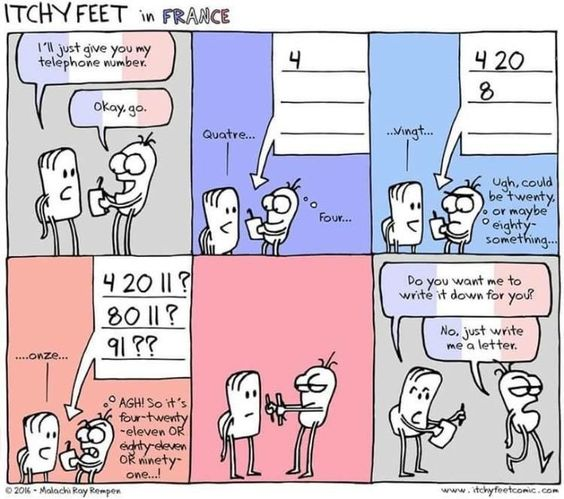
80 to 89: The base number is "quatre-vingts" (80), meaning "four twenties". You then add the numbers from 1 to 9.
| Number | French | Pronunciation |
|---|---|---|
| 80 | quatre-vingts | kat-ruh van |
| 81 | quatre-vingt-un | kat-ruh van uhn |
| 82 | quatre-vingt-deux | kat-ruh van duh |
| 83 | quatre-vingt-trois | kat-ruh van twah |
| 84 | quatre-vingt-quatre | kat-ruh van kat-ruh |
| 85 | quatre-vingt-cinq | kat-ruh van sank |
| 86 | quatre-vingt-six | kat-ruh van sees |
| 87 | quatre-vingt-sept | kat-ruh van set |
| 88 | quatre-vingt-huit | kat-ruh van weet |
| 89 | quatre-vingt-neuf | kat-ruh van nuhf |
90 to 99: The base number is "quatre-vingt-dix" (90), meaning "four twenties and ten." Then add the numbers from 1 to 9.
| Number | French | Pronunciation |
|---|---|---|
| 90 | quatre-vingt-dix | kat-ruh van dees |
| 91 | quatre-vingt-onze | kat-ruh van onz |
| 92 | quatre-vingt-douze | kat-ruh van dooz |
| 93 | quatre-vingt-treize | kat-ruh van trez |
| 94 | quatre-vingt-quatorze | kat-ruh van kah-torz |
| 95 | quatre-vingt-quinze | kat-ruh van kanz |
| 96 | quatre-vingt-seize | kat-ruh van sez |
| 97 | quatre-vingt-dix-sept | kat-ruh van dees-set |
| 98 | quatre-vingt-dix-huit | kat-ruh van dees-weet |
| 99 | quatre-vingt-dix-neuf | kat-ruh van dees-nuhf |
Counting to 100 and Beyond
Number 100
The number 100 in French is "cent."
When counting beyond 100, "cent" is used similarly to how we use "hundred" in English:
- 101: cent un
- 110: cent dix
- 120: cent vingt If you have more than one hundred (like 200, 300), you add "cent" in plural:
- 200: deux cents
- 300: trois cents However, note: When "cent" is followed by another number, it stays singular:
- 201: deux cent un
Number 1,000
The number 1,000 in French is "mille."
Unlike "cent," "mille" does not take an "s" for plural:
- 2,000: deux mille
- 3,000: trois mille
Larger Numbers
For numbers like 1,100 or 1,200, you simply combine "mille" with the appropriate hundreds:
- 1,100: mille cent
- 1,200: mille deux cents For 10,000, the word "dix-mille" is used:
- 10,000: dix-mille
- 20,000: vingt-mille
Note
Pronunciation Tips
- "Cent" (100) is pronounced "son," with a soft nasal sound.
- "Mille" (1,000) is pronounced "meel," similar to the English word "meal."
Note
Memory Hacks
- Break it Down: For numbers like 21 (vingt et un), remember it's just "20 and 1".
- Patterns: Notice the patterns in numbers 70 to 99. They are based on 60 (soixante) and 80 (quatre-vingts).