Extrusive Volcanic Features (Leaving Cert Geography): Revision Notes
📚Revision Notes
Extrusive Volcanic Features
Volcanic activity produces various landforms both on Earth's surface and within its crust. Surface-formed landforms are known as extrusive or volcanic features, whilst those created underground are called intrusive or plutonic features.
Important
Extrusive features are volcanic materials that have cooled and solidified on Earth's surface, whilst plutonic features are volcanic materials that have cooled and solidified within Earth's crust.
Types of volcanic cones
Composite cones (stratovolcanoes)
Composite cones represent the most recognisable volcanic landforms and display considerable variation in both structure and composition. These impressive volcanoes develop through a combination of explosive and gentle eruptions, creating distinctive layered structures.
The formation process involves alternating layers of pyroclastic material and lava flows building up over time. This creates volcanoes with broad bases and steep sides that become progressively steeper towards the summit. The alternating materials include both acidic and basic volcanic products, giving these volcanoes their characteristic strength and height.
Note
Composite volcanoes typically form at destructive plate boundaries where tectonic forces create the conditions for varied eruption styles. Mount Fuji in Japan serves as an excellent example, demonstrating the classic cone shape and layered structure that defines this volcanic type.
Cinder cones
Cinder cones are the smallest type of volcano, rarely exceeding heights of 300 metres. They represent the most common volcanic form found on Earth, consisting entirely of pyroclastic material from relatively explosive eruptions.
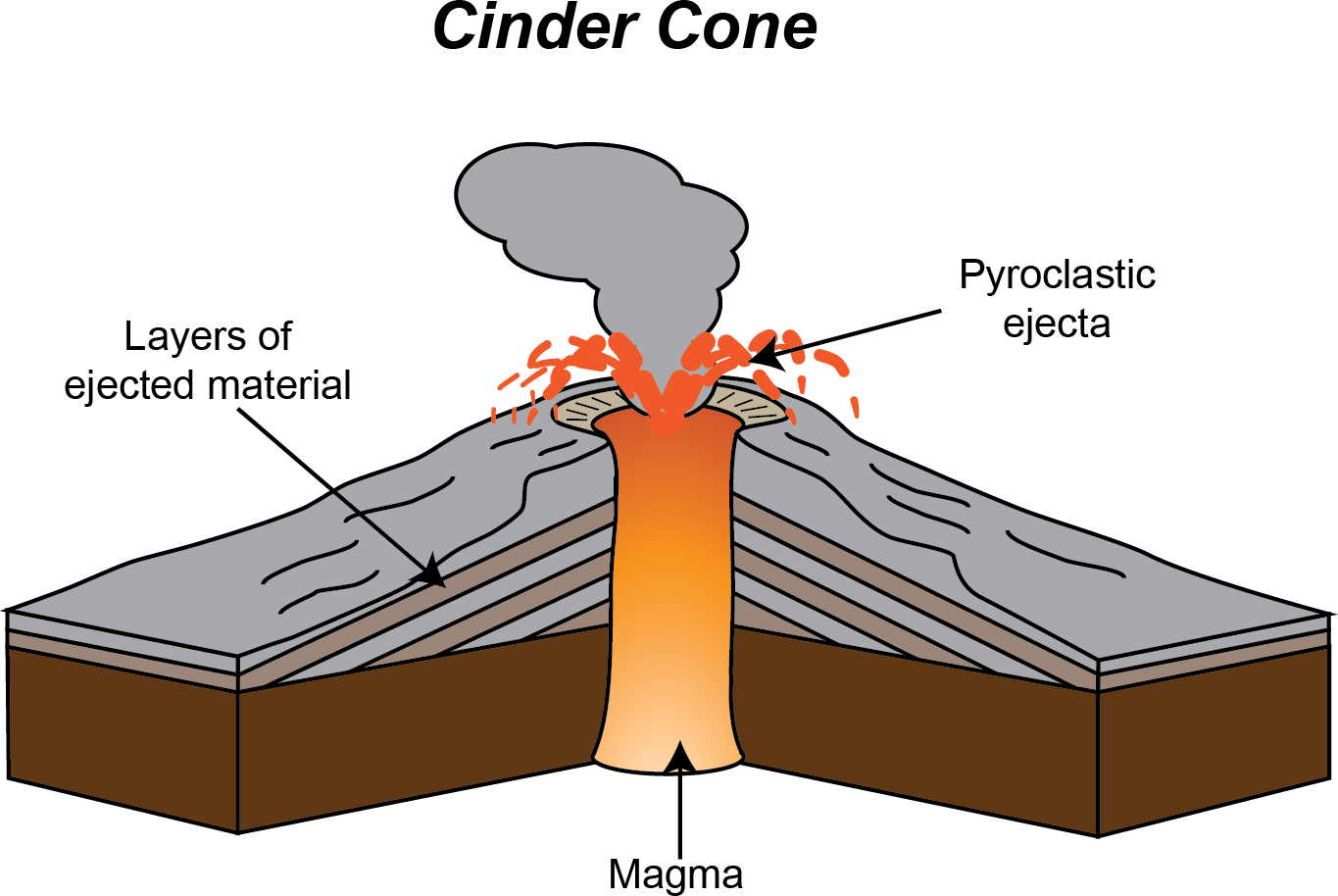
These volcanoes have distinctively steep sides and wide craters at their summit. Most cinder cones erupt only once during their existence, as the eruption process destroys their structure. They commonly develop around larger shield volcanoes and composite cones, with Mauna Loa in Hawaii being surrounded by over 100 cinder cones.
Shield volcanoes
Shield volcanoes are characterised by their massive size and gently sloping sides, earning their name from their shield-like profile. These volcanic giants form through gentle eruptions where basic lava reaches the surface and spreads across large areas.
Note
Basic lava has low silica content (approximately 50%), temperatures around 1,100°C, travels long distances, cools slowly, and produces quiet eruptions.
The basic lava flows build up very slowly over time, creating volcanic mountains with gradually sloping sides. The base of shield volcanoes can exceed 100 kilometres in diameter, making them the largest volcanoes on Earth. Mauna Loa in Hawaii exemplifies this volcanic type, measuring 180 kilometres wide at its base.
Shield volcanoes typically form at hotspots and occasionally at constructive plate boundaries, where the gentle eruption style allows for the characteristic broad, low-profile shape to develop.
Lava plateaux
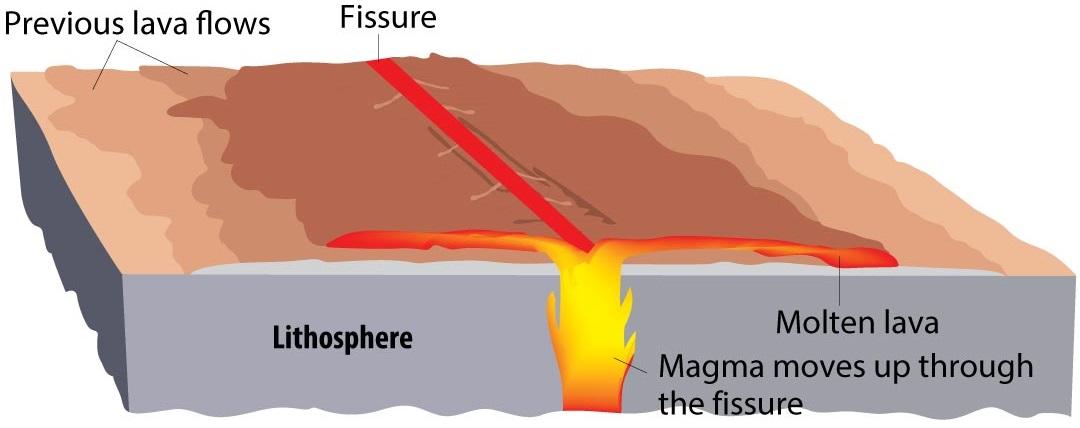
Lava plateaux form when extensive floods of basic lava are released from cracks or fissures in the ground, spreading across large areas before solidifying. The fissures allow gases to escape, resulting in non-violent eruptions that can continue for extended periods.
Multiple eruptions cause the plateau to build up through successive layers. The Antrim-Derry Plateau provides an excellent case study, having formed approximately 60 million years ago when the Eurasian and North American plates began separating.
Example
Case Study: The Antrim-Derry Plateau Formation
Step 1: As the crust pulled apart, large fissures developed, allowing massive lava flows to cover the surrounding area.
Step 2: These lava flows continued for over 2 million years, creating a plateau reaching up to 1,800 metres thick.
Step 3: During cooling and contraction, the lava formed distinctive hexagonal columns of basalt, best observed at the Giant's Causeway in County Antrim.
Evidence of ancient fissures can still be observed around the plateau. When lava hardened within the vents, it created formations known as volcanic plugs, with Slemish in County Antrim serving as a prominent example.
Central vent eruptions
Central vent volcanoes form when volcanic materials are emitted from an opening in Earth's crust called a central vent. Three main types of material are expelled during eruptions:
- Lava - the name given to magma once it reaches Earth's surface, which can be either basic or acidic, determining both eruption magnitude and resulting volcano shape
- Gases - including carbon dioxide, sulphur dioxide, nitrogen and chlorine
- Rock fragments called tephra - encompassing volcanic dust, volcanic ash and cinders
Acidic vs basic lava characteristics
Note
Acidic lava has high silica content (approximately 70%), temperatures around 900°C, forms thick substances that travel short distances, cools quickly, and produces violent eruptions.
The composition of lava fundamentally influences both the eruption style and the resulting volcanic landform. Basic lava creates gentle eruptions and broad shield volcanoes, whilst acidic lava produces explosive eruptions and steep-sided composite volcanoes.
Calderas
Calderas are large depressions formed through violent eruptions at composite volcanoes. The formation process occurs in distinct stages:
Example
Formation Process: Caldera Development
Stage 1: Explosive eruptions remove huge volumes of magma from the magma chamber whilst fracturing the overlying rock that forms the chamber roof.
Stage 2: The fractured rock collapses into the emptied chamber, creating a large depression on Earth's surface called a caldera.
Stage 3: Often, a resurgent dome develops within the caldera as new volcanic activity begins.
Example: Crater Lake in Oregon, USA exemplifies caldera formation, demonstrating how these dramatic landscape features develop following major volcanic events.
Fissure eruptions
Fissure eruptions occur when basic lava flows quietly from linear cracks in Earth's crust. These fissures can extend up to 50 metres in width, having been widened by the force of rising magma. The lava spreads slowly over large areas, often covering more than 50 kilometres from the fissure source.
Important
Repeated lava flows from fissure eruptions result in the formation of lava plateaux, as demonstrated by the Antrim-Derry Plateau formation process described earlier.
Hydrothermal features
Geysers
Geysers are natural springs that eject hot water with tremendous force at regular intervals. The formation process begins when water descends into the lower crust, where surrounding hot rock heats it significantly.
Pressure builds as the water boils, eventually causing a spray of hot water and steam to explode onto Earth's surface. Old Faithful in Yellowstone National Park, Wyoming, USA represents the most famous example of geyser activity.
Note
Yellowstone National Park contains approximately half of the world's geysers, making it a unique geological environment for studying these hydrothermal features.
Black smokers
Black smokers are chimney-like vents commonly found at depths below 3,000 metres near mid-ocean ridges. The superheated water they release contains particles of dissolved minerals, including high levels of sulphur, giving them their characteristic dark appearance.
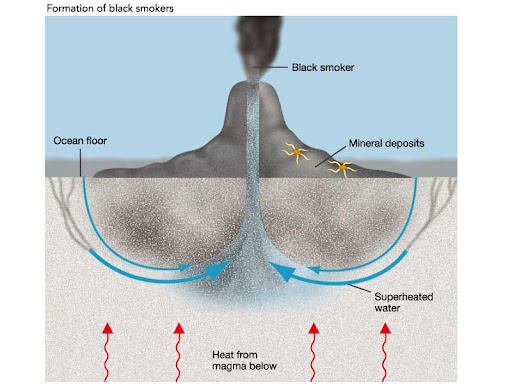
The Mid-Atlantic Ridge hosts numerous black smokers, where these underwater volcanic features play important roles in ocean chemistry and support unique ecosystems adapted to extreme conditions.
Summary
Key Points to Remember:
- Extrusive features form on Earth's surface from cooled and solidified volcanic materials
- Basic lava (low silica, high temperature) creates gentle eruptions and shield volcanoes, whilst acidic lava (high silica, lower temperature) produces violent eruptions and composite volcanoes
- Shield volcanoes are the largest volcanic landforms with gentle slopes, composite volcanoes have steep sides with alternating layers, and cinder cones are the smallest and most common type
- Lava plateaux form from fissure eruptions that spread basic lava across extensive areas over long periods
- Calderas develop when explosive eruptions empty magma chambers, causing surface collapse and creating large depressions