Volcanic Activity on the Earth’s Surface (Leaving Cert Geography): Revision Notes
📚Revision Notes
Volcanic Activity on the Earth's Surface
Introduction to volcanic features
Volcanic processes create two main types of geological features that differ based on where and how they form. Understanding these differences helps explain the variety of volcanic landscapes we observe around the world.
Important
Extrusive features develop on the Earth's surface when molten rock (lava) cools and hardens rapidly upon contact with air or water.
Important
Intrusive features develop beneath the Earth's surface when molten rock (magma) and associated gases cool and harden gradually within the crust.
Note
The key difference between these two types of features lies in their cooling environment. Surface cooling creates fine-grained rocks due to rapid solidification, while subsurface cooling allows for the formation of coarse-grained rocks through slower crystallisation processes.
Key volcanic terminology
Several important terms help us understand volcanic processes:
Important
Magma refers to molten rock and metallic materials that exist beneath the Earth's surface at extremely high temperatures.
Important
Volcanic describes any features or processes related to extrusive activity that occurs on the Earth's surface.
Important
Plutonic describes features or processes related to intrusive activity that occurs within the Earth's crust.
Locations of volcanic activity
Volcanic activity occurs in five primary settings, each related to different types of plate tectonic movements and processes. These locations demonstrate how the Earth's internal heat and plate movements work together to create volcanic features.
Note
The distribution of volcanoes around the world is not random - it follows clear patterns that correspond to tectonic plate boundaries and special geological features. This relationship between plate tectonics and volcanism is fundamental to understanding our planet's geological processes.
Volcanoes at subduction zones
Subduction zones represent areas where tectonic plates collide, creating some of the world's most dramatic volcanic activity. When plates meet, the denser oceanic plate descends beneath the lighter plate, triggering a complex process of melting and magma formation.
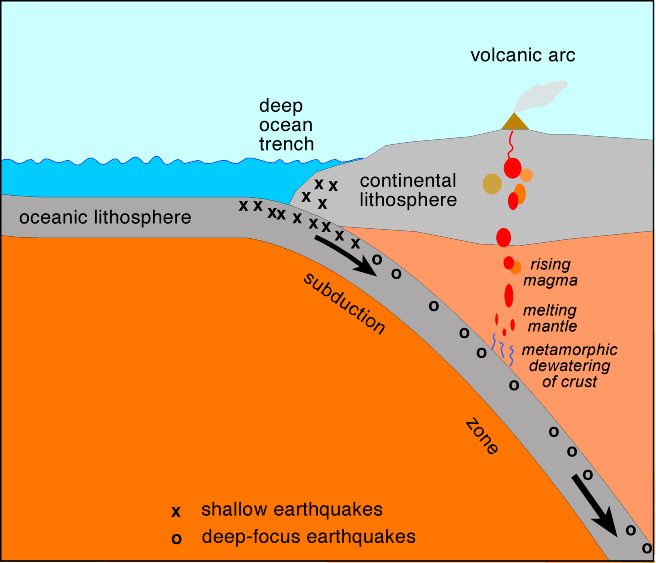
As the descending plate moves deeper into the mantle, it releases water vapour and other gases, including carbon dioxide and sulphur compounds. These substances lower the melting point of surrounding rock, causing the subducting crust to melt. The resulting magma, enriched with silica and gases, rises through the overlying crust and often produces explosive volcanic eruptions.
Island arcs form when two oceanic plates collide at subduction zones. The Japanese archipelago provides an excellent example, having formed through the collision of the Pacific and Eurasian plates over millions of years.
Volcanic arcs develop where oceanic plates collide with continental plates. The Andes mountain range exemplifies this process, formed as the oceanic Nazca Plate subducts beneath the continental South American Plate.
Example
Worked Example: The Ring of Fire
The Pacific Ring of Fire demonstrates subduction zone volcanism on a massive scale:
Step 1: Multiple oceanic plates (Pacific, Nazca, Philippine) meet continental plates around the Pacific Ocean
Step 2: Subduction occurs, creating volcanic arcs along the margins
Step 3: This results in 75% of the world's active volcanoes being located around the Pacific Rim
Volcanoes at constructive plate boundaries
Constructive boundaries occur where tectonic plates move apart, allowing magma to rise and create new crustal material. This process operates differently from subduction zone volcanism and typically produces less explosive eruptions.
When oceanic plates separate, cracks or fissures develop in the ocean floor. Magma rises through these openings and encounters cold seawater, causing rapid cooling and solidification. Over time, this process builds underwater volcanic mountain ranges.
Mid-ocean ridges represent the most extensive volcanic systems on Earth. The Mid-Atlantic Ridge, which includes Iceland above sea level, formed as the Eurasian and North American plates gradually separate.
Continental rifting occurs when rising columns of hot magma cause continental crust to stretch and fracture. This process has created volcanoes such as Mount Kilimanjaro in East Africa, where the African continental crust is slowly splitting apart.
Volcanoes at hotspots
Hotspots represent a unique type of volcanic activity that occurs independently of plate boundaries. These features provide insight into the Earth's internal structure and the movement of tectonic plates over geological time.
Important
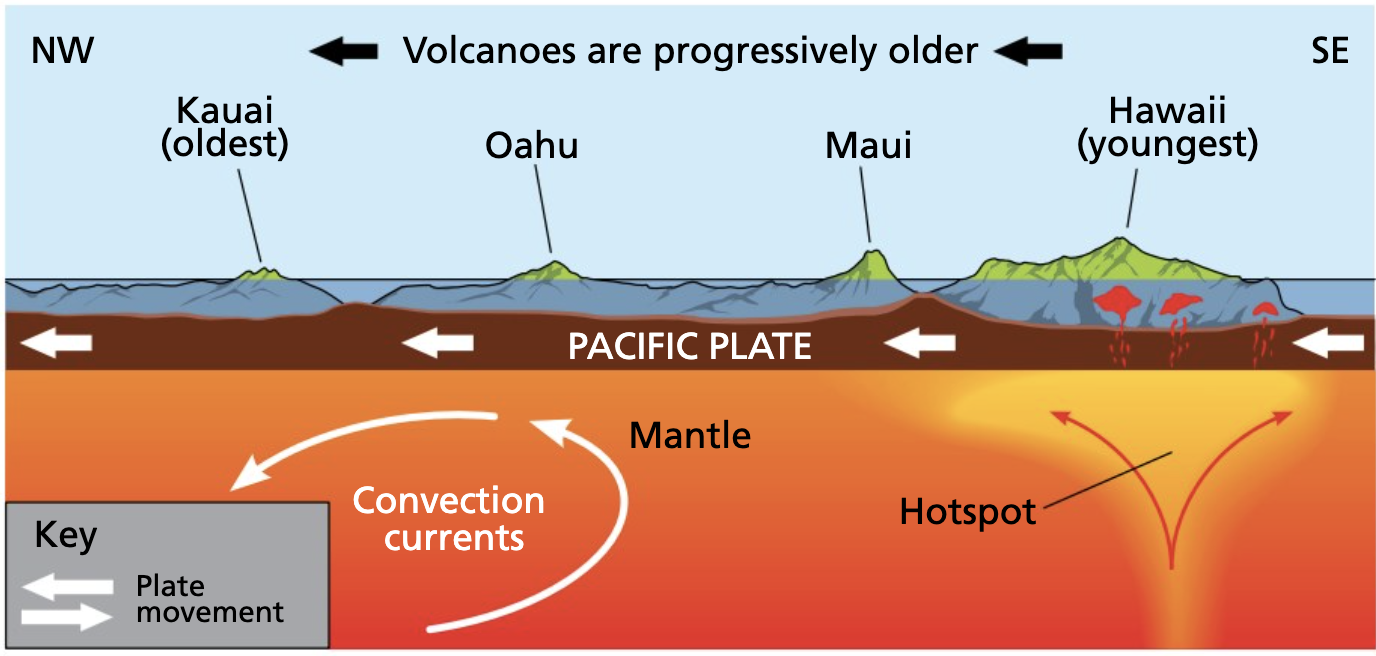
Hotspots are regions where the mantle contains unusually hot material compared to surrounding areas. These zones remain stationary while tectonic plates move over them.
When a section of oceanic crust passes over a hotspot, columns of hot magma rise from the mantle to the surface, creating volcanic islands. As the tectonic plate continues moving, it carries the newly formed volcano away from the hotspot. The volcano becomes extinct as it loses its magma source, but the hotspot continues creating new volcanoes at its fixed location.
This process repeats over millions of years, creating chains of volcanic islands with a distinct age pattern. Islands closest to the hotspot remain volcanically active, while those farther away become progressively older and extinct.
Example
Worked Example: Hawaiian Island Chain Formation
The Hawaiian hotspot demonstrates this process perfectly:
Step 1: The stationary Hawaiian hotspot creates volcanic activity as the Pacific Plate moves over it
Step 2: As the plate moves northwest at 3-4 cm per year, new volcanoes form over the hotspot
Step 3: Older volcanoes move away and become extinct, creating an age progression
Result: Hawaii (Big Island) is currently active, while Kauai (oldest major island) is completely extinct
Fascinating facts about volcanic activity
Note
Volcanic processes have shaped approximately 80% of the Earth's surface, both above and below sea level. This demonstrates the fundamental importance of volcanic activity in creating the landscapes and ocean floors we see today.
The continuous cycle of volcanic creation and destruction plays a crucial role in the Earth's geological evolution and affects everything from climate patterns to the formation of new islands and mountain ranges.
Summary
Key Points to Remember:
-
Volcanic activity creates both extrusive features (on the surface) and intrusive features (within the crust), depending on where magma cools and solidifies
-
The five main locations for volcanic activity are subduction zones, constructive plate boundaries, and hotspots, each producing different types of volcanic features
-
Subduction zones create explosive volcanism through island arcs and volcanic arcs, formed when plates collide and the denser plate melts as it descends
-
Constructive boundaries produce less explosive volcanism, creating mid-ocean ridges and continental rift volcanoes as plates separate and magma fills the gaps
-
Hotspots create volcanic island chains as stationary mantle plumes interact with moving tectonic plates, with the Hawaiian islands serving as the classic example