Soil Profile (Leaving Cert Geography): Revision Notes
📚Revision Notes
Soil Profile
Understanding soil structure
When we examine soil by taking a vertical slice through it, we discover that it isn't just one uniform layer. Instead, soil consists of distinct layers that have formed over time through various natural processes. This vertical cross-section reveals what geographers call a soil profile - essentially a 'side view' of the soil that shows all its different layers.
Important
Soil profile - A vertical cross-section of soil showing the different layers that have developed over time.
These individual layers within the soil are known as horizons. Each horizon has unique characteristics based on the materials it contains and the processes that have shaped it. Understanding these horizons helps us appreciate how soil develops and functions as a complex ecosystem.
The five main soil horizons
Soil profiles typically contain five distinct horizons, each with specific features and roles. From the surface downwards, these are labelled as O, A, B, C, and R horizons.
Note
Each horizon has developed unique characteristics through different natural processes, creating a layered structure that tells the story of how the soil formed over time.
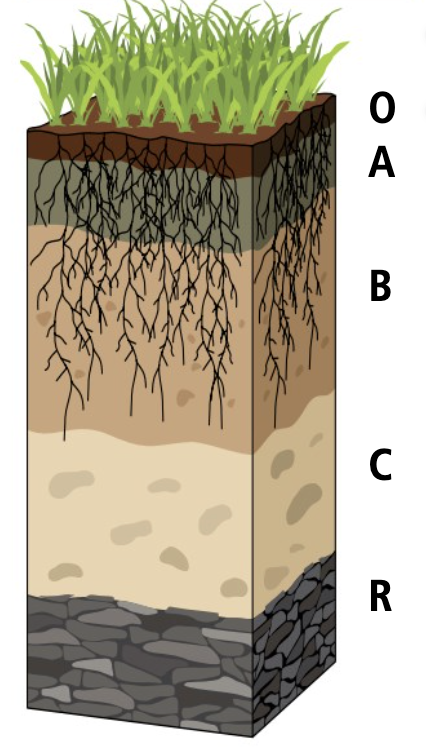
O horizon - The organic layer
The O horizon sits right at the surface of the soil profile and consists primarily of organic material. This layer is made up of plant debris - fresh leaves, twigs, and other organic matter that has recently fallen to the ground. As you move deeper into this horizon, you'll find material in various stages of breakdown and decomposition.
This surface layer plays a crucial role in protecting the soil beneath and provides nutrients as the organic matter gradually decomposes.
A horizon - The topsoil
Directly beneath the organic layer lies the A horizon, commonly referred to as topsoil. This layer represents one of the most important parts of the soil profile for plant growth and agricultural activities.
Important
Topsoil - The uppermost layer of soil that contains a mixture of organic matter and mineral particles, making it highly fertile.
Key characteristics of the A horizon include:
- Rich in humus - This layer contains decomposed organic matter that gives soil its dark, rich appearance
- Dark colouration - The presence of humus creates the characteristic dark brown or black colour
- Biologically active - Most soil organisms, including bacteria, fungi, and small animals, live in this zone
- Root concentration - The majority of plant roots are found within this horizon
- Human influence - Agricultural practices, fertiliser application, and the activities of burrowing animals can significantly alter this layer
However, the A horizon faces challenges in certain climates. In areas with heavy rainfall, valuable nutrients can be washed away through a process called leaching, reducing the soil's fertility over time.
B horizon - The subsoil
The B horizon, known as subsoil, appears lighter in colour compared to the topsoil above it. This layer serves as a collection point for materials that have moved down from the upper horizons.
Important
Zone of accumulation - An area within the soil profile where minerals and nutrients collect after being transported from layers above.
The B horizon functions as a zone of accumulation, meaning that minerals and nutrients washed down from the A horizon by rainwater collect here. Over time, this accumulation process can create problems:
- Hardpan formation - The concentrated minerals may form a dense, impermeable layer
- Drainage issues - When hardpan develops, water cannot pass through easily
- Waterlogging - Poor drainage can lead to water accumulation, affecting plant growth
C horizon - Weathered parent material
The C horizon consists of parent material that is in the process of being broken down by weathering. This layer represents the original rock or sediment from which the soil is forming, but it has begun to experience the effects of physical and chemical weathering processes.
The material in this horizon is only partially weathered, meaning it retains some characteristics of the original rock whilst showing signs of breakdown and alteration.
R horizon - The bedrock
At the base of the soil profile lies the R horizon, which consists of solid rock or bedrock. This layer remains largely unaffected by the weathering processes that have transformed the layers above it.
The bedrock provides the foundation for the entire soil profile and serves as the ultimate source of the parent material found in the C horizon above.
Soil profile formation
The development of distinct horizons within a soil profile occurs through several interconnected processes that work together over hundreds and thousands of years to create the layered structure we observe in mature soil profiles.
Note
Understanding these formation processes helps explain why different soil types develop in different environments and climates around the world.
The key processes include:
- Weathering - Physical and chemical breakdown of rock creates the parent material
- Organic matter addition - Plant and animal debris contributes to the O and A horizons
- Leaching - Water movement transports materials downward through the profile
- Accumulation - Materials collect in lower horizons, particularly the B horizon
- Biological activity - Living organisms mix and modify soil materials
Summary
Key Points to Remember:
- A soil profile is a vertical cross-section showing the different layers (horizons) that make up soil
- The five main horizons are O (organic matter), A (topsoil), B (subsoil), C (weathered parent material), and R (bedrock)
- The A horizon is the most biologically active and fertile layer, containing humus and most plant roots
- The B horizon acts as a zone of accumulation where minerals collect, sometimes forming hardpan
- Soil profiles develop over long periods through weathering, leaching, and biological processes