Faulting (Leaving Cert Geography): Revision Notes
📚Revision Notes
Faulting
What is faulting?
While rocks can withstand enormous pressure without breaking, they eventually reach their limit. When rocks experience excessive strain, they fracture and break, creating faults. These fractures occur when the sudden release of built-up pressure causes rock to move rapidly either vertically (up or down) or laterally (sideways). This movement is called rock displacement, which plays a major role in shaping our landscape.
Important
Faulting is the process where rocks fracture due to compression, tension, or shearing forces, resulting in rock displacement that significantly impacts landscape formation.
Processes of faulting
Faulting occurs when rocks are subjected to three main types of stress forces:
Compression
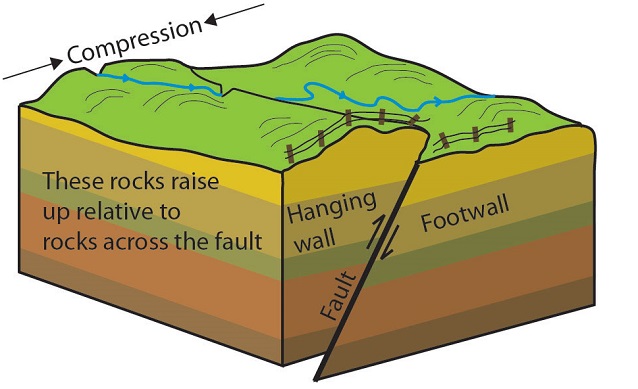
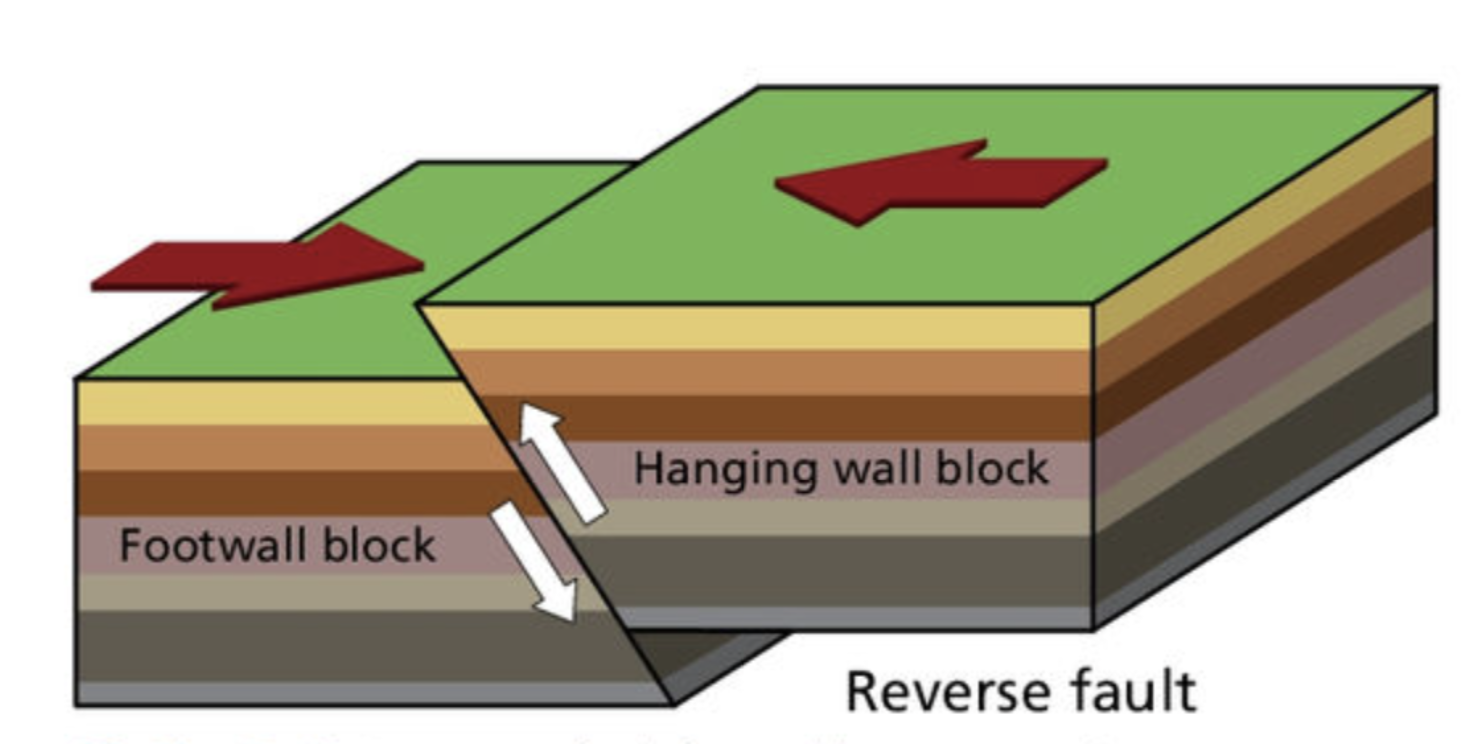
This happens when rock layers are pushed together from both sides. The intense pressure causes the main movement of the crust to be upwards. Think of squeezing a sponge - the material has nowhere to go but up. Compression is the primary process that creates reverse faults.
Tension
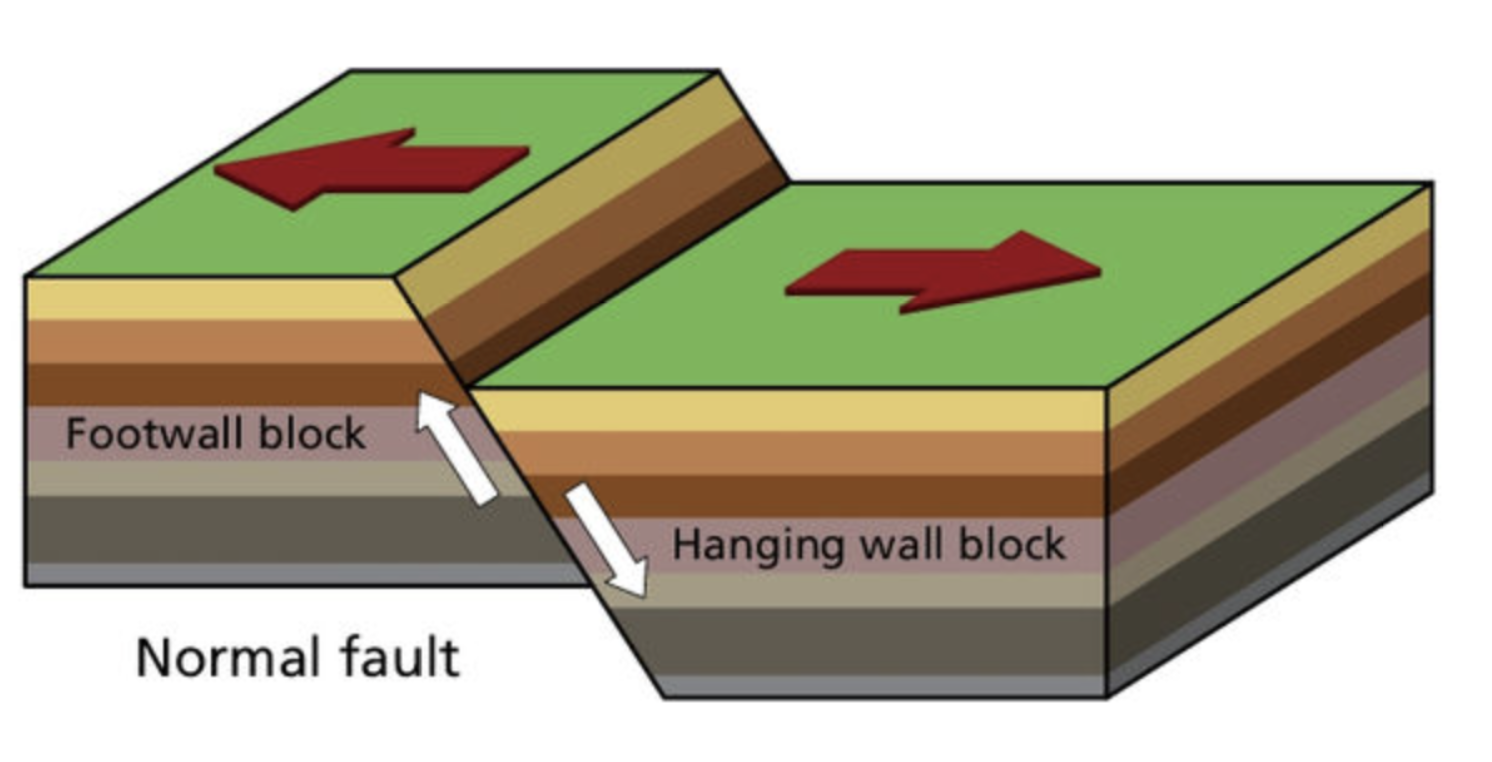
This occurs when rock layers are pulled apart as they experience stretching forces from both sides. This stretching generally causes the crust to move downwards, similar to when you pull apart a piece of elastic until it snaps. Tension is the key process behind normal fault formation.
Shearing
This takes place when sections of rock are moved laterally in opposite directions. Imagine trying to tear a piece of paper by moving your hands in opposite directions - this causes the crust to tear apart. Shearing is associated with transform fault formation.
Parts of a fault
Note
Every fault has several identifiable features that help geologists understand how the movement occurred:
-
Scarp (or escarpment): The cliff face that forms due to vertical displacement of rock. When part of the crust moves downwards, the remaining elevated section creates this visible cliff face.
-
Throw: The total amount of vertical displacement that has occurred. This measures how far the crust has moved up or down.
-
Heave: The amount of horizontal displacement. As the crust moves vertically, it also shifts horizontally.
-
Hanging wall: The section of crust that sits above the fault line. This is the upper block of rock.
-
Footwall: The section of rock that lies beneath the fault line. This is the lower block of rock.
The hanging wall slides along the footwall during fault movement.
Types of fault
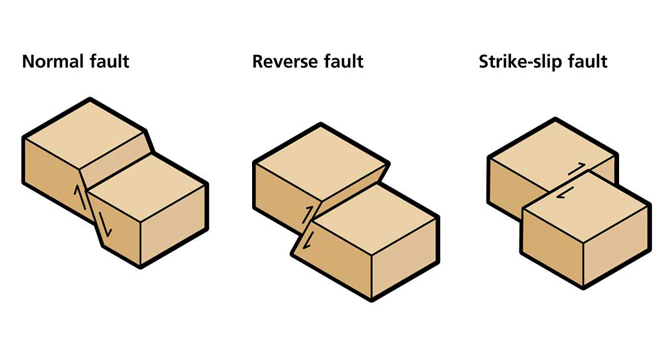
There are three main types of faults, each formed by different stress forces:
Normal faults
Normal faults develop when the Earth's crust experiences stretching forces (tension). This stretching is so powerful that it causes rock to pull apart. As the crust stretches, tension makes it become thinner, similar to stretching a rubber band. Eventually, the stress causes the rock to fracture and pull apart completely.
When fracturing occurs, one side of the fault sinks downwards under gravity's influence, while the other section remains elevated. This process eventually creates a constructive boundary between two tectonic plates.
Example
Case Study: East African Rift Valley
The East African Rift Valley provides an excellent example of normal faulting in action. Over the past 20 million years, a series of normal faults has developed due to crustal stretching caused by convection currents beneath the African continent.
Key features:
- The rift valley stretches approximately km from Syria to the Zambezi River
- The crust between fault lines is - km wide
- Some areas have sunk more than m below current sea level
- The Red Sea has formed in the northern section where the crust dropped below sea level
- The rifting continues at mm per year
- Contains numerous volcanoes (like Mount Kilimanjaro) and lakes (like Lake Tanganyika)
In Ireland, Killary Harbour in County Mayo represents a rift valley (also called a graben) that formed as part of the larger Scottish Rift Valley system approximately million years ago.
Reverse faults
Reverse faults (also known as thrust faults) occur when the crust experiences compression forces. The pressure from compression causes the crust to buckle upwards, forming an anticline shape. As pressure continues building, the rock experiences increased stress until it eventually fractures along its anticline.
When fracturing happens, one section of rock slips upwards on top of the other, creating an escarpment (steep cliff face).
Example
Case Study: Killarney-Mallow Thrust Fault
This reverse fault formed during the Armorican folding period million years ago, when the African Plate collided with the Eurasian Plate. The collision created intense compression that caused sandstone layers to buckle upwards. Continued pressure eventually caused the Old Red Sandstone to fracture, with the sandstone being pushed upwards onto limestone that lay to the north.
Block mountains
When two parallel reverse faults develop, they can create block mountains (also called horsts). The compression forces push the central section upwards above the surrounding down-faulted landscape.
Note
In Ireland, the Ox Mountains in County Sligo represent block mountains formed by granite that has been elevated above the surrounding limestone through this process.
Transform faults
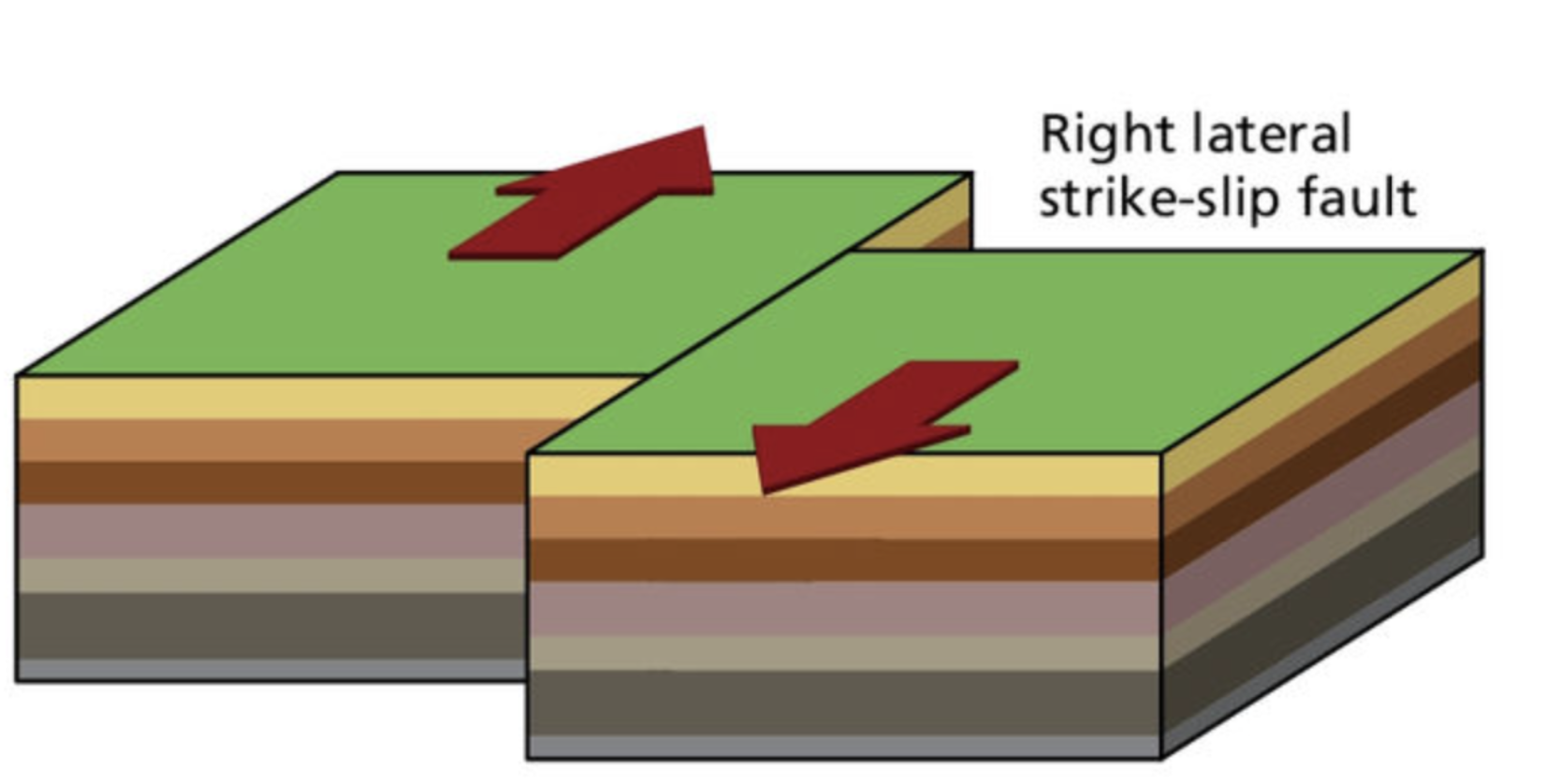
Transform faults (also known as tear faults or strike-slip faults) develop when two sections of crust move in opposite directions. This lateral movement eventually leads to the formation of a passive plate boundary.
Unlike other fault types, transform faults involve horizontal movement rather than vertical displacement, which means no new crust is created or destroyed.
Important
The movement along transform faults is not constant. Opposing rock sections can become stuck, allowing pressure to build up over time. When movement finally occurs, it happens very suddenly, leading to violent earthquakes.
Example
Case Study: San Andreas Fault
The San Andreas Fault represents the largest transform fault on Earth, lying between the North American and Pacific Plates. The Pacific and North American plates move past each other but at different speeds, creating the characteristic lateral displacement. Earthquakes occurring along this fault line are particularly violent because the earthquake focus tends to be close to the Earth's surface.
Summary
Key Points to Remember:
-
Three main processes cause faulting: compression (pushing together), tension (pulling apart), and shearing (lateral movement in opposite directions)
-
Normal faults form from tension forces, causing downward movement and creating rift valleys like the East African Rift Valley
-
Reverse faults develop from compression forces, causing upward movement and forming escarpments like the Killarney-Mallow thrust fault
-
Transform faults result from shearing forces, creating horizontal movement without escarpments, exemplified by the San Andreas Fault
-
Fault components include the scarp (cliff face), throw (vertical displacement), heave (horizontal displacement), hanging wall (upper block), and footwall (lower block)