The Development of Europe and the European Union (Leaving Cert Geography): Revision Notes
📚Revision Notes
The Development of Europe and the European Union
The Expansion of the European Union
- The European Union (EU) began in 1951 with the European Coal and Steel Community (ECSC), created to integrate the economies of Belgium, France, Italy, Luxembourg, the Netherlands, and West Germany.
- The Treaty of Rome in 1957 established the European Economic Community (EEC), creating a common market that allowed for the free movement of goods, labour, and capital.
- The EEC was renamed the European Community (EC) in 1965, expanding its scope to include social and political issues, with the European Parliament gaining legislative power.
- In 1973, Ireland, Britain, and Denmark joined the EC, marking the beginning of its expansion beyond the original six members.
- The Maastricht Treaty in 1992 transformed the EC into the European Union (EU) and introduced the euro as the common currency for many member states.
- The EU's largest expansion occurred in 2004, with 10 Eastern European countries joining, increasing the EU's population by 75 million.
- The Lisbon Treaty of 2009 strengthened the EU's governance and established a process for member states to withdraw, paving the way for Brexit.
- Croatia became the EU's 28th member in 2013. This was one of the recent enlargements, although the EU now has 27 members following Brexit.
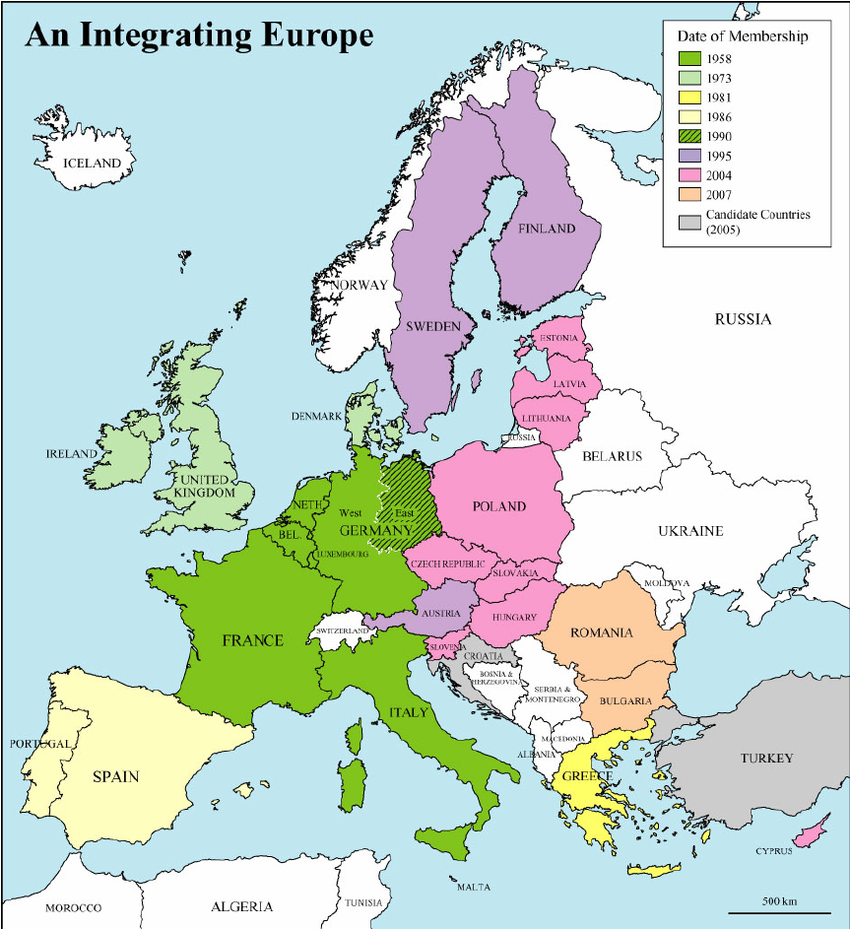
*Map showing year each country joined the EU *
Introduction to the EU and Its Enlargement
The European Union (EU) was founded to promote economic cooperation, political stability, and social progress among European countries. Since Ireland joined the EU in 1973, membership has expanded from 9 to 28 states, significantly impacting member countries like Ireland.
This enlargement has had profound effects on Ireland, influencing its economy and culture, as well as its place in an increasingly integrated Europe.
Economic Impacts of EU Enlargement on Ireland
1. Economic Assistance
-
When Ireland joined, it was one of the poorest and most peripheral countries in the EU, relying heavily on agriculture.
-
Ireland benefitted significantly from EU grants and subsidies, particularly through:
- Common Agricultural Policy (CAP):
- Farmers received grants for livestock units, machinery upgrades, and ecological preservation (e.g., "set-aside" grants for protecting poor-quality land).
- EU Structural and Cohesion Funds:
- These were used to improve infrastructure (e.g., motorway construction).
- Funding supported job creation and boosted the Irish economy during its early years in the EU. 2. Decrease in Funding
-
EU enlargement in 2004 and 2007 added poorer Eastern European countries like Greece, Cyprus, and Bulgaria, diverting financial support from Ireland to these new members.
-
By 2004-2006, €40 billion was allocated to developing agriculture and infrastructure in these regions.
-
As a result, Irish farmers experienced reduced CAP subsidies, and Ireland received fewer structural funds. 3. Labour and Free Movement
-
The 1993 Maastricht Treaty introduced the free movement of people between EU member states.
-
During the Celtic Tiger era, Ireland attracted 350,000 foreign workers by 2009, particularly from Eastern Europe.
- Poland: The Polish population in Ireland grew from 20,000 in 2003 to 60,000 in 2007, and now stands at 120,000.
-
These workers filled skill gaps in sectors like construction and healthcare.
-
Their contributions supported the economy through taxes, housing, and spending on goods and services.
Cultural Impacts of EU Enlargement on Ireland
1. Immigration and Multiculturalism
-
Free movement allowed a large influx of workers from Eastern Europe, fostering a multicultural society in Ireland.
-
Cultural diversity is reflected in:
- Language:
- Polish is now one of the most commonly spoken languages in Ireland, and Polish Mass is celebrated in many Catholic churches.
- Languages like Latvian and Polish are available for study at Leaving Cert level.
- Ethnic Food:
- Polish and other ethnic food shops offer produce and products not typically available in Ireland.
- Intercultural Families:
- Many immigrants have married Irish citizens, and their children blend traditions from both cultures (e.g., playing Gaelic sports while maintaining bilingualism). 2. Cultural Diversity and Acceptance
-
Ireland is considered a "salad bowl" of cultures, where traditions and identities are preserved while being celebrated and promoted in Irish society.
-
Examples of cultural integration include festivals, food markets, and religious events from different cultures.
Challenges and Opportunities of Enlargement
| Aspect | Impact on Ireland |
|---|---|
| Economic Assistance | Reduced funding as Eastern European states required more CAP and Cohesion Funds. |
| Labour Force Growth | Foreign workers filled skill gaps but also created competition for lower-paid jobs. |
| Cultural Diversity | Enriched Irish society through new traditions and languages, fostering multiculturalism. |
| Infrastructural Strain | Rapid population growth in certain areas created housing and service demands. |
Summary of EU Enlargement's Impact on Ireland
| Aspect | Details |
|---|---|
| Economic Assistance | Ireland benefited significantly in the early years (CAP, Structural Funds) but lost funding post-2004. |
| Labour and Migration | Free movement brought skilled foreign workers, supporting economic growth and filling job shortages. |
| Cultural Enrichment | Diverse languages, traditions, and foods have contributed to a multicultural and welcoming society. |
Note
EU enlargement has had a transformative impact on Ireland. While the reduction in financial assistance posed challenges, the free movement of people and goods has enriched Ireland's economy and society. The cultural diversity introduced by migrant workers has strengthened Ireland's identity as an open and inclusive nation within Europe.