Urban Growth and the Expansion of Cities (Leaving Cert Geography): Revision Notes
📚Revision Notes
Urban Growth and the Expansion of Cities
Introduction to Urban Growth
Urban growth refers to the expansion of cities, encompassing increased population, economic activity, and land area. This process is influenced by industrialisation, rural-to-urban migration, and the need for enhanced infrastructure. Urban growth offers opportunities such as economic development and modern amenities but also introduces challenges like environmental degradation and urban sprawl.
Key Concepts in Urban Growth
Urban Sprawl
- Definition: Uncontrolled expansion of urban areas into surrounding rural regions.
- Causes:
- Population growth and housing demand.
- Enhanced transport infrastructure and car ownership.
- Decentralisation of industries and services.
- Impacts:
- Loss of agricultural and greenfield land.
- Increased pollution and traffic congestion.
- Strain on public services and infrastructure costs.
Case Study: The Randstad (Netherlands)
Overview
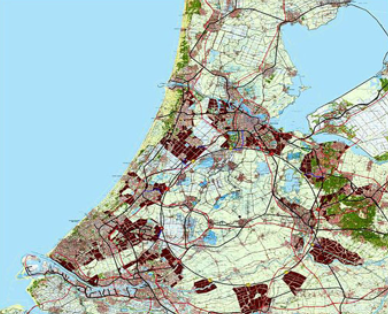
The Randstad, a conurbation in the Netherlands, is an exemplary model of urban growth and planning:
- Comprises Amsterdam, Rotterdam, The Hague, and Utrecht.
- Population: 7.5 million (40% of the Dutch population) on just 17% of the country's land area.
Characteristics of the Randstad
- Polycentric Structure: No single dominant city; each urban area has its unique function:
- Amsterdam: Tourism and retail hub.
- Rotterdam: Major port city.
- The Hague: Political centre.
- Utrecht: Transport hub.
- Horseshoe Shape: Open in the east with a central Greenheart region used for agriculture and recreation.
- Transport and Growth: Excellent infrastructure (rivers, canals, motorways, railways) has driven post-WW2 rapid urbanisation.
Planning Challenges in the Randstad
- Urban Sprawl: Fierce competition for land threatens the Greenheart.
- Buffer Zones: Established to limit urban expansion and protect green spaces.
- Decentralisation: Development of regional centres like Eindhoven and Groningen to redistribute population and economic activities.
- Unchecked Growth Risks: Potential for the Randstad to merge with adjacent urban regions like Rhine-Ruhr (Germany) and Brussels/Antwerp/Ghent (Belgium), forming a West European Megalopolis with severe environmental consequences.
Urban Growth in Ireland
Greater Dublin Area (GDA)
- Population: Over 1.3 million, representing 30% of Ireland's population.
- Urban Expansion:
- Natural limits include the Dublin Mountains, Irish Sea, and fertile agricultural land in the north.
- Expansion into towns like Dundrum, Lucan, and Blanchardstown, turning them into commuter hubs.
Challenges of Urban Sprawl
- Degeneration of inner-city areas as populations move outward.
- Loss of green belts between urban and suburban zones.
Solutions to Urban Sprawl
- Urban Renewal Projects:
- Redevelopment of Dublin Docklands, Temple Bar, and Point Village.
- Planned Towns:
- Development of Tallaght and Adamstown with modern amenities and green belts.
- Improved Public Transport:
- Expansion of Dublin's LUAS and commuter rail services to reduce congestion.
European Urban Growth Example: Rhine-Ruhr (Germany)
- Urban Network: Includes cities like Cologne, Essen, and Dusseldorf.
- Population: Approximately 11 million people, forming one of Europe's largest urban regions.
- Industrial Heartland: Historical growth due to coal mining and steel production.
- Modern Challenges: Urban sprawl, environmental degradation, and economic diversification.
Sustainability Measures for Urban Growth
Green Belts
- Protect rural landscapes from urban encroachment.
- Ensure biodiversity and recreational opportunities.
Buffer Zones
- Introduced in regions like the Randstad to limit expansion and preserve areas like the Greenheart.
Regional Centres
- Encourage development outside major conurbations to alleviate urban pressures.
Urban Renewal
- Investments in housing, infrastructure, and services to rejuvenate decaying urban areas (e.g., Paris Basin's Schéma Directeur).
Note
Urban growth is a defining feature of modern development, but it requires careful planning to balance economic, social, and environmental needs. Case studies like the Randstad, Dublin, and Rhine-Ruhr highlight the importance of sustainable measures like green belts, decentralisation, and urban renewal. Future growth must prioritise minimising environmental impact while ensuring vibrant, functional cities.