River Landforms – Youthful Stage (Leaving Cert Geography): Revision Notes
📚Revision Notes
River Landforms - Youthful Stage
Introduction to the youthful stage
Rivers pass through different stages as they flow from source to mouth, each creating distinct landforms. The youthful stage (also called the upper course) occurs near the river's source in highland areas where the landscape is steep and mountainous.
Important
Youthful stage: The upper section of a river characterised by steep slopes, high velocity water flow, and dominant vertical erosion processes.
During this stage, rivers have tremendous energy due to their steep gradient and high velocity. This energy is primarily used for vertical erosion - cutting downwards into the riverbed rather than sideways. The main landforms created during this stage are V-shaped valleys and waterfalls.
Characteristics of youthful stage rivers
Youthful rivers have several distinctive features that distinguish them from rivers in their mature and old age stages. Understanding these characteristics helps geographers identify where a river is in its developmental cycle.
Note
Key Characteristics of Youthful Rivers:
- High velocity - water moves quickly due to steep gradients
- Steep slopes - creating rapid water flow
- Narrow channel - concentrated flow increases erosive power
- Vertical erosion dominates - rivers cut downwards into bedrock
- Rocky riverbed - with boulders and irregular surfaces
These characteristics can be identified on maps where contour lines are close together, indicating steep slopes in highland areas.
V-shaped valleys
V-shaped valleys are the most characteristic landform of youthful rivers. These deep, narrow valleys get their distinctive shape from the way rivers erode downwards through dominant vertical erosion processes.
How V-shaped valleys form
The formation of V-shaped valleys is a complex process involving multiple erosion mechanisms working together in high-energy environments.
Example
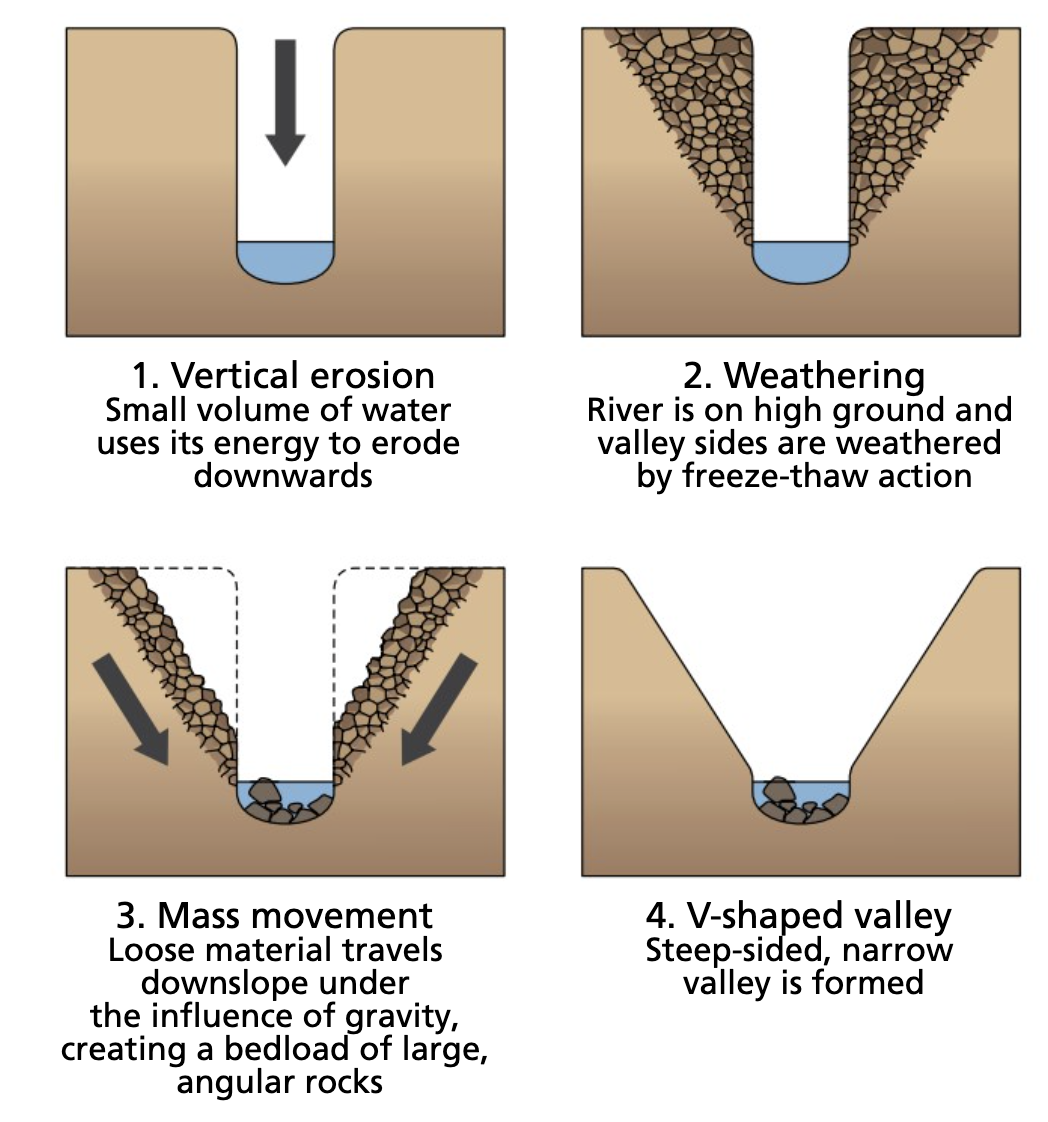
Formation Process: Creating a V-shaped Valley
Step 1: Vertical erosion and downcutting Young rivers have excess energy beyond what's needed to transport their load. This surplus energy drives downcutting - the process where rivers erode vertically into their bed.
Step 2: Hydraulic action As water flows rapidly down the valley, it creates powerful hydraulic forces. This hydraulic action dislodges stones and sediment from the riverbed and banks.
Step 3: Abrasion The loosened stones become tools for further erosion. They scrape and grind against the riverbed through abrasion, widening and deepening the channel.
Step 4: Pothole formation Swirling water creates circular motions that carve out deep hollows called potholes in the riverbed, which eventually join together.
Key features of V-shaped valleys
Once formed, V-shaped valleys display several distinctive characteristics that make them easily identifiable in the landscape.
Note
Distinctive Features:
Interlocking spurs: As the river cuts downwards, it encounters rocks of varying resistance. The river flows around more resistant rock areas, creating a winding, zigzag course. The harder rock areas that jut into the valley are called interlocking spurs - they appear to 'lock' into each other when viewed from downstream.
Steep valley sides: The valley walls are very steep because erosion is concentrated at the bottom where the river flows, leaving the sides unsupported and prone to weathering.
Narrow valley floor: The river occupies most or all of the valley floor, leaving little space for flat land beside the channel.
Examples in Ireland
V-shaped valleys can be found throughout Ireland's mountainous regions, including:
- Upper Shannon valley
- Upper Blackwater valley
- Upper River Moy valley
Waterfalls
Waterfalls are spectacular vertical drops in a river's course that develop where the river flows over different rock types. They represent one of the most dramatic examples of how differential erosion shapes the landscape.
Important
Waterfall: A vertical interruption in the river's profile caused by differential erosion where hard rock overlies softer rock in the youthful stage.
How waterfalls form
The formation of waterfalls is a fascinating process that demonstrates how geological structure influences river behaviour and landform development.
Example
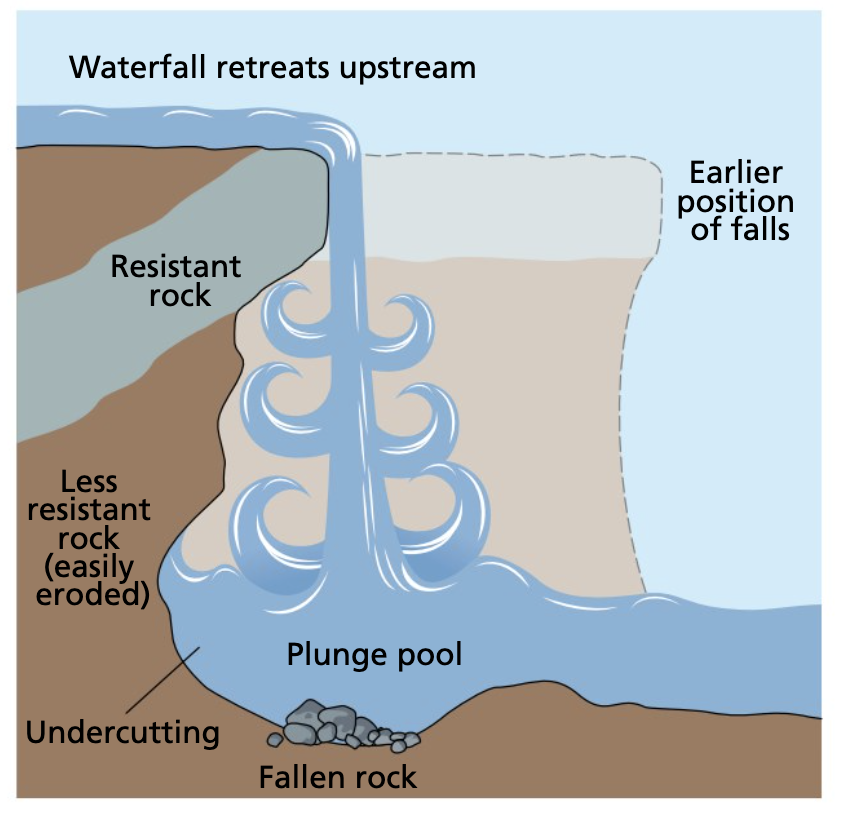
Formation Process: Waterfall Development
Step 1: Initial conditions Waterfalls develop where a band of hard, resistant rock (like granite) lies above softer, less resistant rock (such as limestone or chalk).
Step 2: Differential erosion The youthful river's high velocity affects these rock types differently. The softer rock erodes much faster, creating an uneven riverbed with a vertical step.
Step 3: Plunge pool development Falling water creates a deep hollow called a plunge pool through constant hydraulic action and abrasion.
Step 4: Undercutting and collapse Undercutting hollows out rock behind the waterfall, creating an overhang that eventually collapses, causing the waterfall to retreat upstream through headward erosion.
Gorge formation
As waterfalls retreat upstream over time, they leave behind steep-sided valleys called gorges. The length of the gorge indicates how far the waterfall has retreated from its original position.
Note
When vertical erosion occurs much faster than weathering can break down the valley sides, spectacular deep gorges form - like the Grand Canyon in Arizona, USA.
Examples in Ireland
Notable Irish waterfalls include:
- Torc Waterfall in Killarney, Co. Kerry
- Aasleagh Falls, Co. Mayo
- Powerscourt Falls, Co. Wicklow
Key processes in youthful stage landforms
Several erosion processes work together to create youthful stage landforms, each contributing to the distinctive characteristics we observe.
Note
Primary Erosion Processes:
Hydraulic action: The sheer force of moving water that breaks apart rock through pressure and impact.
Abrasion: The grinding and scraping action of rocks and sediment carried by the river against the channel bed and banks.
Vertical erosion: Downward cutting that deepens the river channel and creates the characteristic steep-sided valleys.
Solution: Chemical weathering where slightly acidic river water dissolves certain rock types, particularly limestone.
These processes are most effective in the youthful stage because of the high energy environment created by steep gradients and rapid water flow.
Summary
Key Points to Remember:
- Youthful rivers are characterised by high velocity, steep slopes, and dominant vertical erosion that creates distinctive landforms
- V-shaped valleys form through downcutting, hydraulic action, and abrasion, creating deep narrow valleys with interlocking spurs
- Waterfalls develop where hard rock overlies soft rock, leading to differential erosion and plunge pool formation
- Headward erosion causes waterfalls to retreat upstream, leaving behind steep-sided gorges
- Key processes include hydraulic action, abrasion, vertical erosion, and solution working together in high-energy environments