River Processes (Leaving Cert Geography): Revision Notes
📚Revision Notes
River Processes
Rivers are powerful forces that continuously shape the landscape through three main surface processes that work together. These processes - erosion, transportation and deposition - occur at different stages along a river's journey from its source to the sea.
Introduction to river processes
Rivers perform three fundamental activities as they flow from their source to the mouth. Erosion occurs mainly in the upper course where fast-flowing water has the most energy. The eroded material, called the river's load, is then carried downstream through transportation. Finally, when the river loses energy and slows down, deposition takes place as the load is dropped along the river bed and banks.
Note
Understanding these three interconnected processes is essential for explaining how rivers create different landforms and continuously modify the landscape over time.
Erosion
Important
Erosion: The wearing away of the river bed and banks through physical and chemical processes that deepen and widen the river channel.
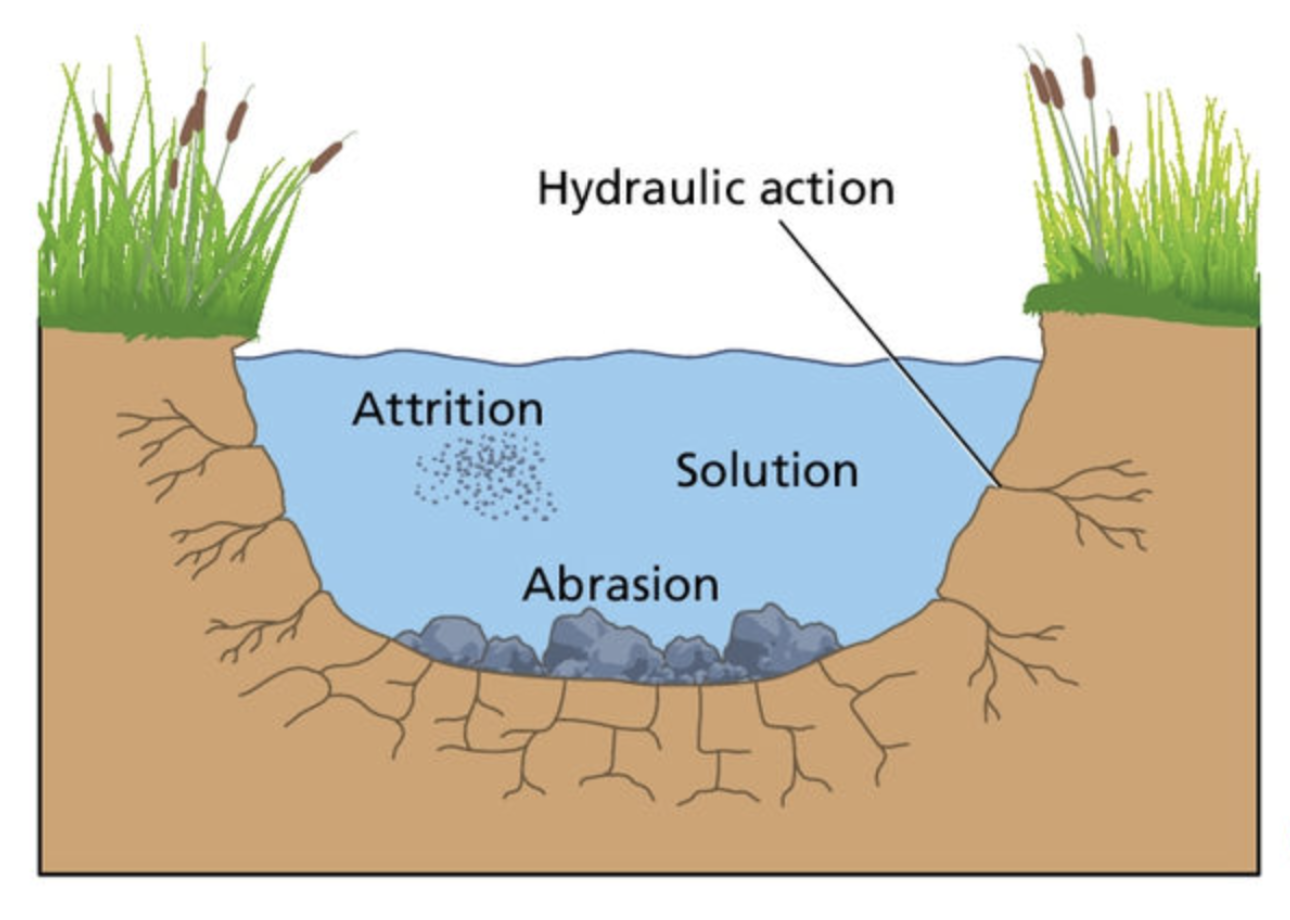
Rivers use their energy to erode the landscape in two main ways. Vertical erosion deepens the river bed, whilst lateral erosion widens the river banks. Four distinct processes work together to achieve this erosion.
Hydraulic action
Hydraulic action occurs when fast-flowing, turbulent water strikes the river bed and banks with tremendous force. As water rushes downstream, it hits against the sides of the channel, dislodging and breaking apart fragments of rock. The faster the water flows, the greater its erosive power becomes.
A special form of hydraulic action called cavitation also contributes to erosion. This happens when millions of tiny air bubbles in the turbulent water suddenly burst, creating powerful shockwaves. These shock waves are strong enough to loosen fragments of clay and sand from the river banks, causing them to collapse into the water. This process is known as bank caving.
Example
Worked Example: Hydraulic Action in Practice
During a flood event:
- Water velocity increases from 2 m/s to 6 m/s
- The force of water against the bank increases by a factor of 9 (force increases with velocity squared)
- This massive increase in force can dislodge rocks that remained stable under normal flow conditions
Abrasion
Important
Abrasion: The process where a river uses the rocks and sediment it carries (its load) to scrape and wear away the river bed and banks.
When hydraulic action breaks off pieces of rock and clay, these fragments become part of the river's load. As the river transports this material downstream, it constantly hits against the bed and banks, loosening even more fragments. Abrasion works most effectively during flood conditions when the river carries its heaviest load and has the most energy to move large amounts of material.
Attrition
The constant movement of the river's load creates a sandpapering effect called attrition. As the river carries rocks, pebbles and soil particles downstream, these materials frequently collide with each other. Each collision wears the particles down, making them progressively rounder and smaller as sharp edges are knocked off. Over time, this process reduces even large rocks to fine particles called alluvium.
Note
Studies show that angular rocks can become completely rounded within just a few kilometres of transport, demonstrating the effectiveness of the attrition process.
Solution
Important
Solution: The chemical breakdown and dissolving of rocks by weak acids naturally present in river water.
Not all erosion involves physical force. Solution is a chemical process where certain types of rock, particularly limestone and chalk, are dissolved by weak acids in the river water. Once dissolved, these minerals are carried away invisibly in the water itself. This process occurs gradually and continuously as the river flows over susceptible rock types.
Transportation
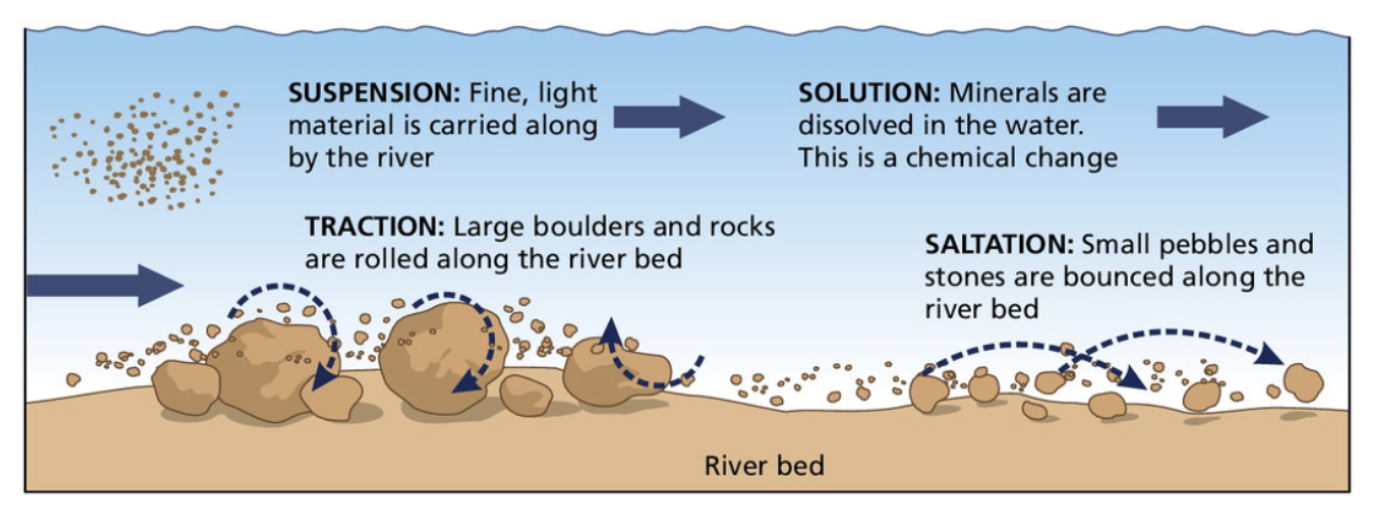
Once material has been eroded, rivers must transport it downstream. The method of transportation depends on the size and weight of the particles, as well as the energy and speed of the river. Four main transportation processes work simultaneously to move different types of material.
Solution in transportation
The minerals dissolved through chemical erosion are carried invisibly in the river water. This process requires very little energy compared to other transportation methods, as the dissolved material adds no weight to slow the river down. Although solution accounts for only a small percentage of the total load transported, it operates continuously regardless of the river's flow conditions.
Suspension
Important
Suspension: The process where fine, lightweight particles such as clay and silt are carried along within the flowing water.
Clay and silt particles are lifted from the river bed by hydraulic action and remain suspended in the water column as the river flows. A large proportion of a river's load travels by suspension, which gives many rivers their characteristic brown or muddy appearance, particularly during flood conditions when more sediment is stirred up.
Saltation
Saltation occurs when small pebbles and stones are too heavy to remain in suspension for extended periods. Instead, hydraulic action periodically lifts these particles off the river bed, and the turbulent water carries them a short distance downstream before dropping them again. This creates a distinctive bouncing motion along the river bed, with particles making repeated short jumps downstream.
Traction
Important
Traction: The dragging of large boulders and rocks along the river bed during periods of high energy flow.
The largest and heaviest materials in a river's load can only be moved by traction. During flood conditions or at certain times of the year when water volume and velocity are at their peak, these massive stones are slowly dragged along the river bed. This process requires enormous amounts of energy and typically occurs during winter months when rivers are at their most powerful. Most of the year, these large rocks remain stationary on the river bed.
Example
Worked Example: Transportation Method by Particle Size
Consider a river carrying different materials:
- Dissolved limestone (0.001mm): Transported by solution - invisible in water
- Clay particles (0.01mm): Transported by suspension - remain floating in water
- Small pebbles (10mm): Transported by saltation - bounce along river bed
- Large boulder (500mm): Transported by traction - dragged during floods only
Deposition
Important
Deposition: The dropping of sediment when a river loses energy or becomes unable to carry its full load.
When rivers can no longer transport all their sediment, deposition occurs. The deposited material typically forms stratified (layered) deposits, with heavier materials settling first whilst finer particles like silt and clay are carried further downstream. Three main factors trigger deposition.
Reduced velocity
As rivers slow down, they lose the energy needed to transport their load. This commonly happens in the mature and old age stages of rivers where the landscape becomes flatter and the slope gradient decreases. Human activities can also reduce river speed, particularly through dam construction, which blocks the river's natural flow and causes sediment to accumulate behind the barrier.
Reduced discharge
When a river loses volume, its carrying capacity decreases significantly. This can occur naturally at distributaries, where the main river splits into several smaller channels as it approaches the sea. Evaporation during hot weather periods also reduces river volume, particularly in regions with hot climates or during summer drought conditions.
Human interference frequently causes reduced discharge through irrigation schemes. These systems extract large quantities of water from rivers to supply agricultural areas during dry periods. As water is removed for crop irrigation, the river's volume decreases, forcing it to deposit some of its load.
Increased load
Sometimes rivers receive more sediment than they can transport, even when their energy levels remain constant. Heavy rainfall periods wash additional soil from the surrounding landscape into rivers, suddenly increasing their sediment load. When tributary streams carrying large amounts of sediment join the main river, the combined load may exceed the main river's transport capacity. In these situations, the river channel can become clogged with deposited sediment, sometimes leading to flooding as the channel's capacity is reduced.
Note
Research has found that human activities like deforestation and urbanisation can increase sediment loads by up to 300%, significantly affecting river systems and increasing deposition rates.
Summary
Key Points to Remember:
-
Rivers perform three main processes: erosion (wearing away), transportation (moving material), and deposition (dropping sediment)
-
Four types of erosion work together: hydraulic action (water force), abrasion (load scraping), attrition (particles wearing each other down), and solution (chemical dissolving)
-
Transportation methods depend on particle size: solution (invisible dissolved minerals), suspension (fine particles), saltation (bouncing pebbles), traction (dragging large rocks)
-
Deposition occurs when rivers lose energy through reduced velocity, reduced discharge, or increased sediment load
-
These processes work continuously along a river's course, with erosion dominating in the upper course and deposition becoming more important in the lower course