Mechanical Weathering Processes (Leaving Cert Geography): Revision Notes
📚Revision Notes
Mechanical Weathering Processes
What is mechanical weathering?
Mechanical weathering, also called physical weathering, is the process where rocks are broken down into smaller pieces without changing their chemical composition. Unlike chemical weathering (which alters the rock's minerals), mechanical weathering simply breaks rocks apart through physical stress.
Important
Mechanical weathering is the breaking down of rock into smaller pieces through stress caused by expansion and contraction. The process creates fragments ranging from large boulders to small grains, but doesn't change what the rock is made of.
There are two main types of mechanical weathering that you need to understand: freeze-thaw action and exfoliation.
Freeze-thaw action
Freeze-thaw action is the most common form of mechanical weathering. This process happens in places where temperatures regularly go above and below freezing point (0°C).
Where does freeze-thaw action occur?
This weathering process is particularly active in:
- Cold climates like Arctic regions
- Alpine environments (mountain areas)
- Upland areas in the west of Ireland
- Any location with frequent temperature changes around freezing point
Conditions needed for freeze-thaw action
Three essential conditions must be present:
- Adequate water supply - There needs to be enough water available (from rain, snow, or streams)
- Pre-existing cracks and joints - The rock must already have fractures where water can enter (sedimentary rocks are particularly vulnerable)
- Temperature fluctuations - Temperatures must regularly rise and fall above and below freezing point
Note
Diurnal range is the difference between the highest and lowest temperatures recorded in a day. Areas with large diurnal ranges are more susceptible to freeze-thaw weathering.
How freeze-thaw action works
The process follows a clear cycle:
- Water enters cracks - During warmer periods, rainwater seeps into existing fractures and joints in the rock
- Temperature drops - At night or during cold periods, temperatures fall below 0°C
- Water expands - When water freezes, it expands by approximately 9%, creating enormous pressure (about 110 kg/cm²) inside the crack
- Rock fractures - This expansion acts like a wedge, forcing the crack to widen and deepen
- Cycle repeats - When temperatures rise, ice melts and water flows deeper into the enlarged cracks
- Rock breaks apart - After many freeze-thaw cycles, the rock eventually splits completely
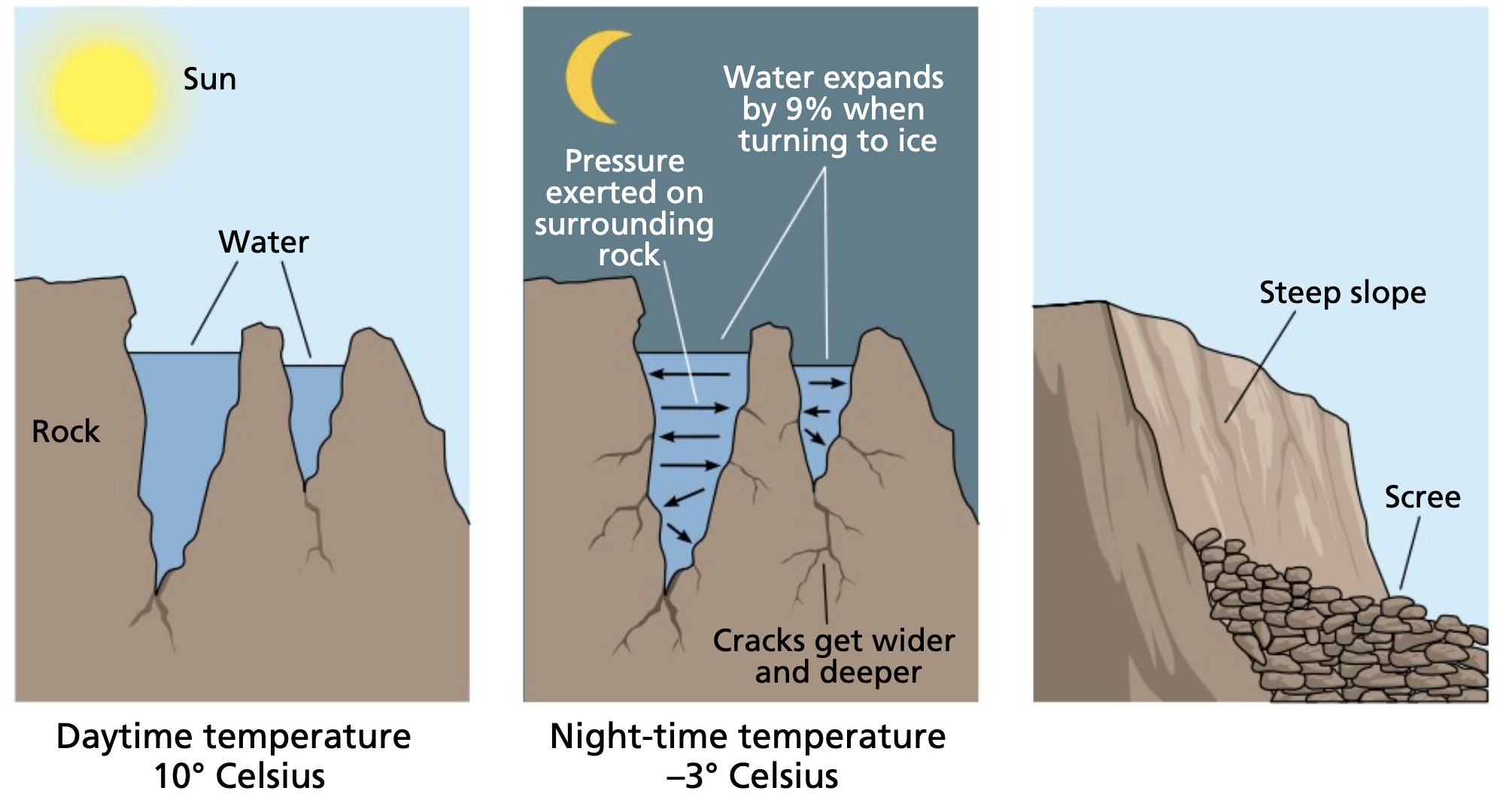
Results of freeze-thaw action
The most visible result of freeze-thaw weathering is the formation of scree. These are accumulations of broken, angular rock fragments that collect at the bottom of slopes and mountainsides.
Note
Scree consists of small pieces of broken rock that accumulate at the bottom of a slope. An area covered in scree is called a scree field.
Example
Irish Examples of Freeze-Thaw Weathering:
- Croagh Patrick in County Mayo shows extensive scree accumulation
- Carrantouhill in County Kerry has large scree fields on its slopes
- Many mountains in western Ireland display clear evidence of freeze-thaw weathering
The process is most effective where freezing and thawing happen many times throughout the year, rather than in areas where water remains permanently frozen.
Exfoliation
Exfoliation is a mechanical weathering process where layers of rock peel away from the surface. It's sometimes called "onion weathering" because the layers come off like the skin of an onion.
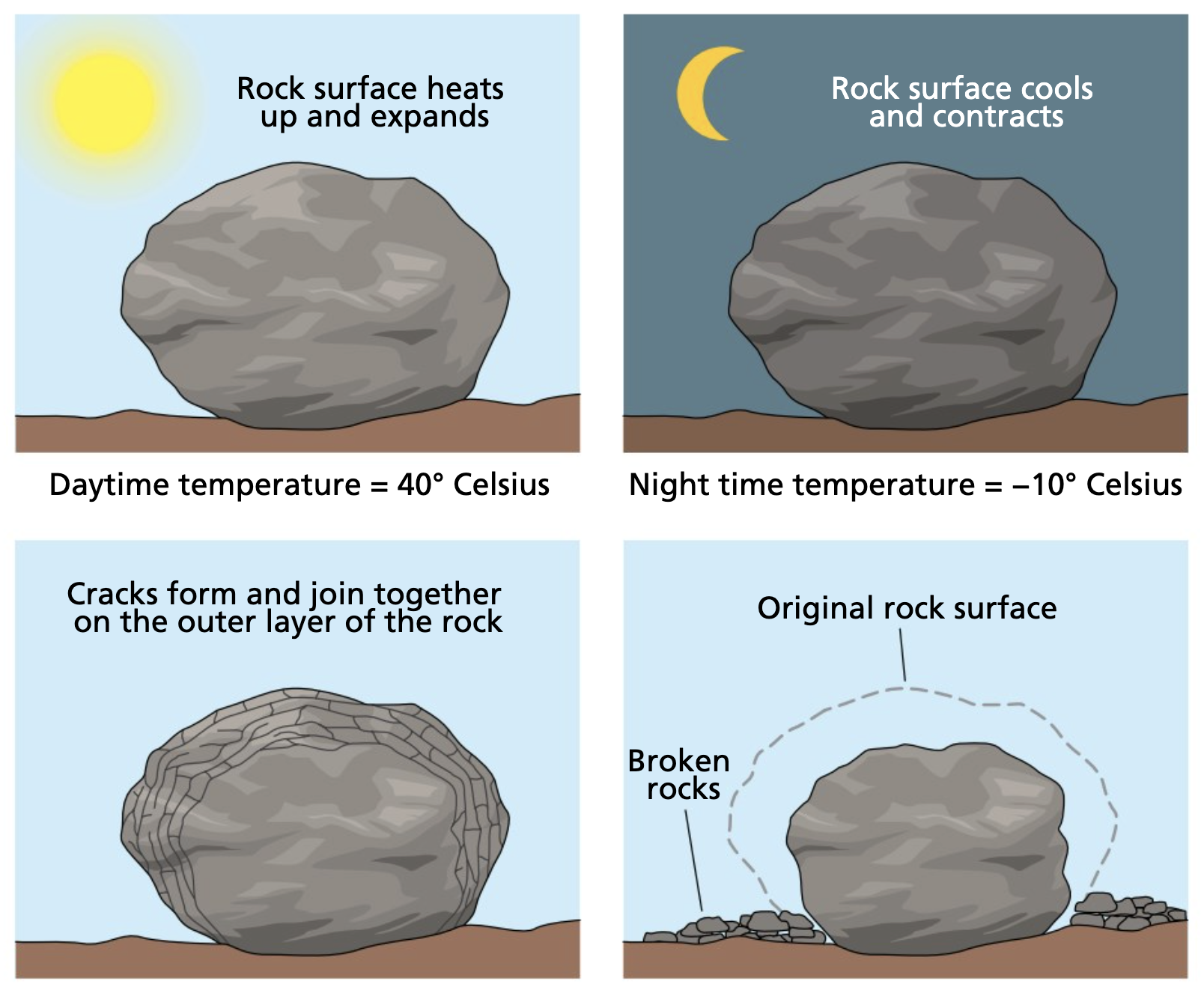
How exfoliation works
Unlike freeze-thaw action, exfoliation doesn't require water. Instead, it relies on large temperature changes:
- Extreme heating - During the day in hot desert regions, temperatures can exceed 40°C
- Outer layers expand - The rock's surface heats up much more than the inner layers, causing the outer layers to expand
- Cooling at night - When temperatures drop dramatically at night (often to near freezing), the outer layers contract
- Stress develops - Repeated expansion and contraction creates stress between the outer and inner layers
- Layers crack and peel - Eventually, the outer layers crack and peel away, leaving a more rounded rock surface
The process is particularly effective in rocks that have natural layers (strata) or existing joints, as these provide weak points where separation can occur.
Different mineral expansion rates
Some minerals in rocks expand more than others when heated. For example, quartz expands three times as much as feldspar when heated. This uneven expansion creates additional stress within the rock, helping the weathering process.
Note
In desert areas, dew sometimes forms at night and then freezes, combining exfoliation with freeze-thaw action. This combination weakens rocks more rapidly than either process alone.
Block disintegration
When exfoliation and freeze-thaw action work together, they can create a process called block disintegration. This breaks rocks down into large rectangular blocks rather than the typical angular fragments of freeze-thaw action alone.
Important
Block disintegration is the breakdown of rocks into large rectangular blocks through a combination of freeze-thaw action and exfoliation.
Example
Famous Example: Monument Valley in the Arizona Desert demonstrates this process, where the combination of weathering processes has created distinctive large rock blocks.
Doming
Exfoliation can also lead to the formation of dome-shaped mountains through a process called doming.
How doming occurs
- Pressure release - When overlying materials (like soil or other rocks) are removed by erosion, the pressure on underlying rock layers is reduced
- Rock expansion - As pressure decreases, the underlying rock layers expand upwards
- Surface fracturing - The rigid top layers cannot expand as easily, so they fracture into pieces of scree
- Dome formation - The expanding lower layers push upwards, creating a dome-shaped landform
- Tor development - Often, rock around the dome is more resistant to weathering, forming blocks called tors around the dome
Important
Doming occurs when overlying materials are removed, reducing pressure on underlying rock layers, causing them to expand upwards and fracture into pieces of scree.
Example
Irish Example: Three Rock Mountain in County Dublin is an excellent example of a tor formed through doming processes.
Summary
Key Points to Remember:
-
Mechanical weathering breaks rocks apart without changing their chemical composition - it's purely physical breakage
-
Freeze-thaw action is the most common type, requiring water, rock fractures, and temperature changes around freezing point
-
Water expands by 9% when it freezes, creating enough pressure to split even solid rock
-
Exfoliation happens in hot climates through repeated heating and cooling, causing rock layers to peel away like onion skin
-
Irish examples include scree on Croagh Patrick and Carrantouhill (freeze-thaw) and Three Rock Mountain (doming)