Coastal Erosion (Leaving Cert Geography): Revision Notes
📚Revision Notes
Coastal Erosion
What is coastal erosion?
Coastal erosion occurs when powerful destructive waves continuously strike the shoreline, gradually wearing it away. The speed at which erosion happens varies greatly depending on what type of coastline is being attacked and how strong the waves are. Understanding coastal erosion is crucial as it shapes our landscape and affects coastal communities worldwide.
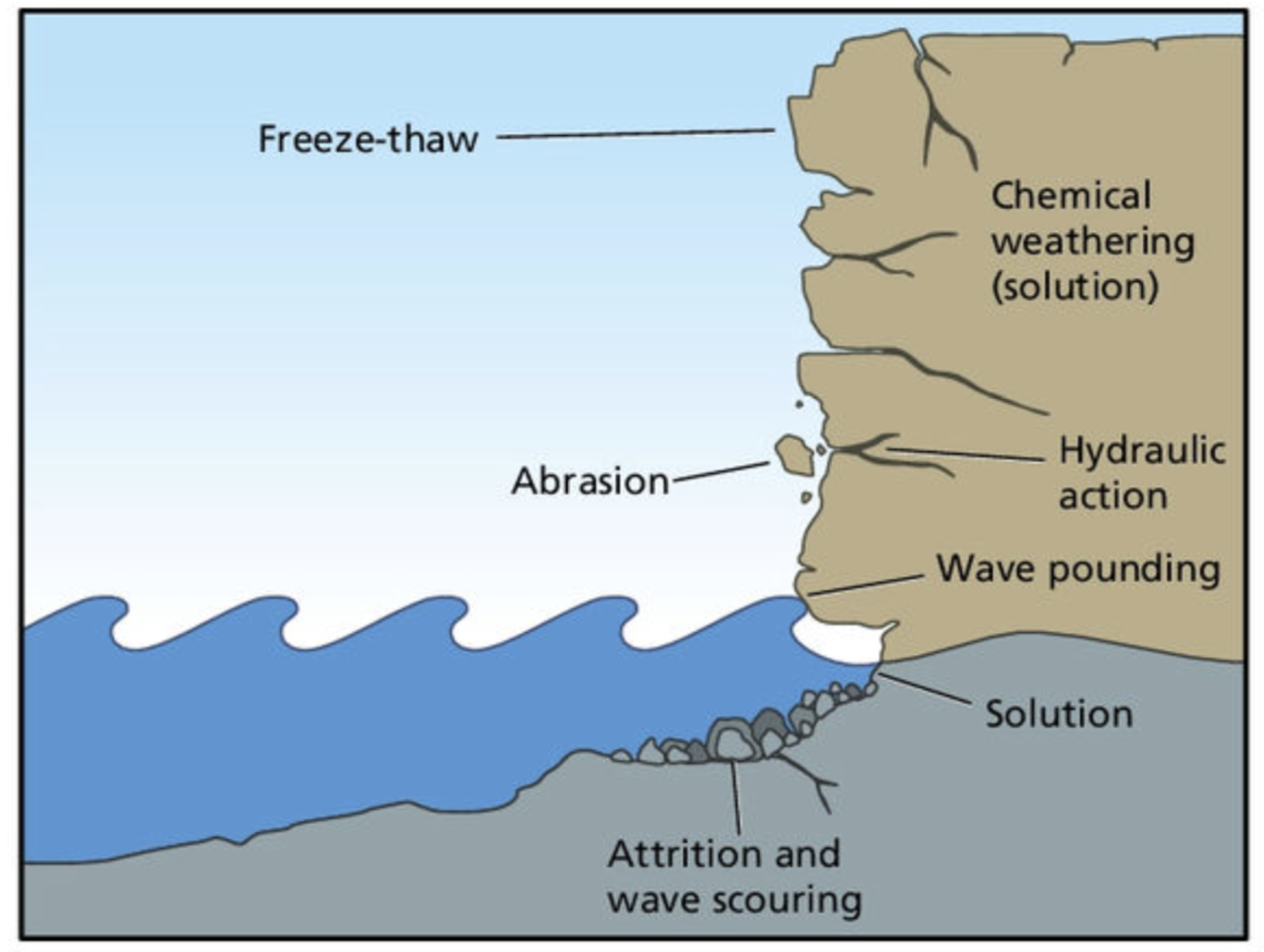
Factors that influence coastal erosion
Several key factors determine how quickly coastal erosion occurs:
1. Coastal composition
The material that makes up the coast plays a massive role in erosion rates:
Important
Hard coasts are made from resistant rock formations like sandstone cliffs, or human-built structures such as sea walls and piers. These take much longer to erode because they can withstand wave attack better.
Soft coasts consist of weaker materials like boulder clay (clay mixed with pebbles and stones), sand, or shingle (rounded pebbles). These erode much more rapidly when hit by destructive waves.
2. Wave power
Wave strength varies considerably depending on weather conditions. Waves become most destructive during storm events, particularly when strong winds combine with high tides.
Example
Real-World Example: Irish Storm Damage
The severe storms that battered Ireland's west coast in December 2013 caused extensive coastal damage due to the combination of strong winds and high tides, demonstrating how weather conditions can dramatically increase wave power.
3. Coastal shape
The outline of the coast affects how waves hit it. Coastlines that stick out into the sea face the full force of incoming waves, making them more vulnerable to erosion. In contrast, sheltered areas like bays receive less direct wave attack.
4. Shore gradient
Steep coastal slopes tend to create more destructive wave conditions than gentle slopes. On steep shores, waves maintain their energy right up to the coastline and crash with maximum force, causing more erosion.
5. Human interference
People can either speed up or slow down coastal erosion. Removing natural beach materials makes coasts more exposed to wave attack. However, building protective structures like sea walls and rock armour can significantly reduce erosion rates.
Note
Human activities have a dual impact on coastal erosion - they can either accelerate the process through removing natural protection or help prevent it through engineered coastal defences.
6. Rising sea levels
Climate change is causing sea levels to rise as ice caps and glaciers melt. Scientists predict that water levels around Ireland could rise by up to 30cm over the next two decades, leading to increased flooding and accelerated coastal erosion.
7. More frequent storms
Climate change has also increased both the frequency and intensity of storms affecting Ireland. These stronger storms can overwhelm coastal defences and dramatically increase erosion rates in previously protected areas.
How coastal erosion works
Coastal erosion happens through five main processes that often work together:
Hydraulic action
This process involves the sheer force of waves crashing against the coastline. When waves hit the coast, they can exert pressure of up to 25 tonnes per square metre. As waves strike cliffs and rocky shores, the water gets forced into cracks and joints in the rock, creating intense pressure. This hydraulic action breaks apart rock formations, widens existing cracks, and removes loose debris. It works particularly well on weaker rock types like boulder clay cliffs.
Abrasion
Often considered the most effective erosion process, abrasion occurs when waves pick up rocks, pebbles, and other debris and hurl them against the coastline. This constant bombardment weakens and breaks down rock and clay, making hydraulic action even more effective. During storms, when more loose material is available in the water, abrasion becomes especially powerful. The debris acts like natural sandpaper, gradually wearing away the coast.
Attrition
As rocks and pebbles get thrown around by waves, they constantly collide with each other and the coastline. This grinding action gradually wears them down through friction, making them smaller, rounder, and easier for waves to transport away. This process is often called the sandpapering effect.
Compression
When waves crash against the coast, air gets trapped and compressed in cracks and joints in the rock. As the waves pull back, this compressed air expands rapidly, creating an explosive effect. This sudden expansion weakens and shatters rock, making it more susceptible to other erosion processes.
Solution
This chemical process involves salt water dissolving certain types of rock. It works particularly well on limestone and chalk coastlines, where the minerals in the rock get dissolved and carried away in solution by the sea water.
Note
These five erosion processes often work together simultaneously, with their combined effect being much more powerful than any single process acting alone.
Landforms created by coastal erosion
Cliffs and wave-cut platforms
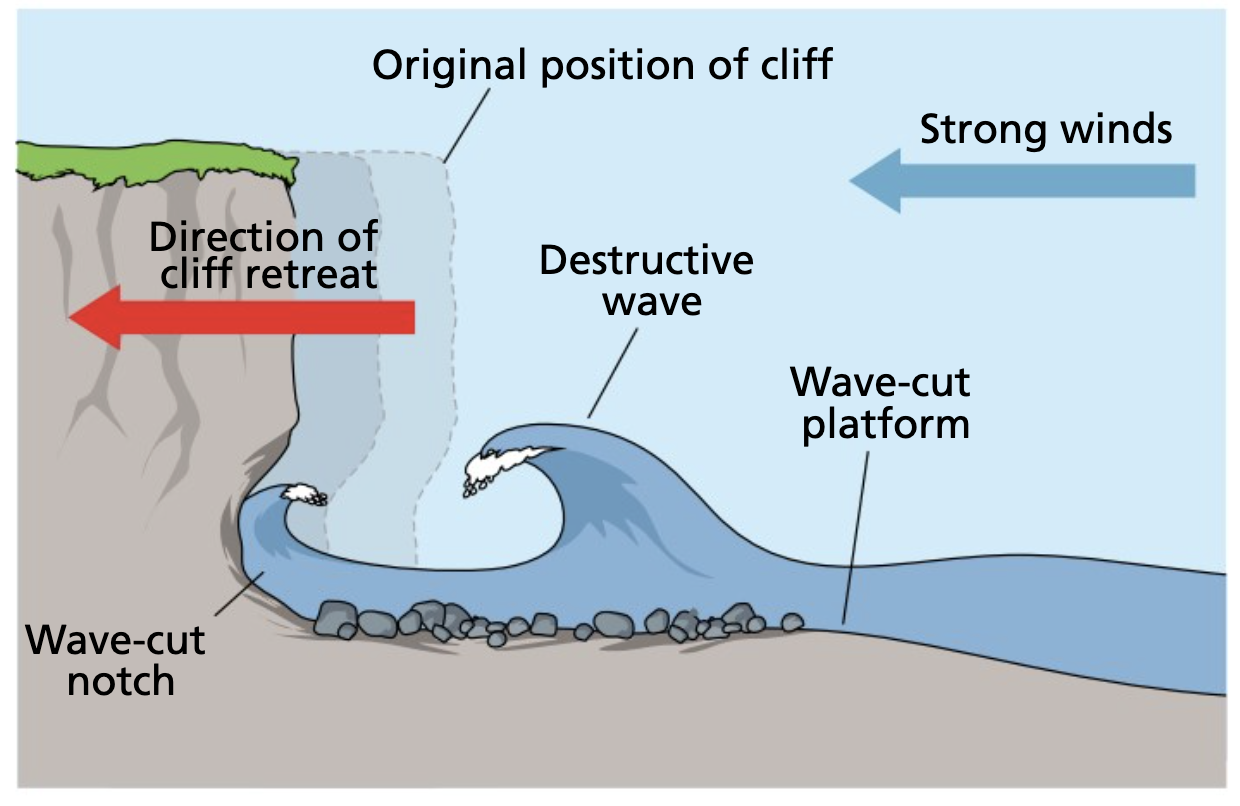
Cliffs are steep or vertical rock faces that form along coastlines through a process called undercutting. Most cliffs develop when destructive waves repeatedly attack the coast, using hydraulic action, abrasion, attrition and compression to break down rock.
Example
Formation Process: How Cliffs Develop
Step 1: Waves attack the base of the coast, creating a wave-cut notch just above the high tide mark
Step 2: Hydraulic action and compression enlarge this notch, leaving the upper part of the slope unsupported
Step 3: Eventually, the overhanging rock becomes too heavy to support itself and collapses
Step 4: This creates a steep cliff face, and the process repeats, causing the cliff to gradually move inland (coastal retreat)
Important
Wave-cut platforms are flat rock surfaces that appear at the base of retreating cliffs. They become visible at low tide and act like natural wave breaks, absorbing wave energy and protecting the cliff from further erosion.
As cliffs continue to retreat, fallen debris collects at the base and gets worn down by attrition. This material eventually forms a ridge called a wave-built terrace. When the wave-cut platform becomes large enough to absorb most wave energy, the cliff becomes inactive, often showing signs like vegetation growth on its face.
Bays and headlands
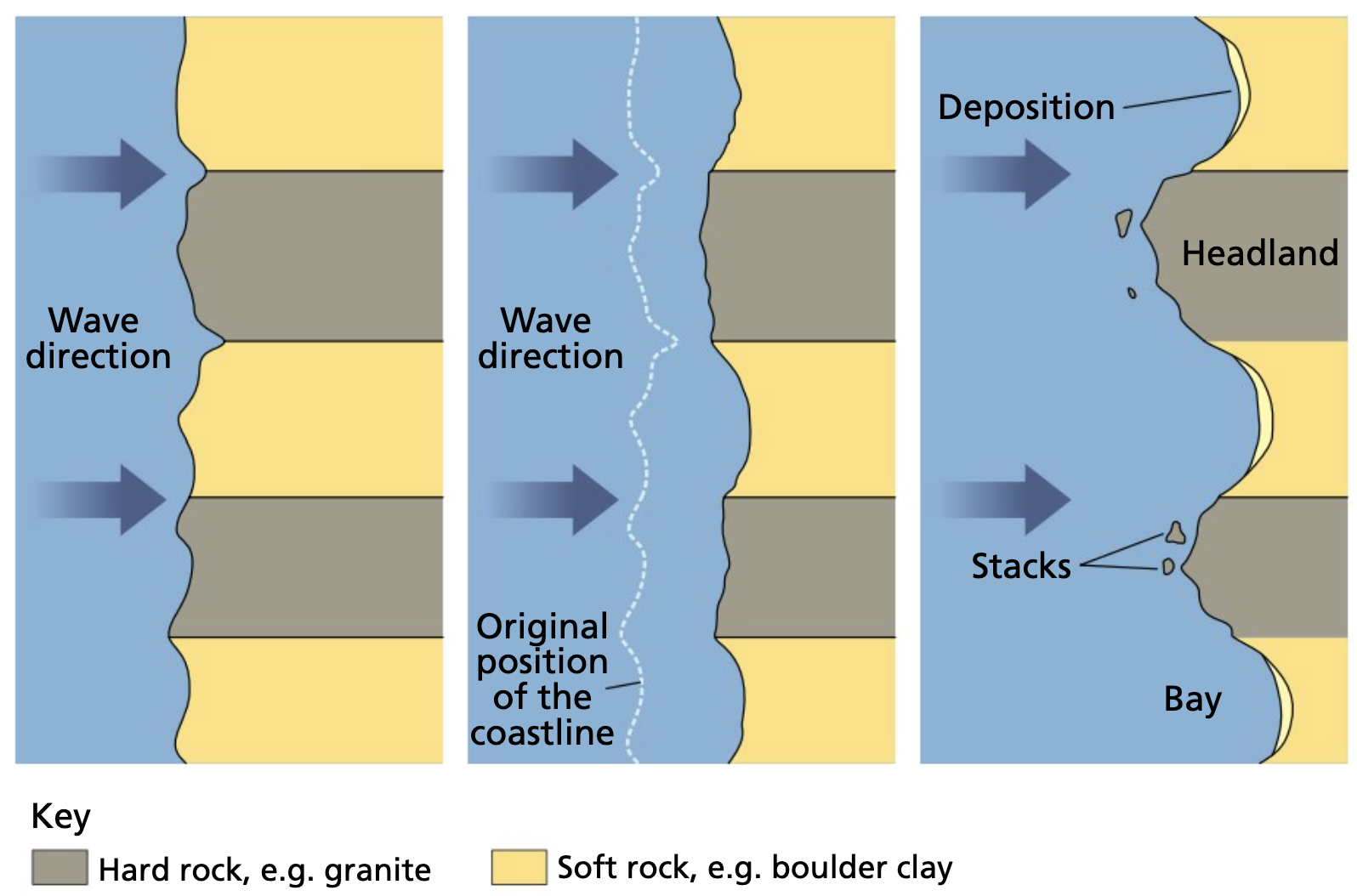
These curved coastal features form where bands of hard and soft rock lie next to each other along a coastline. The process, known as differential erosion, works through the following mechanism:
Example
Formation Process: Bays and Headlands
Step 1: Destructive waves attack both rock types, but the softer rock erodes much faster
Step 2: As the weaker rock gets worn away, the coastline retreats inland to form a curved bay
Step 3: The harder, more resistant rock erodes much more slowly, so it continues to stick out as a headland
Examples include Liscannor Bay in County Clare and Galway Bay, with headlands like Mizen Head in County Cork and Slea Head in County Kerry.
Note
Wave refraction plays an important role in this process. As waves approach the coast, they slow down in the shallow water around headlands, causing them to bend and focus their energy on the protruding rock. Meanwhile, weaker waves deposit material in the sheltered bays, often creating beaches.
Sea stumps
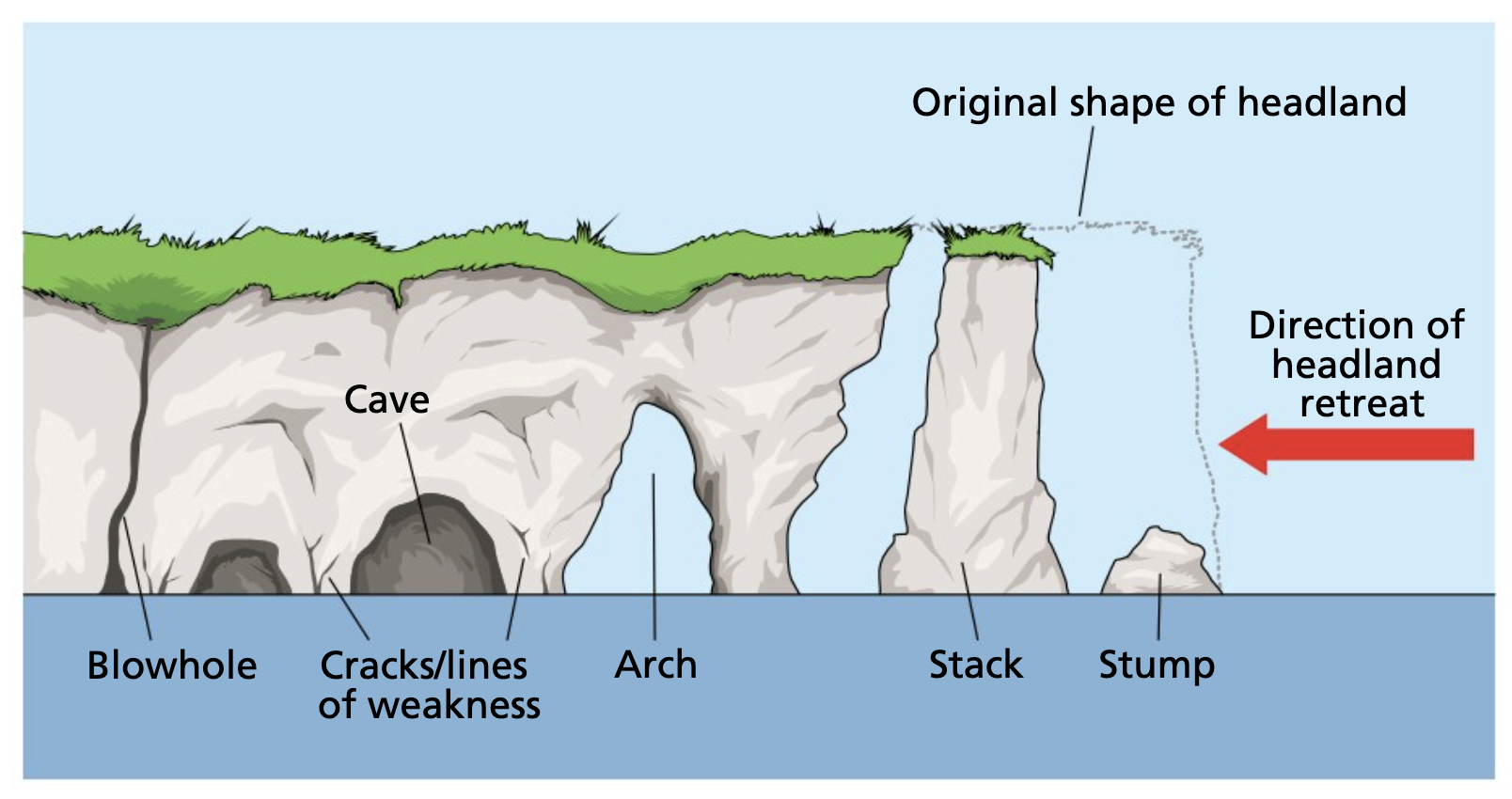
Sea stumps represent the final stage in the erosion of headlands, formed through a sequence of erosional landforms.
Example
Formation Sequence: From Headland to Sea Stump
Stage 1 - Cave Formation:
- Wave refraction concentrates destructive waves on headlands
- Waves attack lines of weakness through undercutting
- A wave-cut notch develops, which deepens into a sea cave through hydraulic action and compression
Stage 2 - Arch Creation:
- Storms hurl rocks against cave walls, deepening them through abrasion
- In narrow headlands, caves on opposite sides join together, creating a sea arch
Stage 3 - Stack Formation:
- The arch roof becomes progressively thinner and weaker
- Eventually, the roof collapses, leaving the seaward section isolated as a sea stack
Stage 4 - Stump Creation:
- Waves continue eroding the stack base through undercutting
- The stack collapses, leaving only its base as a sea stump
- Waves eventually wear away the stump completely
Blowholes and geos
Sometimes, compression causes the roof of a sea cave to shatter, creating a tunnel that connects the cave to the land surface above. This feature is called a blowhole because during stormy weather, sea spray gets blown up through it dramatically. The 'Two Pistols' in County Donegal provide excellent examples of blowholes.
Important
A geo is a small, narrow coastal inlet that forms either from a line of weakness along a cliff face or when a sea cave collapses.
Summary
Key Points to Remember:
- Coastal erosion occurs when destructive waves attack coastlines, with rates depending on rock type and wave strength
- Seven key factors influence erosion: coastal composition, wave power, coastal shape, shore gradient, human activity, rising sea levels, and storm frequency
- Five main processes work together: hydraulic action (wave pressure), abrasion (debris bombardment), attrition (rock grinding), compression (air expansion), and solution (chemical dissolving)
- Major landforms include cliffs with wave-cut platforms, bays and headlands from differential erosion, and the sequential formation of sea caves, arches, stacks and stumps
- Climate change is accelerating coastal erosion through rising sea levels and more frequent, intense storms