The Rallies - Location, Theme and Role in Propaganda (Leaving Cert History): Revision Notes
📚Revision Notes
The Rallies - Location, Theme and Role in Propaganda
Site of the Rallies
- The area featured a series of large open spaces, such as the Zeppelin Field, the Luitpold Arena, and the March Field. Plans also included numerous large buildings, such as the Congress Hall. These spaces were linked by the Great Road, which was 2 kilometres long and 60 metres wide. Significant progress was made in constructing the site, but it was not completed due to the outbreak of war in 1939. (Source 2)
- The Zeppelin Field was built on an old airfield and could accommodate over 100,000 spectators. Speer's design for a stone structure included a mighty flight of stairs topped and enclosed by a long colonnade, flanked on both ends by stone abutments. The structure measured 1,300 feet in length and 80 feet in height.
- The Luitpold Arena could hold 150,000 people and was used for mass gatherings of the SS and the SA.
- The Congress Hall was a huge hall based on Roman architecture.
- Hitler and Speer aimed to create buildings that would last 1,000 years, matching the great buildings of past civilizations like those of Ancient Greece and Rome. Hitler believed in Speer's theory of 'ruin value', which stated that ancient ruins provided proof of the greatness of previous civilizations.
- Hitler also wanted his buildings to glorify his works and magnify his pride. According to Albert Speer in his autobiography, Inside the Third Reich, these buildings in the Party Rally grounds were intended to demonstrate Nazi power and reflect the glory Hitler planned for Germany. They were also designed to mobilise large crowds and create the feeling of a great national community. (Sources 1 to 4)
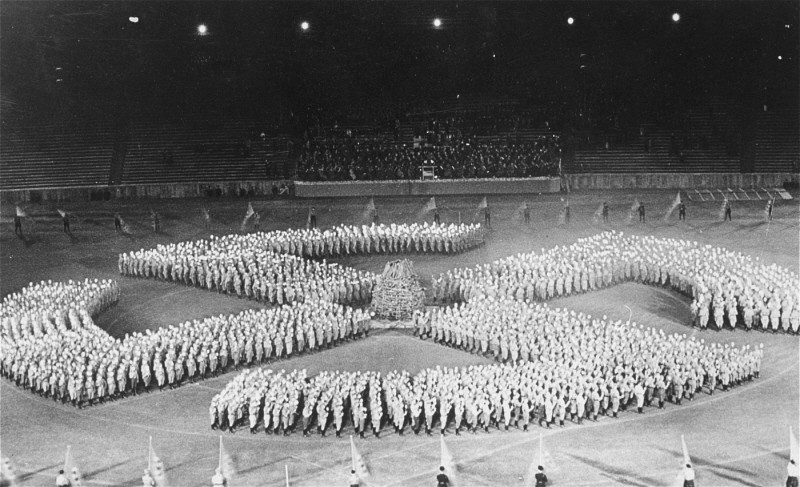
- Hitler also wanted his buildings to glorify his works and magnify his pride. According to Albert Speer in his autobiography, Inside the Third Reich, these buildings in the Party Rally grounds were intended to demonstrate Nazi power and reflect the glory Hitler planned for Germany. They were also designed to mobilise large crowds and create the feeling of a great national community. (Sources 1 to 4)
The Themes of the Rallies - Their Role in Propaganda
- The Rallies served many purposes: to glorify Hitler and thereby cement his relationship with the German people, spread Nazi ideology, celebrate Nazi achievements, and mobilise the German masses. They played a central role in propagandising Party members and served as a forum for further recruitment. (See sources 5, 6, and 7)
- One way of spreading Nazi propaganda was that each rally had a different theme, usually celebrating recent Nazi achievements.
- In 1933, the Nazis celebrated their rise to power in the Rally of Victory.
- Leni Riefenstahl filmed Victory of Faith at this rally. Ernst Röhm, leader of the SA, featured in it, so almost all copies were destroyed after the Night of the Long Knives.
- In 1934, the Nazis emphasised the oneness of Germany in the Rally of Unity and Strength.
- Leni Riefenstahl filmed Triumph of the Will at this rally.
- In 1935, the Rally of Freedom celebrated breaking the Treaty of Versailles with the introduction of conscription.
Table of Rallies
| Year | Location | Theme | Was Rally Filmed? | Context Behind Rally |
|---|---|---|---|---|
| 1923 | Munich | Germany Awake | ||
| 1926 | Weimar | Refounding Congress | Yes | |
| 1927 | Nuremberg | Day of Awakening | First proper Nuremberg rally | |
| 1929 | Nuremberg | Day of Composure | Yes | Before the Wall Street Crash |
| 1933 | Nuremberg | Rally of Victory | Victory of Faith | After Nazi seizure of power/Speer's involvement |
| 1934 | Nuremberg | Rally of Unity and Strength | Triumph of the Will | After Night of Long Knives and Death of Hindenburg Full-scale development of Rally grounds |
| 1935 | Nuremberg | Rally of Freedom | Day of Freedom | Introduction of conscription Nuremberg Laws |
| 1936 | Nuremberg | Rally of Honour | Yes | Remilitarisation of Rhineland Announcement of 4 Year Plan Cathedral of Light |
| 1937 | Nuremberg | Rally of Labour | Yes | Reduced unemployment Cathedral of Light |
| 1938 | Nuremberg | Rally of Greater Germany | Yes | Annexation of Austria Conflict over Sudetenland Cathedral of Light |
| 1939 | Nuremberg | Rally of Peace | Cancelled because of World War II |