Lenin and the New Economic Policy + Kronstadt Rising (Leaving Cert History): Revision Notes
📚Revision Notes
Lenin and the New Economic Policy & Kronstadt Rising
When studying Vladimir Lenin, there is always a large selection of key events to draw upon that will add context to your study/research. The notes below will deal with two vital areas of discussion. Both of which will be hugely important if you wish to answer on Lenin in your exam.
The New Economic Policy (NEP)
Background and Implementation
- Vladimir Lenin introduced the New Economic Policy (NEP) in March 1921 as a response to the severe economic crisis and widespread social unrest caused by War Communism.
- The NEP marked a temporary retreat from the strict socialist policies of War Communism, reintroducing limited market mechanisms to stimulate the economy and improve living conditions.
Key Features:
- The policy ended forced requisitioning of grain and replaced it with a tax in kind. After meeting the tax quota, peasants were allowed to sell their surplus produce on the open market.
- Small-scale industries and businesses were denationalised, allowing private ownership and operation. Larger industries remained under state control, but they operated with greater autonomy.
- The NEP restored a monetary economy, reintroducing currency to replace barter and stabilise the economy. State banks were reopened, and foreign trade was encouraged.
- Labour regulations were relaxed, and wages were paid in money rather than kind. This incentivized productivity and helped reduce labour shortages.
Impact and Outcomes
- The NEP successfully revitalised the economy, leading to a significant increase in agricultural and industrial production. By the mid-1920s, the Soviet economy had largely recovered to pre-World War I levels.
- The policy improved living standards and helped to stabilise the Soviet state, gaining temporary support from peasants and workers.
- Despite its success, the NEP created tensions within the Communist Party, as some members viewed it as a betrayal of socialist principles. In the late 1920s, Joseph Stalin eventually abandoned the policy in favour of rapid industrialisation and collectivisation.
The Kronstadt Rising
Background
- The Kronstadt Rising was a major uprising of Soviet sailors, soldiers, and civilians against the Bolshevik government in March 1921. It occurred at the Kronstadt naval base on Kotlin Island in the Gulf of Finland.
- The uprising was driven by widespread dissatisfaction with Bolshevik policies, particularly War Communism, which had led to severe food shortages, economic hardship, and political repression.
Demands and Actions
- The Kronstadt rebels issued a set of demands known as the Petropavlovsk Resolution. Key demands included:
- Immediate new elections to the Soviets with secret ballots.
- Freedom of speech and assembly for workers and peasants.
- Release of all socialist political prisoners.
- Abolition of Bolshevik-controlled political commissars in the military.
- Equal rations for all working people.
- The uprising aimed to replace Bolshevik rule with a more democratic and socialist form of governance, reflecting the original ideals of the Russian Revolution.
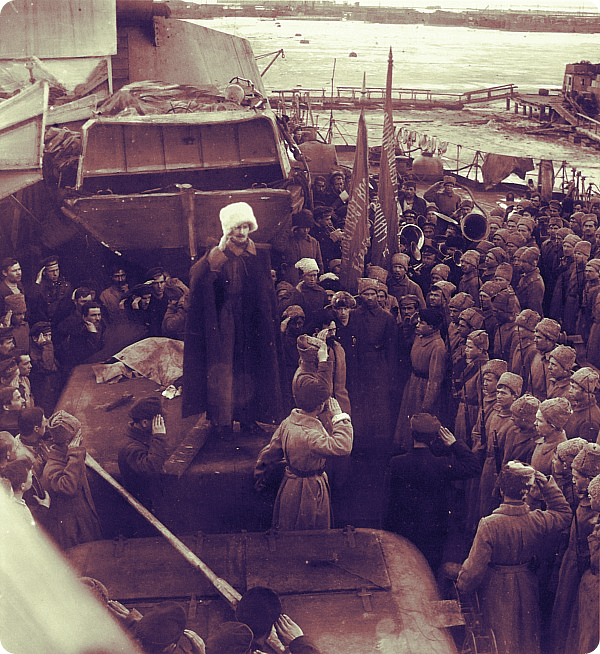
Bolshevik Response and Suppression
- The Bolshevik government, led by Lenin and Trotsky, viewed the uprising as a significant threat to their control and acted swiftly to suppress it.
- Trotsky ordered a military assault on Kronstadt. After intense fighting, the Red Army, led by Marshal Tukhachevsky, stormed the naval base on March 17, 1921.
- The suppression was brutal, with thousands of rebels killed or executed and many more imprisoned or sent to labour camps.
Significance and Legacy
- The Kronstadt Rising highlighted widespread discontent with Bolshevik rule and exposed the contradictions between the government's policies and its revolutionary ideals.
- The uprising catalysed the NEP's introduction, as it underscored the need for economic and political reforms to maintain Bolshevik control.
- The brutal suppression of the Kronstadt Rising deepened the rift between the Bolshevik leadership and many of their former supporters, contributing to the consolidation of a more authoritarian regime under Lenin and, later, Stalin.
Key Quotes
"The New Economic Policy was a strategic retreat in order to gain a tactical victory." - Lenin
"All power to the Soviets, but not to parties." - Kronstadt rebels' slogan
"We have always understood that the revolution would not be a bed of roses." - Trotsky on suppressing the Kronstadt Rising