Focus on: JM Keynes (Leaving Cert History): Revision Notes
📚Revision Notes
Focus on: John Maynard Keynes
Whilst Keynes is more likely to appear in some form on an OL paper, there is nothing to state that he won't show up in some way as a part of a HL question, be it in a DBQ or an essay. And look, even if he doesn't show up directly, having a general understanding of who he was and what he contributed to Britain in the 1920s will only help you anyway.
Here are some solid points on JM Keynes that you can add to any essay or context question in a DBQ.
Early Life and Career
- John Maynard Keynes was born in 1883 in Cambridge, England. He was a prominent economist whose ideas fundamentally changed economic theory and policy in the 20th century.
- Keynes studied at Eton and King's College, Cambridge, where he excelled in mathematics and economics. He later joined the British Civil Service and became a lecturer at Cambridge University.
Criticisms in "The Economic Consequences of the Peace"
- Keynes is best known for his critical analysis of the Treaty of Versailles in his book "The Economic Consequences of the Peace" (1919).
- He argued that the harsh reparations and economic terms imposed on Germany would lead to severe economic instability and resentment, potentially causing future conflicts.
- Keynes predicted that the treaty's punitive measures would devastate the German economy, leading to hyperinflation, unemployment, and political unrest. His predictions were largely accurate, as Germany faced significant economic turmoil in the 1920s.
Opposing the Gold Standard
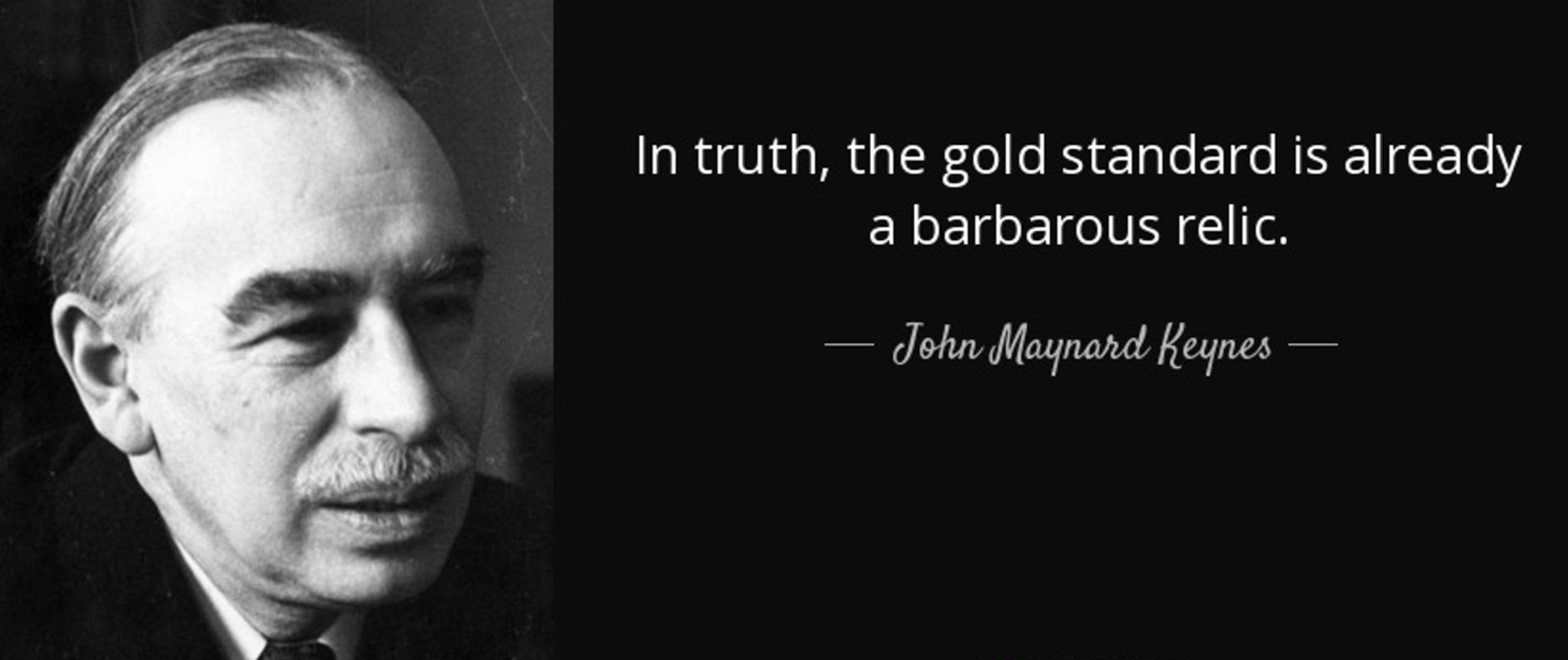
- Keynes was a vocal critic of the Gold Standard, which Britain re-adopted in 1925.
- He argued that it restricted economic growth and exacerbated economic downturns by limiting the money supply.
- He believed that the Gold Standard forced countries into deflationary policies, leading to higher unemployment and lower economic output.
- Keynes advocated for more flexible monetary policies that could respond to economic conditions.
"The General Theory of Employment, Interest and Money"
-
In 1936, Keynes published his seminal work, "The General Theory of Employment, Interest and Money," which revolutionised economic thought.
- In this book, Keynes challenged the classical economic notion that markets are always self-correcting and that full employment is the economy's natural state.
- He introduced the concept of aggregate demand—the total demand for goods and services within an economy—as the primary driver of economic activity and employment levels.
- Keynes argued that insufficient aggregate demand could lead to prolonged periods of high unemployment and economic stagnation.

-
He advocated for active government intervention to manage demand through fiscal policies, such as public spending and tax adjustments.
The Keynesian Revolution
- Keynes's ideas led to the Keynesian Revolution, a fundamental shift in economic policy and theory. Governments worldwide began to adopt Keynesian policies to manage economic cycles.
- His theories influenced the development of macroeconomics as a distinct field and provided the intellectual foundation for many post-World War II economic policies.
- Keynesian economics became particularly influential during the Great Depression and the post-war era, guiding policies to achieve full employment and economic stability.
- His advocacy for government intervention in the economy led to the establishment of welfare states and the implementation of social safety nets, such as unemployment insurance and social security.

Legacy
- John Maynard Keynes's contributions to economics have left a lasting legacy. His ideas continue to influence economic policy and theory, particularly during economic crises.
- The principles of Keynesian economics have been revisited and adapted in various forms, such as neo-Keynesian and post-Keynesian economics, demonstrating the enduring relevance of his work.