The Defeat of the Third Republic (Leaving Cert History): Revision Notes
📚Revision Notes
The Defeat of the Third Republic
If you do want to write about Vichy France, then it is crucial to know how the Vichy State came about. Below are three key subsections that will provide you with valuable context to aid you in your assessment of the Third Republic and the success of German invasion.
The End of the Third Republic
- The Third Republic of France, established in 1870 following the collapse of the Second French Empire, was characterised by political instability and frequent government changes.
- Despite these challenges, it navigated several significant historical events, including World War I. However, the outbreak of World War II and the subsequent German invasion in May 1940 marked the beginning of its end.
- The Third Republic struggled to respond effectively to the rapid and overwhelming blitzkrieg tactics employed by the German military. Despite its size and resources, the French military was ill-prepared for the speed and coordination of the German assault, leading to a series of defeats.
- By June 14, 1940, German forces had entered Paris, signalling the collapse of French defences and the imminent fall of the government. Realising the untenability of continued resistance, the political leadership sought an armistice with Germany.
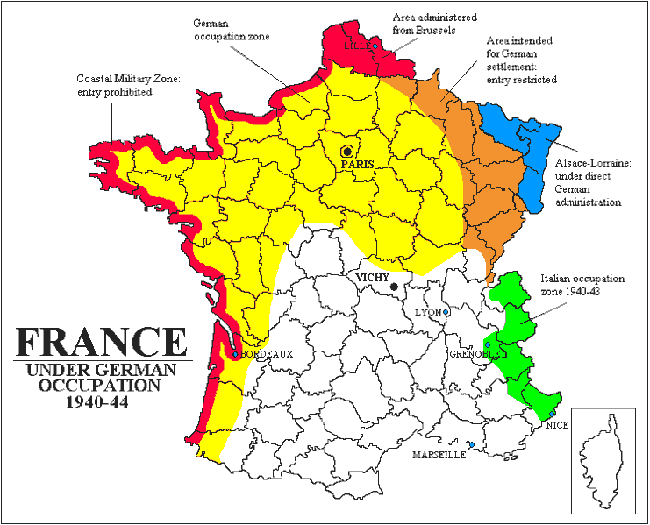
- This armistice, signed on June 22, 1940, marked the official end of the Third Republic, as France was divided into occupied and unoccupied zones, with German forces controlling the northern and western parts of the country.
How the French Lost the Third Republic
- The rapid fall of France in 1940 can be attributed to several critical factors, including military unpreparedness, strategic miscalculations, and political disunity. The German invasion, launched on May 10, 1940, exploited weaknesses in the French defensive strategy, particularly the reliance on the Maginot Line, a series of fortifications along the French-German border.
- The Germans bypassed this line by advancing through the Ardennes Forest, a region the French had deemed impassable for an army. This strategic oversight allowed German forces to penetrate deep into French territory at an alarming speed.
- The fall of Paris on June 14, 1940, was a significant blow to French morale and governance, leading to the collapse of the central authority.
- The French military, despite fighting valiantly in some areas, was unable to stem the tide of the German advance. Political leaders, recognising the futility of further resistance, opted to seek an armistice.
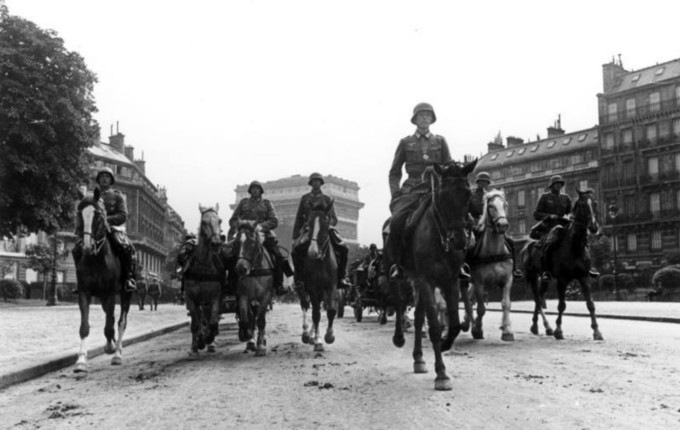
June 14, 1940: German Troops Occupy Paris
- Prime Minister Paul Reynaud, who initially resisted surrender, was replaced by Marshal Philippe Pétain, who favoured negotiating with the Germans. The armistice signed on June 22, 1940, led to the division of France into an occupied zone under direct German control and a so-called "free zone" administered by a new French government.
How the Vichy State Was Set Up
-
Following the armistice with Germany, the southern part of France, not initially occupied by German forces, became known as the Vichy State, named after its administrative capital in Vichy. Marshal Philippe Pétain, a World War I hero, assumed leadership of this new regime.
-
On July 10, 1940, the French National Assembly granted Pétain full powers, effectively dissolving the Third Republic and establishing an authoritarian regime.
-
The Vichy government sought to collaborate with Nazi Germany, believing that cooperation would mitigate the harshness of occupation and preserve some degree of French sovereignty. The regime implemented numerous policies in alignment with Nazi objectives, including anti-Semitic laws and the suppression of political dissent.
-
The Vichy State also used propaganda to promote its legitimacy and marshal support for its collaborationist stance.
-
However, this collaboration deeply divided the French population and led to the rise of the French Resistance, which opposed both the Vichy government and the German occupiers.
-
The Vichy regime remained in power until the Allied invasion of France in 1944, which liberated the country and restored a provisional government that eventually transitioned into the Fourth Republic.
- The legacy of the Vichy State remains controversial, marked by its role in the persecution of Jews and its collaboration with the Nazi regime.