Focus on: Ian Paisley (Leaving Cert History): Revision Notes
📚Revision Notes
Focus on: Ian Paisley
-
Ian Paisley was born in 1926 in Armagh, Northern Ireland, and became a prominent Protestant minister and politician, known for his fiery rhetoric and strong opposition to Catholicism.
-
Paisley founded the Free Presbyterian Church of Ulster in 1951, which became the religious foundation for his political views and attracted many followers who shared his hardline Protestant beliefs.
-
He was a staunch unionist and loyalist, dedicated to keeping Northern Ireland part of the United Kingdom and opposing any moves towards a united Ireland.
-
In 1971, Paisley co-founded the Democratic Unionist Party (DUP), which quickly became the main political vehicle for his unionist agenda, challenging the more moderate Ulster Unionist Party (UUP).
-
Paisley was a fierce opponent of the 1973 Sunningdale Agreement, which sought to establish a power-sharing government in Northern Ireland. He viewed the agreement as threatening Northern Ireland's union with Britain.
-
He led the Ulster Workers' Council Strike in 1974, leading to the collapse of the Sunningdale Agreement and the power-sharing executive.
-
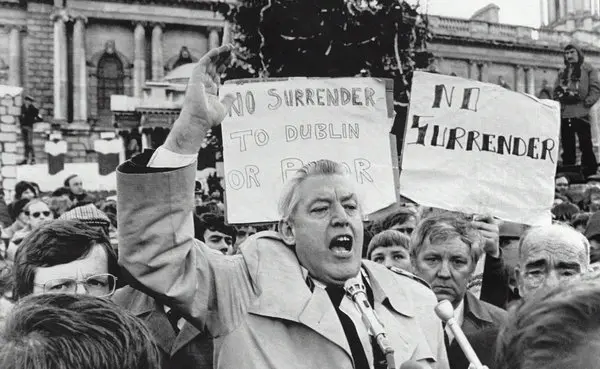
Paisley's opposition to the Anglo-Irish Agreement of 1985, which gave the Republic of Ireland a consultative role in Northern Irish affairs, included organising mass protests and rallies against the agreement.
- Throughout the Troubles, Paisley was a vocal critic of any negotiations with the Irish Republican Army (IRA) or Sinn Féin, refusing to engage with republicans whom he viewed as terrorists.
- Despite his hardline stance, Paisley later entered into talks with Sinn Féin during the peace process, eventually leading to the St Andrews Agreement in 2006.
- In 2007, Paisley became the First Minister of Northern Ireland as part of a power-sharing agreement with Sinn Féin, marking a significant shift in his political career and Northern Irish politics.
- His partnership with Martin McGuinness, a former IRA leader, in the Northern Ireland Executive was a historic and symbolic moment. Their unexpected rapport earned them the nickname "The Chuckle Brothers."
- Paisley's leadership of the DUP and his eventual participation in power-sharing helped to stabilise Northern Ireland's political landscape, though his earlier opposition to peace efforts remains controversial.
- After stepping down as First Minister in 2008, Paisley continued to be an influential figure in Northern Ireland until his retirement from public life. He passed away in 2014, leaving a complex legacy.
- Paisley's impact on Northern Ireland was profound, shaping the course of unionist politics and playing a key role in both opposing and later supporting efforts to bring peace to the region.