Internment (Leaving Cert History): Revision Notes
📚Revision Notes
Internment
What Happened?
- Brian Faulkner replaced James Chichester-Clark as Prime Minister of Northern Ireland in March 1971. Faulkner, who was more popular with unionists than his predecessor, faced a rapidly deteriorating situation as violence escalated across Northern Ireland.
- Nationalists, however, viewed him with suspicion and were unimpressed by his leadership. Although Faulkner attempted to reach out to moderate nationalists by offering them a more significant role in government, his efforts were largely unsuccessful.
- He invited the SDLP to chair several parliamentary committees, but this gesture was met with a lukewarm response. SDLP leader John Hume acknowledged the offer as a good start but insisted that it did not go far enough.
- The SDLP ultimately withdrew from Stormont on 16 July 1971, after the government refused to hold an official inquiry into the deaths of two Catholic men who had been shot by British soldiers earlier that month.
- While Faulkner was attempting to engage with moderate nationalists, he took a much harder line against the IRA.
- He pressured the British government to allow the introduction of internment, a policy that permitted the arrest and detention of individuals without trial, primarily targeting those suspected of involvement with the IRA.
- The British government, under Edward Heath, eventually granted Faulkner's request, and Operation Demetrius was launched on 9 August 1971.
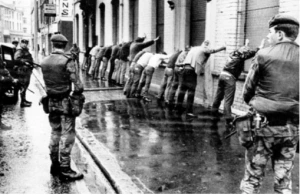
- This operation focused almost exclusively on IRA suspects, leading to the immediate arrest of 342 men, most of whom were Catholics.
- However, many key IRA leaders managed to avoid capture, as they had been tipped off about the operation in advance.
- In the first 48 hours of Operation Demetrius, approximately 7,000 Catholics fled their homes and sought refuge in the Republic of Ireland.
- The operation also resulted in the deaths of 17 people, including 10 Catholic civilians. By the end of the year, over 2,000 individuals had been arrested, nearly all of whom were Catholic.
- Nationalists reacted with fury, viewing the internment policy as an assault on their community.
Consequences of Internment
-
Internment proved to be a disaster for several reasons:
- It was almost exclusively enforced on Catholics despite the fact that loyalists were also responsible for ongoing violence. It was not until 1973 that loyalists were interned in significant numbers.
- The use of internment deepened the mistrust between Catholics and the British Army, eroding any remaining goodwill that the Catholic community might have had towards the British forces.
- Rather than weakening the IRA, internment actually increased support for republican paramilitaries, as the Catholic community began to see the IRA as their only means of protection.
- The intelligence used to justify the internment of suspects was often out of date, leading to the detention of older or inactive members of the IRA, while active members managed to avoid capture.
- The SDLP organised a Rent and Rates Strike to protest against internment, with up to 30% of homeowners in Belfast withholding their payments by October 1971.
-
Many of the internees were held at the Long Kesh internment camp or on a prison ship in Belfast Lough.
-
Reports of mistreatment and torture by members of the RUC and British Army sparked outrage among nationalists, civil rights groups, and even the clergy.
-
Although the Northern Ireland government denied these allegations and refused to investigate, the Irish government took the matter to the European Court of Human Rights, which later ruled that while the treatment of prisoners was not classified as torture, it was nonetheless "inhuman and degrading."
-
Despite these serious issues, Faulkner did little to address the growing dissatisfaction within the nationalist community.
- He failed to take a tough stance against unionists, allowing controversial Apprentice Boys' marches to continue and permitting the growth of loyalist "rifle clubs," through which unionists could legally arm themselves by obtaining a gun licence from a Justice of the Peace.
- He failed to take a tough stance against unionists, allowing controversial Apprentice Boys' marches to continue and permitting the growth of loyalist "rifle clubs," through which unionists could legally arm themselves by obtaining a gun licence from a Justice of the Peace.
-
By the end of 1971, there were over 100,000 licensed firearms in Northern Ireland, further contributing to the climate of fear and escalating violence.
Defining and Assessing Key Terms
-
Brian Faulkner: The last Prime Minister of Northern Ireland, serving from 1971 to 1972. Faulkner was known for his hardline stance against the IRA, including the introduction of internment without trial, which significantly escalated tensions during the Troubles.
-
SDLP (Social Democratic and Labour Party): A moderate nationalist political party in Northern Ireland, founded in 1970. The SDLP sought civil rights and advocated for Irish unification through peaceful, democratic means, opposing the use of violence.
-
Internment: A policy introduced in Northern Ireland in 1971 that allowed for the arrest and detention of individuals without trial, primarily targeting suspected IRA members. The policy was highly controversial and contributed to increased support for the IRA among the Catholic community.
-
Operation Demetrius: The British Army operation launched on 9 August 1971 to implement internment. It involved the mass arrest of suspected IRA members, most of whom were Catholic, leading to significant backlash and increased violence.
-
Rent and Rates Strike: A form of protest organised by the SDLP against internment, where residents in nationalist areas, particularly in Belfast, withheld rent and rates payments to the government. This strike highlighted the widespread opposition to internment among the Catholic community.
-
Long Kesh: An internment camp near Lisburn, Northern Ireland, where many of those detained under internment were held. It later became infamous as the site of the Maze Prison, where many republican prisoners were incarcerated during the Troubles.
-
Belfast Lough: A large, natural sea inlet on the northeast coast of Northern Ireland, near which a prison ship was moored to hold internees during the early 1970s. The use of such facilities for detention without trial was highly controversial.
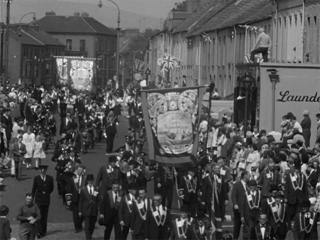
- Apprentice Boys' marches: Annual parades held by the Protestant fraternal order, the Apprentice Boys of Derry, commemorating the 1689 siege of Derry. The Catholic community often saw these marches as provocative and, during the Troubles, they were a source of tension.
- Apprentice Boys' marches: Annual parades held by the Protestant fraternal order, the Apprentice Boys of Derry, commemorating the 1689 siege of Derry. The Catholic community often saw these marches as provocative and, during the Troubles, they were a source of tension.
-
Rifle clubs: Organisations that allowed loyalists to legally obtain firearms under the guise of sports shooting. These clubs became a way for unionists to arm themselves during the Troubles, contributing to the proliferation of weapons and the potential for violence.