What is the Eucharistic Congress & Why Ireland in 1932? (Leaving Cert History): Revision Notes
📚Revision Notes
What is the Eucharistic Congress & Why Ireland in 1932?
- The Eucharistic Congress is a major international gathering of Roman Catholics focused on celebrating and deepening devotion to the Eucharist, which is the sacrament commemorating the Last Supper, where Catholics believe bread and wine become the body and blood of Christ.
- These congresses are held every few years in different countries. They typically involve Masses, processions, prayers, and theological discussions, drawing large crowds of clergy and laypeople from around the world.
- The event symbolises the unity of Catholics worldwide and their shared faith in the Eucharist.
- The decision to hold the 31st International Eucharistic Congress in Dublin, Ireland, in 1932 was significant for several reasons.
- First, 1932 marked the 1,500th anniversary of the arrival of St. Patrick in Ireland, the missionary credited with converting the Irish to Christianity.
- This milestone was an ideal opportunity to showcase Ireland's strong Catholic faith globally.
- The Congress in Dublin was also an affirmation of Ireland's identity as a predominantly Catholic nation following its independence from Britain in 1922.
- At this time, the Irish Free State was eager to solidify its domestic and international identity.
- Hosting such a prominent religious event allowed Ireland to present itself as a devout and united Catholic nation. It also strengthened the connection between Catholicism and Irish national identity, central to the Irish independence movement.
- The choice of Dublin as the venue was further influenced by the city's historical significance as the centre of Irish Catholicism and its associations with key figures in the Catholic Church.
- Moreover, the 1932 Congress provided an opportunity to heal some of the divisions that had emerged during the Irish Civil War (1922-1923).
- The event united people from across the country and from different political backgrounds in a shared expression of faith.
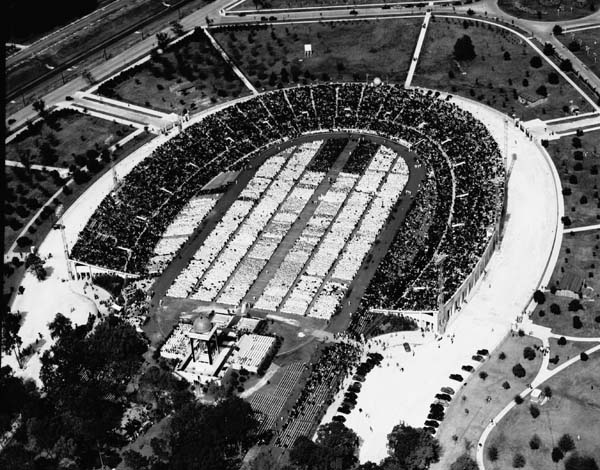
- The Congress was a huge success. Over a million people participated in the final Mass in Dublin's Phoenix Park, making it one of the largest religious gatherings in the world at that time.
- In summary, the Eucharistic Congress of 1932 was held in Ireland due to the nation's deep Catholic roots, its desire to affirm its identity as a Catholic country after independence, and the symbolic significance of the event occurring during the anniversary of St. Patrick's mission to Ireland.
- The Congress reinforced Ireland's religious and cultural identity and played a key role in unifying the country during a pivotal time in its history.