Democracy and the Constitution (Leaving Cert History): Revision Notes
📚Revision Notes
Democracy and the Constitution
De Valera and his Role in Drafting Bunreacht na hEireann
-
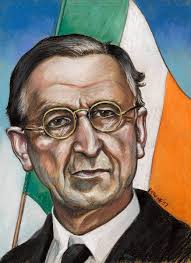
Éamon de Valera played a central role in drafting the Irish Constitution of 1937, a key document that shaped the structure and principles of modern Ireland.
-
After taking power in 1932, de Valera was determined to remove the last vestiges of British influence from Irish governance and create a constitution reflecting the values and aspirations of an independent Irish state.
-
De Valera's approach to the Constitution was deeply influenced by his desire to consolidate democracy and enshrine Ireland's sovereignty.
-
He envisioned a document that would establish a clear identity for the Irish state, independent of British legal and political traditions.
-
To achieve this, de Valera worked closely with legal experts, including John Hearne, who was the principal draughtsman, and John J. Costello, the Attorney General at the time.
-
The drafting process began in 1935 and continued for two years. De Valera took a hands-on approach, personally overseeing the development of key sections.
-
He aimed to create a constitution that balanced preserving Irish traditions with the need for modern governance.
-
De Valera's influence is evident in the Constitution's emphasis on the Irish language, Catholic social teaching, and the concept of a strong central executive.
-
One of the Constitution's most significant features was the establishment of the office of the President of Ireland as the head of state, replacing the British monarch.
-
The Constitution also created a bicameral legislature, consisting of the Dáil Éireann (House of Representatives) and Seanad Éireann (Senate), and outlined the powers of the Taoiseach (Prime Minister).
-
De Valera sought to ensure that the executive branch had sufficient power to govern effectively while maintaining democratic checks and balances.
-
The Constitution was approved by a national referendum on 1 July 1937 and came into force on 29 December 1937.
-
Its adoption marked a crucial step in Ireland's journey towards full sovereignty. The new state was now fully defined by its own laws and principles rather than by British influence.
-
With amendments, the Constitution remains in force today and is seen as one of de Valera's most enduring legacies.
Controversies Surrounding the 1937 Irish Constitution
The 1937 Irish Constitution, while a significant achievement for de Valera and the Irish state, was not without its controversies. These stemmed from various aspects of the document, particularly its definition of the state, the position of religion, the presidency, and the role of women.
- Definition of the State
- The Constitution defined the state as "Éire" in Irish and "Ireland" in English, declaring the country's status as a sovereign, independent nation.
- However, it also included a claim over the entire island of Ireland, including Northern Ireland, which was part of the United Kingdom.
- This claim was controversial, particularly in the ongoing tensions between Ireland and Britain, as it implied a territorial dispute that would remain unresolved for decades.
- Position of Religion
- Another significant controversy arose from the Constitution's treatment of religion. Article 44 recognised the Catholic Church's "special position" in Irish society, reflecting the country's overwhelmingly Catholic population.
- While other religious denominations were also acknowledged, the special status given to the Catholic Church was seen as endorsing a particular religion in the state's legal framework.
- This was controversial among non-Catholics and those who favoured a more secular state.
- Critics argued that this provision blurred the line between church and state, leading to concerns about religious freedom and the influence of the Church on public life.
- The Presidency
- The creation of the office of the President of Ireland also sparked debate. The President was given significant ceremonial powers, but the role was designed to be largely symbolic, with most executive power residing with the government and the Taoiseach.
- Some critics argued that the president's role could become too powerful or too politicised, potentially undermining the democratic balance between the branches of government.
- Role of Women
- Perhaps the most contentious issue was the Constitution's treatment of women. Article 41 recognised the family as the "natural primary and fundamental unit group of Society", and stated that women had a special role within the home.
- It emphasised that the state would ensure that mothers should not be forced by economic necessity to work outside the home to the detriment of their family duties.
- This article was criticised for reinforcing traditional gender roles and limiting women's participation in public life.
- Feminists and women's rights activists viewed this provision as regressive, arguing that it confined women to the domestic sphere and failed to recognise their broader contributions to society.