The 1933 Election and Fianna Fail's Approach to Key Policies (Leaving Cert History): Revision Notes
📚Revision Notes
The 1933 Election and Fianna Fail's Approach to Key Policies
Fianna Fáil in Power: The 1933 General Election and Its Success
-
The 1933 general election was a pivotal moment for Fianna Fáil under the leadership of Éamon de Valera.
-
Coming to power in 1932, Fianna Fáil had already begun implementing significant changes, but the 1933 election was crucial in determining whether the party could consolidate its power and continue its reform agenda.
-
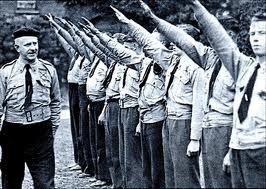
The election was held amid political tension, with Fianna Fáil facing opposition from Cumann na nGaedheal and the recently formed Blueshirts, a quasi-fascist group led by Eoin O'Duffy.
-
Fianna Fáil ran on a platform of continuing to dismantle the remaining ties to Britain established by the Anglo-Irish Treaty and furthering economic self-sufficiency through protectionist policies.
-
The party's promise to abolish the oath of allegiance to the British Crown and its handling of the land annuities dispute with Britain were central issues in the campaign.
-
De Valera's leadership and the party's clear vision for a more independent Ireland resonated with voters, especially during the economic hardships of the Great Depression.
-
In the 1933 election, Fianna Fáil increased its number of seats from 72 to 77 out of 153, solidifying its position as the dominant party in Irish politics.
-
This victory allowed de Valera to continue his policies without needing coalition support, marking the election as a significant success for Fianna Fáil.
-
The win also demonstrated widespread public support for Fianna Fáil's agenda and de Valera's leadership, setting the stage for the party's dominance in Irish politics for decades to come.
Fianna Fail: How They Consolidated Democracy and Maintained Law and Order
-
Upon taking power in 1932, Fianna Fáil faced the challenge of consolidating democracy in a country still scarred by the Civil War.
-
De Valera and his government were committed to democratic principles and worked to ensure that political power was exercised through democratic means rather than through violence.
-
One key step in consolidating democracy was the disbanding of the Blueshirts in 1933, which had posed a serious threat to democratic stability.
- The Blueshirts, who had aligned themselves with Cumann na nGaedheal, were seen as a quasi-fascist organisation, and their disbandment was crucial in maintaining law and order.
- The Blueshirts, who had aligned themselves with Cumann na nGaedheal, were seen as a quasi-fascist organisation, and their disbandment was crucial in maintaining law and order.
-
Fianna Fáil also integrated former anti-Treaty forces into the political process, offering a path for those who opposed the Anglo-Irish Treaty to engage in politics without resorting to violence.
-
This approach helped to reduce tensions and prevent the recurrence of civil conflict, allowing the government to focus on nation-building.
-
To maintain law and order, Fianna Fáil strengthened the Garda Síochána, Ireland's national police force, ensuring that it was loyal to the state and capable of enforcing the law impartially.
-
This was essential in establishing a sense of security and stability, which was crucial for the success of democratic governance.
Fianna Fail and Negotiating Anglo-Irish Relations
- One of the most significant aspects of Fianna Fáil's early years in power was its approach to Anglo-Irish relations.
- De Valera sought to redefine Ireland's relationship with Britain by dismantling the remaining vestiges of colonial control and asserting greater independence.
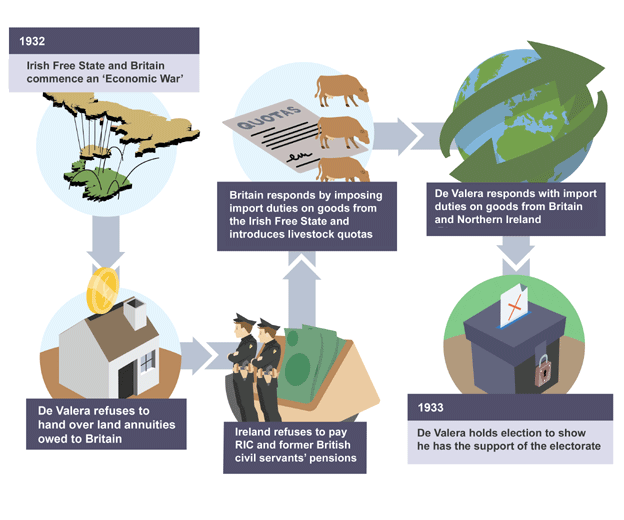
- This was particularly evident in the government's handling of the land annuities dispute. The annuities were payments made by Irish farmers to the British government, and de Valera's decision to withhold these payments sparked a major diplomatic conflict.
- The dispute led to an economic war between Ireland and Britain, with both sides imposing tariffs on each other's goods.
- While this conflict negatively impacted the Irish economy, it was popular domestically as it symbolised Ireland's determination to stand up to Britain.
- The eventual settlement of the dispute in 1938, which involved a significant reduction in the payments and the return of the Treaty Ports to Ireland, was seen as a major victory for de Valera and Fianna Fáil, further solidifying their position in Irish politics.
- Fianna Fáil's early years in power were marked by a careful balancing act of asserting Irish sovereignty while maintaining a functional relationship with Britain.
- De Valera's diplomatic strategies during this period laid the groundwork for Ireland's eventual transition to a fully sovereign republic in 1949.