The Factor Theorem (Leaving Cert Mathematics): Revision Notes
📚Revision Notes
The Factor Theorem
Note
The Factor Theorem is a fundamental result in algebra that links factors and roots of polynomials. It provides a method to determine whether a linear expression is a factor of a given polynomial.
The number of roots is proportional to the degree of the polynomial. A quadratic equation, with a degree of 2, has two roots. A cubic equation, with a degree of 3 has three roots. This is illustrated from the number of times that equations cross the -axis.
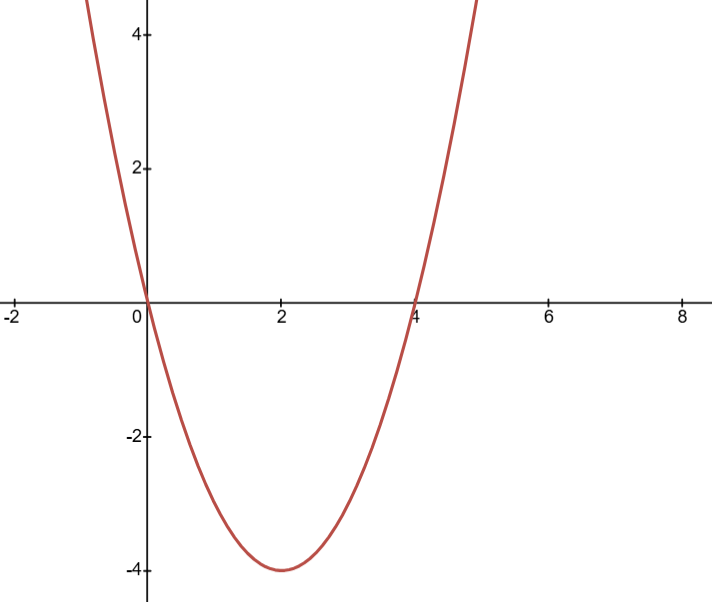
*quadratic equation *
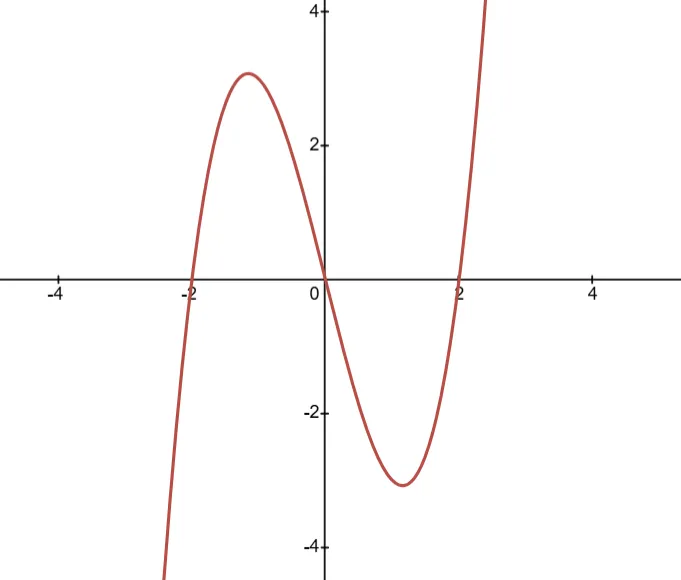
cubic equation
For a polynomial :
- If for some number , then is a factor of . The converse is true as well. Example
Note
The function is such that . Show that is a root of .
If is a root, then should equal to zero.
Therefore, is a root.
To find the other roots, we could convert the root into a factor.
If , it means that it divides evenly into .
Note
First, take the first term in your dividend () and divide by the first term in your divisor ().
This is the first term in our quotient, write on top
Multiply with all the terms in the divisor, and write below the line :
Switch the sign of these newly multiplied terms.
Add the two columns (the first column always cancels ):
The final step (in this cycle) is to bring down the first left term :
Now the process repeats, take the first term in the most recent line and divide it by the first term in the divisor (). . This is the next term in the quotient.
Multiply this term with all the terms in the divisor :
Switch signs :
Add lines :
Bring down the next term :
Final cycle, take the first term in the most recent line and divide it by the first term in the divisor (). . This is the next term in the quotient.
Multiply with all terms in the divisor :
Switch signs :
Add lines :
What is left is a remainder of 0, which makes sense since is a factor which should divide evenly into . What is left is the quotient, which can be used to derive the remaining roots.
So can also be expressed as :