Quadratic Sequences (Leaving Cert Mathematics): Revision Notes
📚Revision Notes
Quadratic Sequences
Introduction
Note
A quadratic sequence is a sequence of numbers where the second difference of every consecutive term is constant.
Consider a sequence of the first squared numbers :
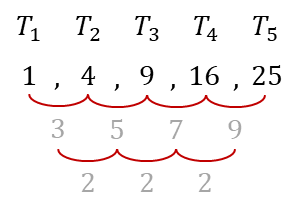
The first common difference of the sequence forms a linear (arithmetic) sequence, and the second difference is constant.
The general term of a quadratic sequence is given by :
A useful property of quadratic sequences is that the second common difference is :
Example
Note
A sequence of square formations is shown below.
- Find the general term of the total number of squares.
- Find how many squares will be contained in the 40th term of the sequence.
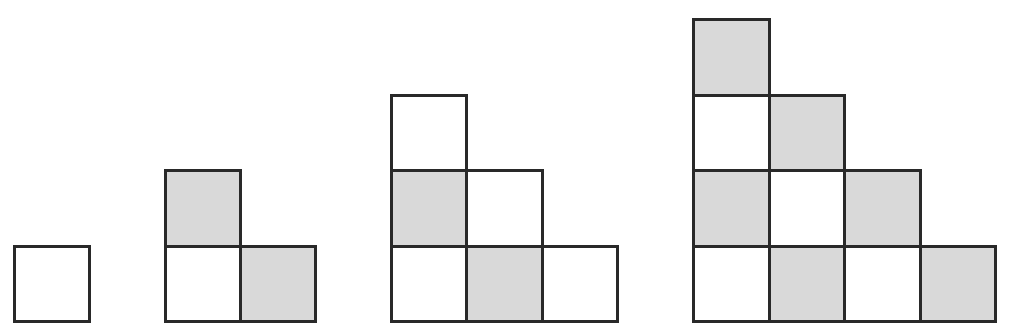
First let's list out the sequence formed by the number of squares in each term.
The first difference form a linear sequence :
The second difference is constant, hence, we know this sequence is quadratic :
Recall that the general term of a quadratic sequence is .
There are three unknown to be found, .
Since we know that the second common difference is , we can solve for , since the second common difference of any quadratic sequence is .
To solve for and we can substitute some of the terms into the general term and solve.
Since we have two equations in terms of and , we can solve simultaneously.
Refer to the algebra chapter on how to solve simultaneously.
Now we find the number of squares in the 40th term :