Problems and Graphs (Leaving Cert Mathematics): Revision Notes
📚Revision Notes
Problems and Graphs
Simultaneous equations are extremely useful for solving real-world algebraic problems. This topic combines your algebra skills with practical problem-solving, making it a popular area for exam questions.
Note
Understanding how to set up and solve simultaneous equations from word problems is a crucial skill that appears frequently in exams. The key is learning to translate real-world situations into mathematical language.
What are simultaneous equations in problems?
Simultaneous equations are systems of two or more equations that share the same variables. In practical problems, these variables represent unknown quantities we need to find, such as numbers, prices, ages, or measurements.
The key skill is translating word problems into mathematical equations, then solving them using algebraic or graphical methods.
Note
Think of simultaneous equations as a way to solve puzzles where you have multiple clues (equations) that all need to be satisfied at the same time. Each equation gives you a different piece of information about the same unknown quantities.
Setting up equations from word problems
Step-by-step approach
When approaching word problems, follow this systematic process:
- Identify the unknowns - decide what variables to use (usually x and y)
- Find two relationships - look for two different pieces of information that connect your variables
- Write the equations - translate each relationship into mathematical form
- Solve the system - use substitution, elimination, or graphical methods
- Check your answer - substitute back into the original problem
Important
Always define your variables clearly at the start. Write down what x and y represent - this prevents confusion later and helps with checking your final answer.
Example
Worked Example: The Coin Problem
James has ten-cent and twenty-cent coins in his piggy bank. He has 18 coins altogether worth €2.30. Find how many of each coin he has.
Step 1: Let = number of 10c coins, = number of 20c coins
Step 2: Set up equations from the given information
- Total coins:
- Total value: (in cents)
Step 3: Solve using elimination method
- Multiply equation 1 by 10:
- Keep equation 2:
- Subtract: , so
- Substitute back: , so
Answer: James has 13 ten-cent coins and 5 twenty-cent coins.
Graphical methods for solving simultaneous equations
Graphical solution involves drawing both equations as straight lines on a coordinate plane. The point where they intersect gives you the solution.
Key principles
Understanding the graphical approach requires knowing these fundamental concepts:
- Each linear equation creates a straight line when graphed
- The point of intersection represents the values of x and y that satisfy both equations
- If lines don't intersect, there's no solution
- If lines are identical, there are infinite solutions
Important
The intersection point is the only set of x and y values that makes both equations true simultaneously. This is why it's called the solution to the system.
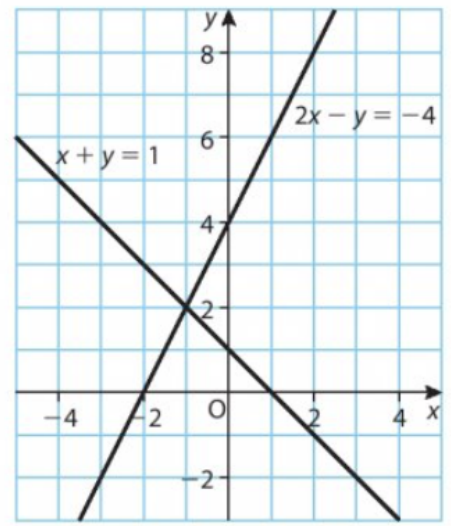
Example
Graphical Solution Example
The diagram shows the graphical solution of the system:
The lines intersect at (-1, 2), meaning and .
Advantages of graphical methods
The graphical approach offers several benefits for understanding simultaneous equations:
- Visual representation makes the solution clear
- Easy to see if equations have no solution or infinite solutions
- Useful for checking algebraic solutions
- Helps with understanding the relationship between equations
Note
While graphical methods provide excellent visual understanding, they may not always give perfectly accurate answers due to the limitations of drawing and reading coordinates. For exact answers, algebraic methods are usually preferred.
Common problem types for exams
Money and coin problems
These involve different denominations of coins or notes. The key is to set up equations based on:
- Total number of items
- Total value in money
Note
Remember to keep units consistent - work entirely in cents or entirely in euros, not a mixture of both.
Age problems
Age problems usually involve current ages and future/past ages. The important relationships to remember:
- If someone is years old now, they were years old 5 years ago
- They will be years old in 3 years
Geometry problems
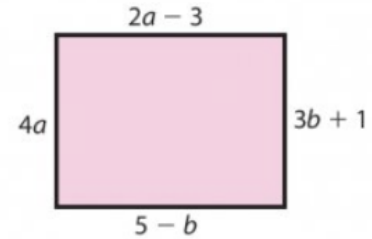
Rectangle problems often involve perimeter or area calculations. For the rectangle shown:
- Opposite sides are equal
- Perimeter =
Note
In geometry problems, draw a diagram if one isn't provided. Label all known and unknown measurements clearly to help visualise the relationships.
Mixture problems
These involve combining quantities with different properties (like different concentrations, weights, or prices).
Example
Worked Example: Cinema Tickets
Cinema tickets cost €12 for adults and €8 for children. If 1 adult and 3 children cost €36, and 2 adults and 5 children cost €64, find the individual ticket prices.
Setting up: Let = adult ticket price, = child ticket price
Equations:
Solving:
- From equation 1:
- Substitute:
- , so
- Therefore:
Answer: Adult tickets cost €12, child tickets cost €8.
Exam tips and common traps
Problem-solving strategy
Note
Effective Problem-Solving Approach:
- Read the question twice before setting up equations
- Define your variables clearly at the start
- Check units are consistent (cents vs euros, etc.)
- Always verify your answer makes sense in the original context
Common mistakes to avoid
Important
Watch Out For These Frequent Errors:
- Mixing up which variable represents which quantity
- Forgetting to convert units (especially money problems)
- Not checking that your solution satisfies both original conditions
- Misreading "more than" vs "less than" relationships
Graphical method tips
Note
For Accurate Graphical Solutions:
- Use a ruler for accurate line drawing
- Label your axes and equations clearly
- Read intersection coordinates carefully
- Check your graphical solution by substituting back into the original equations
Summary
Key Points to Remember:
- Simultaneous equations help solve real-world problems involving two unknown quantities
- Set up equations by identifying two different relationships between your variables
- Graphical solutions show the answer as the intersection point of two lines
- Always check your final answer makes sense in the original problem context
- Common exam topics include money, age, geometry, and mixture problems