Simultaneous Equations (Leaving Cert Mathematics): Revision Notes
📚Revision Notes
Simultaneous Equations
What are simultaneous equations?
Simultaneous equations are two or more equations that must be satisfied by the same values of the variables at the same time. When we have two linear equations with two unknowns (usually x and y), we need to find the values that make both equations true simultaneously.
For example, consider these equations:
Both equations are satisfied when and . We can verify this by substituting these values into both equations.
Note
The key to understanding simultaneous equations is that the same variable values must work for all equations in the system. If you have a solution where x = 2 and y = 3, these values must satisfy every equation in the system.
The elimination method
The elimination method is the primary technique for solving simultaneous equations. This method works by eliminating one variable so we can solve for the other.
Step-by-step process
- Number the equations for convenience (label them ① and ②)
- Make the coefficients equal for one variable by multiplying one or both equations
- Add or subtract the equations to eliminate that variable
- Solve the resulting equation for the remaining variable
- Substitute this value back into either original equation to find the other variable
- Verify your solution by checking both original equations
Important
The most critical step is making the coefficients equal for one variable. This often involves multiplying one or both equations by appropriate numbers. Choose the variable that requires the least manipulation to make your work easier.
Worked examples
Example
Worked Example 1: Basic elimination method
Solve: ... ① ... ②
Step 1: Make the y-coefficients equal by multiplying equation ① by 2 and equation ② by 5:
① × 2: ② × 5:
Step 2: Add the equations to eliminate y:
Step 3: Substitute into equation ①:
Solution: and
Example
Worked Example 2: Dealing with fractions
Solve: ... ① ... ②
Step 1: Eliminate fractions in equation ② by multiplying by 6 (LCM of 3 and 2): ... ②
Step 2: Make x-coefficients equal by multiplying ① by 2 and ② by -3: ① × 2: ② × -3:
Step 3: Add to eliminate x:
Step 4: Substitute into equation ①:
Solution: and
Example
Worked Example 3: Real-world application with geometry
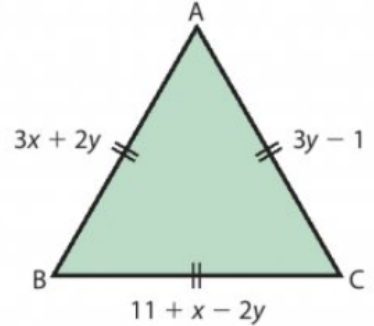
For an equilateral triangle, all sides must be equal in length. If the sides are:
- Side AB:
- Side AC:
- Side BC:
We can form simultaneous equations by setting any two sides equal: ... ① ... ②
Solving these equations will give us the values of x and y, allowing us to find the actual length of each side.
Common exam tips
Mastering simultaneous equations requires both understanding the method and avoiding common pitfalls. Here are the most important strategies for exam success:
Note
Essential Exam Strategies:
- Always verify your answer by substituting the values back into both original equations
- Clear fractions first by multiplying through by the LCM of the denominators
- Keep your work organised by numbering equations and showing each step clearly
- Check for simple arithmetic errors - these are common mistakes in exams
- Look for the easiest elimination - choose the variable that requires the least manipulation
Summary
Key Points to Remember:
- Simultaneous equations are equations that share the same solution values for their variables
- The elimination method works by making coefficients equal and then adding/subtracting to eliminate one variable
- Always verify your solution by substituting back into both original equations
- Clear fractions first to make calculations easier and reduce errors
- Real-world applications often involve setting expressions equal based on given conditions (like equal sides of an equilateral triangle)