Fundamentals of Area and Volume (Leaving Cert Mathematics): Revision Notes
📚Revision Notes
The Trapezoidal Rule
What is the trapezoidal rule?
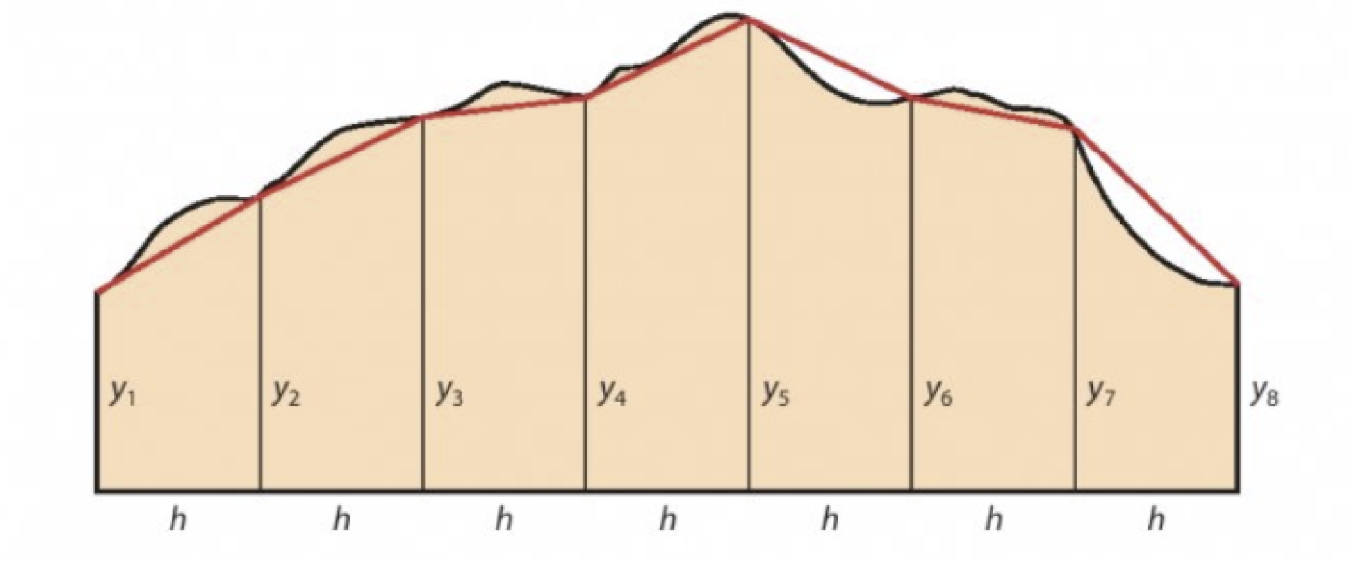
The trapezoidal rule is a mathematical method used to find the approximate area of irregular shapes. Engineers and surveyors frequently use this technique when they need to calculate areas of land parcels, plots, or regions that don't have regular geometric boundaries.
The basic principle involves dividing the irregular area into strips of equal width and then adding up the areas of individual trapeziums to find the total area. This gives us a close approximation of the actual area.
Note
The trapezoidal rule is particularly valuable in real-world applications because most land boundaries and natural shapes are irregular and cannot be calculated using standard geometric formulas.
How the method works
When we look at an irregular shape, we follow these key steps:
- Draw vertical lines to create strips of equal width
- Each strip forms a trapezium shape
- Calculate the area of each trapezium
- Add all the trapezium areas together
The sum of these trapezium areas gives us an approximation that is very close to the true area of the irregular shape.
Note
The accuracy of the trapezoidal rule improves when you use more strips (narrower widths). However, this also increases the calculation time, so there's a balance between accuracy and practicality.
Developing the formula
We start with the basic trapezium area formula:
where h is the height (width of strip) and a, b are the parallel sides.
For multiple strips, we would calculate:
This simplifies to:
The trapezoidal rule formula
Important
The Complete Trapezoidal Rule Formula:
Where:
- h = width of each strip
- First height = the first measurement (y₁)
- Last height = the final measurement (yₙ)
- Remaining heights = all the middle measurements
Key terminology
The vertical measurements in the trapezoidal rule are called offsets or ordinates.
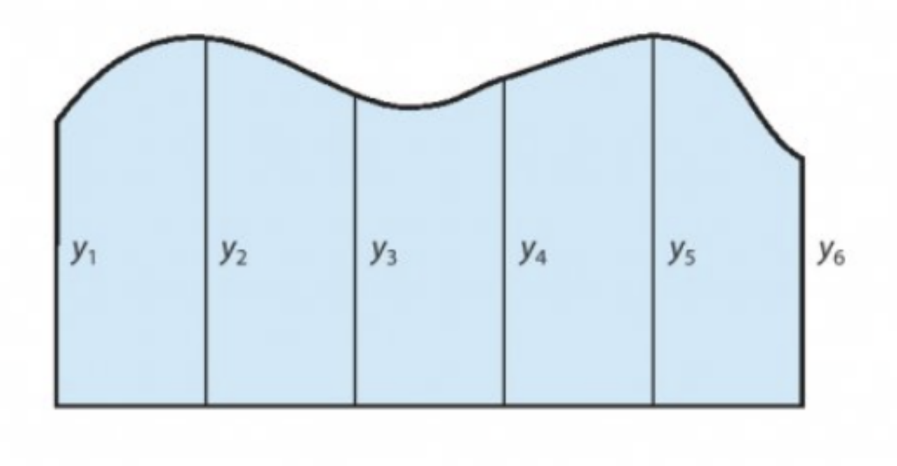
- First ordinate: y₁ (the starting measurement)
- Last ordinate: yₙ (the ending measurement)
- Middle/remaining ordinates: y₂, y₃, y₄, etc. (all measurements in between)
Important
Critical Relationship: For n strips, you need (n + 1) ordinates.
For example:
- 5 strips require 6 ordinates
- 6 strips need 7 ordinates
This is a common source of errors in exams - always count your ordinates carefully!
Worked examples
Example 1: Land area calculation
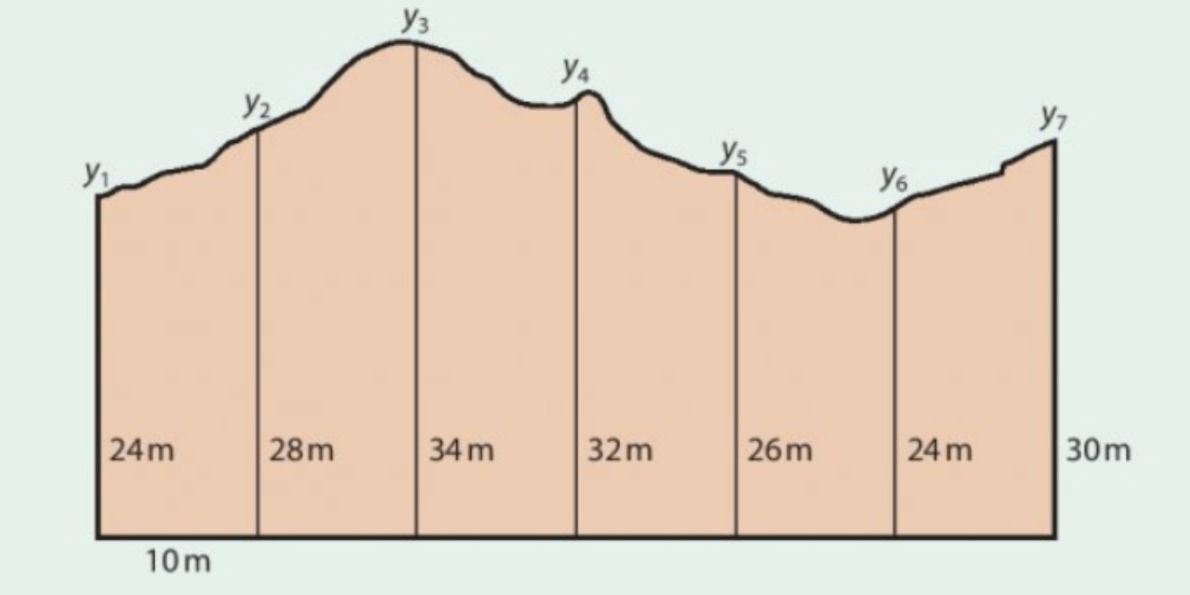
Find the area of an irregular plot where each strip is 10m wide and the ordinate lengths are: 24m, 28m, 34m, 32m, 26m, 24m, 30m.
Example
Worked Example: Land Area Calculation
Given:
- Strip width (h) = 10m
- Ordinates: y₁ = 24, y₂ = 28, y₃ = 34, y₄ = 32, y₅ = 26, y₆ = 24, y₇ = 30
Step 1: Identify the components
- First ordinate = 24m
- Last ordinate = 30m
- Middle ordinates = 28, 34, 32, 26, 24
Step 2: Apply the trapezoidal rule formula
Step 3: Calculate the middle ordinates sum
Step 4: Complete the calculation
Answer: 1710 m²
Example 2: Area under a curve with percentage error
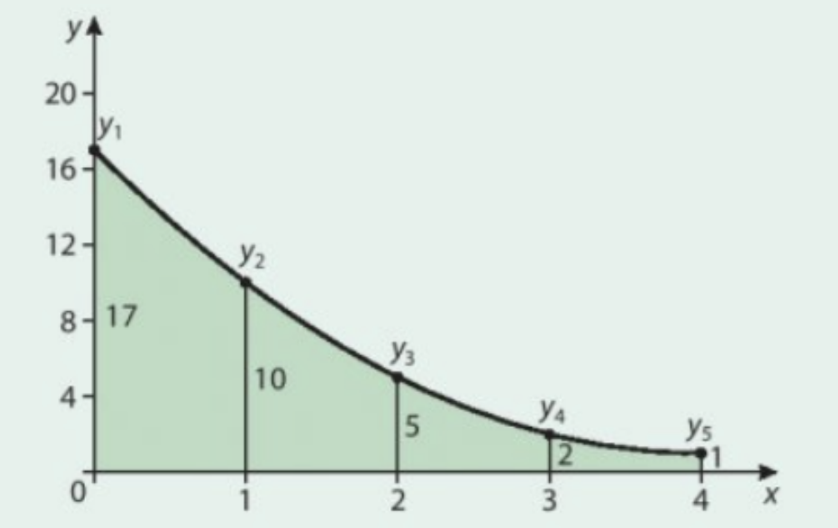
Find the area under the curve f(x) = x² - 8x + 17 from x = 0 to x = 4, using strips of width 1 unit.
Example
Worked Example: Area Under Curve with Error Analysis
Step 1: Calculate the ordinates
- f(0) = 0² - 8(0) + 17 = 17
- f(1) = 1² - 8(1) + 17 = 10
- f(2) = 2² - 8(2) + 17 = 5
- f(3) = 3² - 8(3) + 17 = 2
- f(4) = 4² - 8(4) + 17 = 1
Step 2: Apply the trapezoidal rule
- First ordinate = 17
- Last ordinate = 1
- Middle ordinates = 10, 5, 2
Step 3: Calculate percentage error If the exact area is 25½ square units:
- Error = 26 - 25½ = ½
- Percentage error =
Answer: 26 square units with 2.63% error
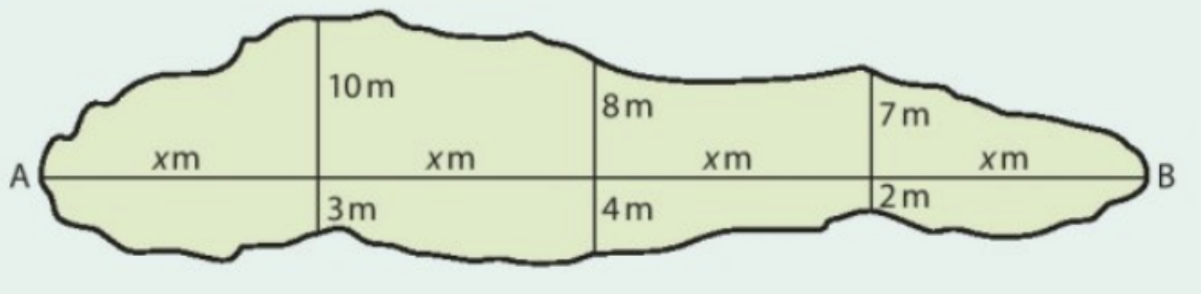
Example 3: Finding strip width
A surveyor estimates a plot area to be 612 m² using the trapezoidal rule. The ordinates are 0, 13, 12, 9, 0 metres. Find the strip width.
Example
Worked Example: Finding Unknown Strip Width
Given:
- Total area = 612 m²
- Ordinates = 0, 13, 12, 9, 0 metres
- Strip width = x (unknown)
Step 1: Identify the ordinates
- First ordinate = 0
- Last ordinate = 0
- Middle ordinates = 13, 12, 9
Step 2: Set up the equation
Step 3: Simplify
Step 4: Solve for x
Answer: Strip width = 18 metres
Special cases
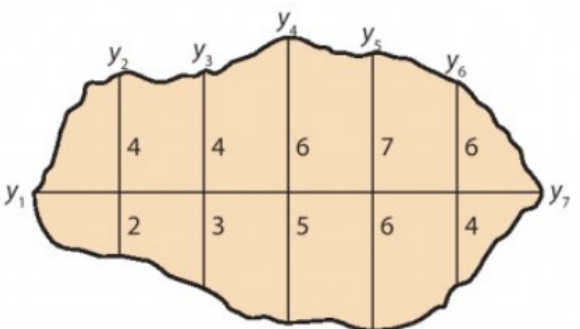
When dealing with shapes that extend both above and below a horizontal baseline, we add the ordinates above and below the line at each measurement point.
Note
Handling Measurements Above and Below Baseline
For example, if at one position we have measurements of 4m above and 2m below the baseline, the total ordinate = 4 + 2 = 6m.
This technique is commonly used in road construction and earthwork calculations where you need to account for cuts and fills.
Exam tips
Here are essential strategies for exam success with trapezoidal rule problems:
- Always identify the first and last ordinates clearly
- Remember that the middle ordinates are multiplied by 2
- Check your arithmetic carefully - small errors multiply through the calculation
- When calculating percentage error:
- Units are crucial - make sure your final answer has the correct units (usually m² for area)
Summary
Key Points to Remember:
- The trapezoidal rule gives an approximation of area, not the exact value
- The formula structure is: h/2 × [first + last + 2(middle ordinates)]
- For n strips, you need (n + 1) ordinates
- Always double-check which measurements are first, last, and middle ordinates
- The method works for any irregular shape by dividing it into equal-width strips
- Greater accuracy is achieved with more strips (narrower widths)