Cylinders and Spheres (Leaving Cert Mathematics): Revision Notes
📚Revision Notes
Cylinders and Spheres
Understanding cylinders and spheres is essential for calculating volumes and surface areas of common 3D shapes. These shapes appear frequently in Leaving Cert exams, so mastering their formulas and applications is crucial for success.
Note
This topic combines geometric understanding with algebraic manipulation, making it a favourite for exam questions that test both conceptual knowledge and mathematical skills.
What are cylinders, spheres and hemispheres?
A cylinder is a 3D shape with two parallel circular bases connected by a curved surface. Think of a tin can or a toilet roll tube. A sphere is a perfectly round 3D shape where every point on the surface is the same distance from the centre. A tennis ball or basketball are good examples. A hemisphere is exactly half of a sphere, like a bowl turned upside down.
These three shapes have specific formulas for calculating their volumes and surface areas, which you need to memorise and know how to apply in various contexts.
Cylinder formulas and calculations
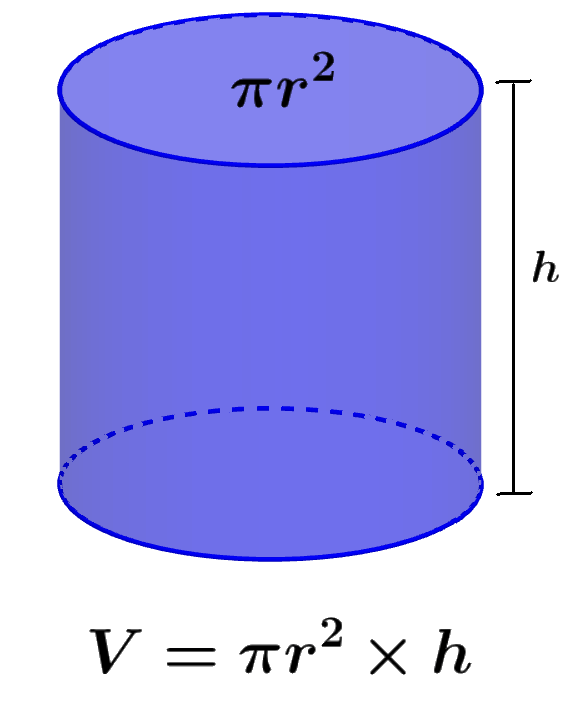
A cylinder has several important measurements you need to understand. The radius (r) is the distance from the centre of the circular base to its edge. The height (h) is the distance between the two circular bases.
Volume of a cylinder
The volume formula tells us how much space is inside the cylinder:
This makes sense because we're taking the area of the circular base () and multiplying by the height to fill the entire cylinder.
Surface area of a cylinder
There are two types of surface area for cylinders:
Curved surface area =
This is just the area of the curved side when you "unwrap" it into a rectangle. The width of this rectangle is the circumference of the circle () and the height is .
Total surface area =
This includes both circular bases plus the curved surface. We can write it as , which factors to .
Important
Essential Cylinder Formulas:
- Volume:
- Curved surface area:
- Total surface area:
These formulas form the foundation for most cylinder-related exam questions.
Sphere formulas and calculations
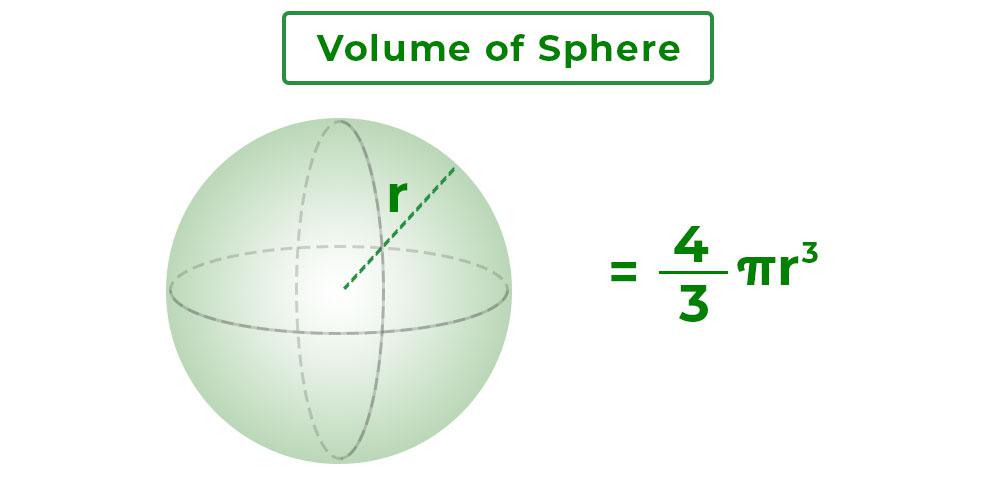
A sphere only needs one measurement - its radius (r), which is the distance from the centre to any point on the surface.
Volume of a sphere
This fraction is crucial to remember. Many students forget it in exams.
Surface area of a sphere
Notice this is exactly 4 times the area of a circle with the same radius. This is a useful way to remember the formula.
Hemisphere formulas and calculations
Since a hemisphere is exactly half a sphere, its volume is half that of a full sphere. However, the surface area calculation is more complex because we need to include the flat circular base.
Volume of a hemisphere
This is exactly half the volume of a sphere:
Surface area of a hemisphere
This includes the curved surface (which is half of ) plus the flat circular base (). So total = .
Note
The hemisphere's surface area is not simply half the sphere's surface area because we must include the additional flat circular base that's created when we cut the sphere in half.
Worked examples
Example
Worked Example 1: Basic cylinder calculations
Find the volume and total surface area of a cylinder with radius 5cm and height 12cm.
Volume calculation:
- Volume =
- Volume =
- Volume =
- Volume = cm³
Total surface area calculation:
- Total surface area =
- Total surface area =
- Total surface area =
- Total surface area = cm²
Example
Worked Example 2: Finding radius from volume
A cylinder has volume 15840 cm³ and height 35cm. Find the radius.
Step-by-step solution:
- Start with volume formula: Volume =
- Substitute known values:
- Rearrange to find :
- Calculate:
- Take square root: cm
Example
Worked Example 3: Equal volumes problem
A sphere of radius 4cm is dropped into a cylinder of radius 8cm partly filled with water. When completely submerged, the water level rises by h cm. Find h.
This is an equal volumes problem. The volume of water displaced equals the volume of the sphere.
Solution:
- Volume of sphere =
- Volume of displaced water =
- Set them equal:
- Divide both sides by :
- Simplify:
- Solve for h: cm
Equal volumes concept
When shapes have equal volumes, we can set their volume formulas equal to solve for unknown dimensions. This concept is particularly useful for several types of problems:
- Liquid displacement: When a solid object is immersed in liquid, the volume of displaced water equals the volume of the object
- Container problems: When liquid is poured from one container to another, the volume remains constant
- Comparative problems: Finding relationships between different shaped objects with the same capacity
Note
Important exam tip: When both sides of an equation contain , you can divide both sides by to simplify the calculation. This eliminates the need to substitute a numerical value for and makes the arithmetic much cleaner.
The key insight is recognising that volume is conserved - it doesn't matter what shape contains the liquid or object, the amount of space occupied remains the same.
Common exam mistakes and tips
Important
Critical Mistakes to Avoid:
- Don't forget the in sphere volume - this is the most common error that costs students marks
- Check whether you need curved or total surface area - read the question carefully as they test different concepts
- Remember hemisphere surface area includes the flat base - it's not just half the sphere's surface area
- Show all working clearly - partial marks are available for correct method even with arithmetic errors
Success Strategies:
- When appears on both sides, cancel it out - this simplifies calculations significantly
- Keep answers in terms of unless asked for decimal approximation - this is usually more accurate
- Double-check your formula before substituting values - getting the wrong formula means losing most marks
Summary
Key Points to Remember:
- Cylinder volume: (area of base × height)
- Sphere volume: (remember that crucial !)
- Hemisphere volume: (exactly half the sphere)
- Equal volumes problems: Set volume formulas equal and solve for unknowns
- When is on both sides of an equation, it cancels out completely
- Surface area of hemisphere: (includes the flat circular base)