Trapezoidal Rule (Leaving Cert Mathematics): Revision Notes
📚Revision Notes
Trapezoidal Rule
What is the Trapezoidal Rule?
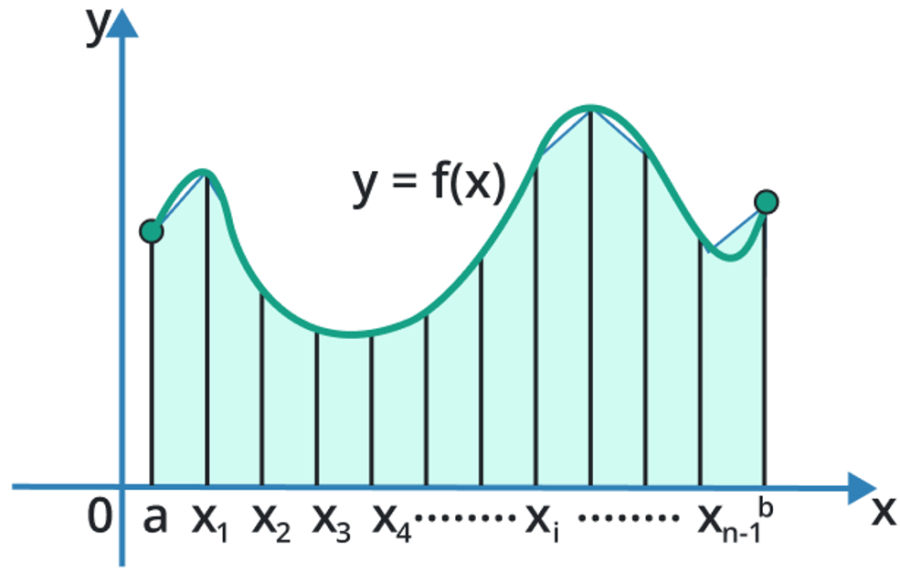
The Trapezoidal Rule is a method to approximate the area under a curve or the integral of a function. It works by dividing the area under the curve into a series of trapezoids and summing their areas. This is particularly useful for irregular shapes or when the function cannot be integrated easily.
Formula for the Trapezoidal Rule
For a curve described by a function between and , divided into n equal intervals:
where:
- h = \frac{b - a}{n} is the width of each interval.
- are the points of division.
A common way to remember this is: first + last + 2(sum of the rest), all multiplied by .
Steps to Use the Trapezoidal Rule
- Divide the Interval: Split the range into n equal parts.
- Calculate Heights: Evaluate the function at each division point
- Apply the Formula: Use the formula to approximate the area by summing the contributions of each trapezoid.
Worked Examples
Note
Example 1: Approximating an Area
Problem: Approximate the integral using the Trapezoidal Rule with n = 4
Solution: Step 1: Divide the interval into parts:
Step 2: Calculate function values:
Step 3: Apply the formula:
Answer: The approximate area is 22
Note
Example 2: Approximating
Problem: Approximate the area under from to with n = 2
Solution: Step 1: Divide the interval:
Step 2: Calculate function values:
Step 3: Apply the formula:
Answer: The approximate area is 6.7
Summary
- Purpose: Approximate areas under curves or integrals.
- Formula:
- Key Steps:
- Divide the range into equal parts.
- Compute function values at these points.
- Sum contributions using the trapezoidal formula.
- Suitable for approximations when exact integration is difficult.