Writing Complex Numbers in Polar Form (Leaving Cert Mathematics): Revision Notes
📚Revision Notes
Writing Complex Numbers in Polar Form
Introduction
The polar form of a complex number represents it in terms of its magnitude (modulus) and angle (argument) with respect to the origin in the complex plane. This form provides a geometric interpretation of complex numbers and is especially useful for multiplication, division, and exponentiation.
A complex number can be written as
where
Example
Note
Express in Polar form
First, it's always best to make a rough sketch of the complex number on the Argand diagram.
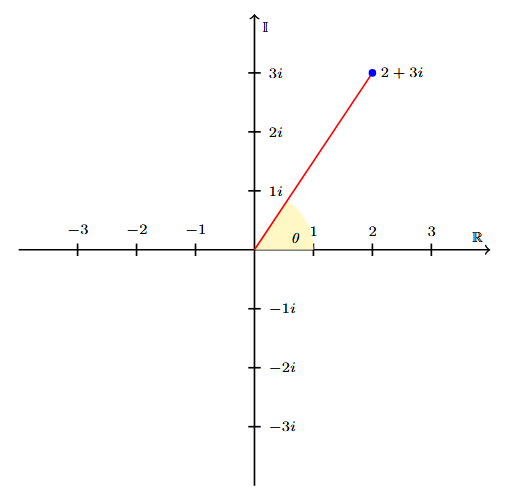
The modulus is the length of the red line and is the angle that the complex number makes with the real axis.
First, let's derive the modulus :
Next, find the value of , which can be found using basic trigonometry. Notice that the plotted complex number outlines a right-angled triangle.
Write in polar form :
The value of will depend on the quadrant that the complex number is in :
- For quadrant 1 :
- For quadrant 2 :
- For quadrant 3 :
- For quadrant 4 :
For radians :
- For quadrant 1 :
- For quadrant 2 :
- For quadrant 3 :
- For quadrant 4 :
Example
Note
Express in Polar form
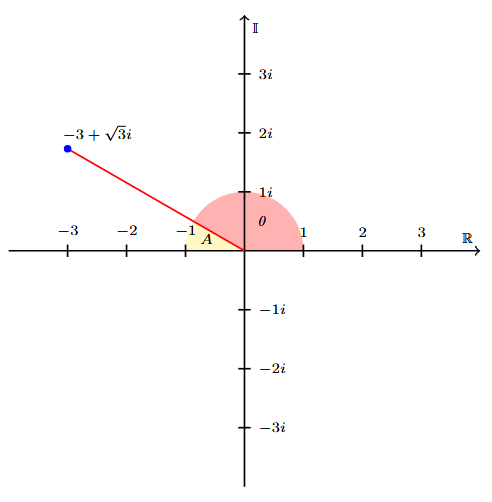
Derive the modulus :
Next, find the value of , which can be found using basic trigonometry. Notice that the plotted complex number outlines a right-angled triangle.
Since lies in the second quadrant, is derived as :