Complex Numbers and Transformations (Leaving Cert Mathematics): Revision Notes
📚Revision Notes
Complex Numbers and Transformations
Complex numbers can be transformed in various ways using mathematical operations. These transformations create predictable geometric changes when we represent complex numbers on the Argand diagram. Understanding these transformations helps us visualise how operations affect complex numbers graphically.
Multiplying complex numbers by real numbers (scaling)
When you multiply a complex number by a real number, you create a scaling transformation. This means the complex number gets larger or smaller while maintaining its direction from the origin.
Note
Key rule: If and you multiply by real number , then:
- Both the real part and imaginary part are multiplied by the same factor
How scaling affects the modulus
The modulus (distance from origin) changes in a predictable way:
Important
- If is the modulus of , then
- When , the modulus doubles
- When , the modulus triples
- When , the modulus halves
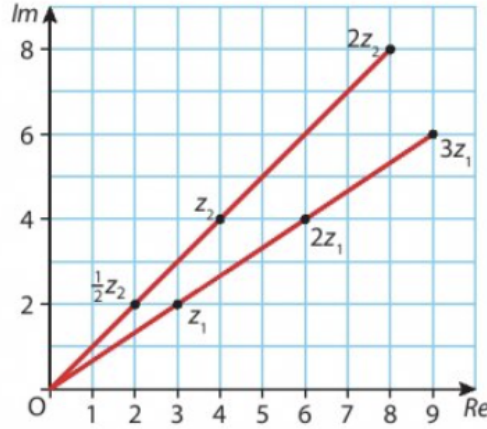
The diagram above shows how multiplying and by different real numbers creates vectors along the same direction but with different lengths.
Example
Worked Example: Scaling a Complex Number
If :
Notice how all three points lie on the same straight line through the origin.
Adding the same complex number (translation)
When you add the same complex number to different complex numbers, you create a translation. This moves all points the same distance in the same direction.
Note
Key rule: Adding complex number to any complex number results in:
- moves by distance horizontally and vertically
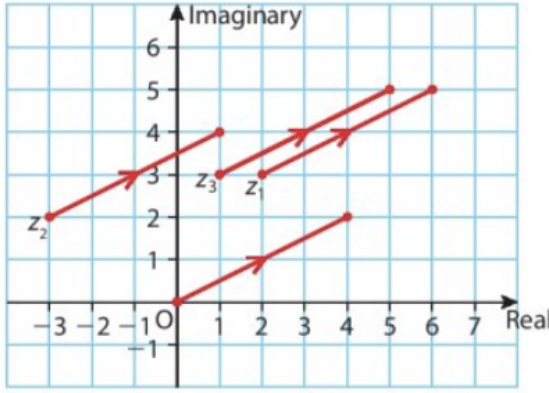
The diagram shows what happens when we add to several different complex numbers. Each original point moves exactly 4 units right and 2 units up.
Translation properties:
- All points move the same distance
- All points move in the same direction
- The shape and size of any figure remains unchanged
- Only the position changes
Multiplying complex numbers by i (rotation)
Multiplying a complex number by i creates a rotation of 90° anticlockwise around the origin. This is one of the most important transformations in complex number theory.
Important
Key rotation rules:
- rotates through 90° anticlockwise
- rotates through 180°
- rotates through 270° anticlockwise
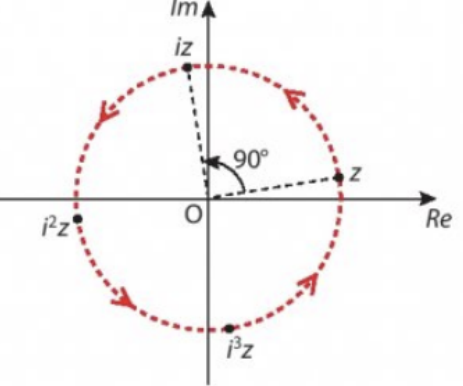
The circular diagram shows how successive multiplications by create quarter-turn rotations around the origin.
Working with powers of i
Remember these essential relationships:
Note
- (back to the start)
Example
Worked Example: Rotating with Powers of i
If :
Worked example
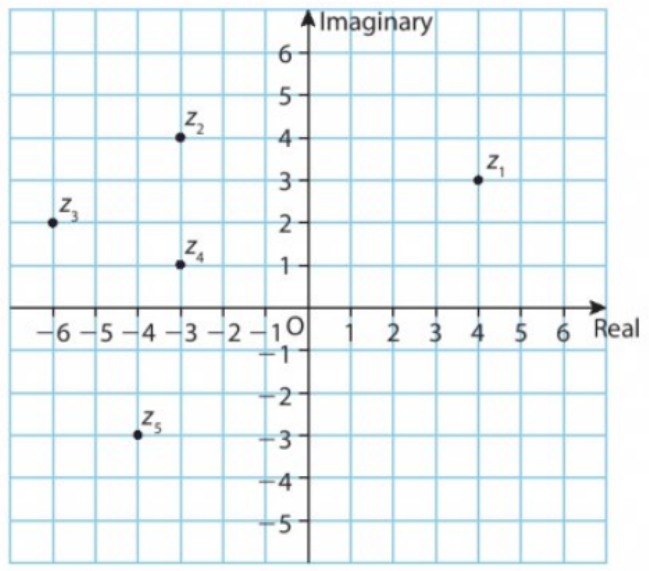
Let's work through a complete example using an Argand diagram.
Example
Complete Worked Example: Complex Number Transformations
From the diagram, we can read the coordinates:
Part (i): If , find .
Since and :
Comparing coefficients:
- Real parts: , so
- Imaginary parts: , so
Therefore, .
Part (ii): If , find .
Since and :
Exam tips
Summary
Key Study Tips:
- Always plot carefully: Use graph paper or a ruler to ensure accuracy when plotting complex numbers
- Check your scaling: When multiplying by real numbers, verify that all points lie on straight lines through the origin
- Rotation memory aid: Think "i = 90° anticlockwise" - this helps remember the rotation direction
- Translation check: When adding complex numbers, verify that all points move the same distance in the same direction
Key formulas to memorise
Important
Essential Formulas:
- Scaling: where is real
- Rotation by i: rotates by anticlockwise
- Powers of i: , , ,
Remember!
Summary
Key Points to Remember:
- Scaling transformations multiply both real and imaginary parts by the same factor and change the distance from the origin proportionally
- Translation transformations add the same complex number to all points, moving everything the same distance in the same direction
- Rotation by i turns complex numbers 90° anticlockwise around the origin each time
- All transformations preserve the fundamental relationships between complex numbers while changing their positions
- The Argand diagram is essential for visualising these transformations clearly