Number Systems (Leaving Cert Mathematics): Revision Notes
📚Revision Notes
Number Systems
What are number systems?
Number systems are different collections of numbers that mathematicians use to solve various types of problems. As you progress through mathematics, you discover that some equations require different types of numbers for their solutions. Understanding these number systems forms the foundation for working with complex numbers.
Note
Understanding number systems is crucial because it explains why certain mathematical problems require specific types of numbers for their solutions. This knowledge becomes essential when working with more advanced mathematical concepts.
Natural numbers (N)
Natural numbers are the positive counting numbers that we use in everyday life.
Definition:
These are the numbers you naturally use when counting objects. Natural numbers do not include zero or negative numbers.
Examples: 1, 7, 25, 100, 1000
Note
The exclusion of zero from natural numbers is important to remember, as this distinguishes them from whole numbers in some mathematical contexts.
Integers (Z)
Integers extend natural numbers to include zero and negative numbers.
Definition:
Integers allow us to solve equations like , which has the solution . This solution cannot be found within natural numbers alone.
Examples: -5, -1, 0, 3, 42
Rational numbers (Q)
Rational numbers are numbers that can be expressed as fractions.
Definition: Rational numbers are numbers that can be written in the form where and .
Rational numbers include all integers (since any integer can be written as ), all terminating decimals, and all recurring decimals.
Examples: , , , 0.5, 0.333..., 2.4
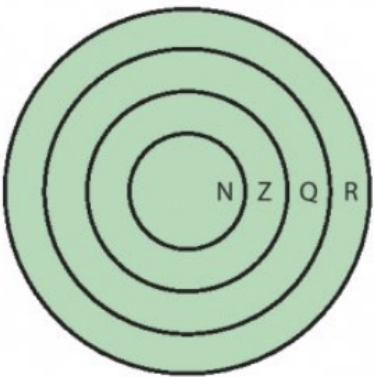
The diagram above shows how these number systems relate to each other. Natural numbers are contained within integers, which are contained within rational numbers.
Converting decimals to fractions
Terminating decimals can be easily converted to fractions by considering their place value.
Example
Worked Example 1: Converting Terminating Decimals
Convert 5.2 to a fraction:
Recurring decimals require a special algebraic method.
Example
Worked Example 2: Converting Recurring Decimals
Convert 0.3333... to a fraction:
- Let
- Multiply by 10:
- Subtract the original:
- Simplify:
- Therefore:
Example
Worked Example 3: Square Root Rationality
Show that is rational:
- Since this can be written as where and , it is rational.
Irrational numbers
Irrational numbers are numbers that cannot be expressed as fractions.
When we try to solve equations like , we get . Using a calculator, . This is a non-terminating, non-repeating decimal that cannot be written as a fraction, making it irrational.
Examples of irrational numbers:
- , , (but not or )
- (note: is just an approximation)
Important
Exam tip: Not all square roots are irrational. Always check if the number under the square root is a perfect square before classifying as irrational.
Real numbers (R)
Real numbers include all the number types we have studied so far.
Definition: Real numbers are the combination of all rational and irrational numbers.
The set of real numbers is denoted by the letter R. Every point on the number line corresponds to a real number.
The complete relationship:
This means:
- All natural numbers are integers
- All integers are rational numbers
- All rational numbers are real numbers
Identifying number types
To determine what type of number you're dealing with, follow this systematic approach:
- Check if it's a natural number: Is it a positive counting number?
- Check if it's an integer: Does it include zero or negatives?
- Check if it's rational: Can it be written as a fraction ?
- If not rational, it's irrational
Example
Worked Example 4: Classification Through Equation Solving
Solve these equations and identify the number type needed:
- (i) (natural number)
- (ii) (integer)
- (iii) (rational number)
Exam tips
Important
Essential Exam Guidelines:
- Set notation: The symbol means "is an element of" or "belongs to"
- Common mistake: Remember that all integers are rational numbers (they can be written as )
- Recurring decimals: Always convert these to fractions using the algebraic method shown above
- Square roots: Check if the number under the root is a perfect square before classifying as irrational
Remember!
Summary
Key Points to Remember:
- Natural numbers (N): Positive counting numbers {1, 2, 3, ...}
- Integers (Z): Include negatives and zero {..., -1, 0, 1, 2, ...}
- Rational numbers (Q): Can be written as fractions , include all terminating and recurring decimals
- Irrational numbers: Cannot be written as fractions, have non-terminating, non-repeating decimal forms
- Real numbers (R): Include all rational and irrational numbers, representing every point on the number line