Definition (Leaving Cert Mathematics): Revision Notes
📚Revision Notes
Definition
Introduction
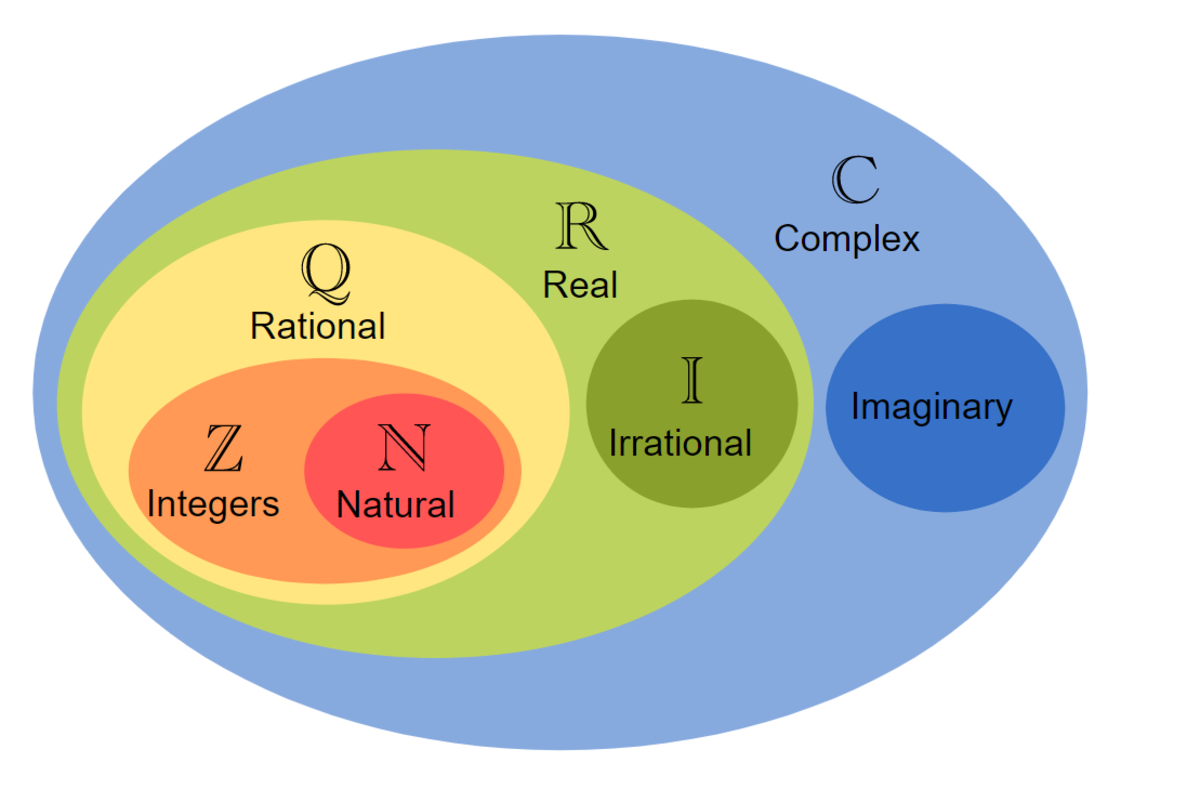
Imaginary numbers are an extension of the real number system and are the foundation of the field of complex numbers. They arise from the need to solve certain equations, particularly those involving square roots of negative numbers, which have no solutions in the real numbers.
Consider the equation : . No such solution exists in the real numbers i.e. you need two identical numbers such that their product is . Euler, assumed that there is such as solution, and gave it the name .
Note
An imaginary number is defined as the number where :
- is a real number.
- is the imaginary unit, defined as .
Note
An complex number is defined as the number
- are real numbers.
- is the imaginary unit, defined as .
Note
An imaginary number is just a special case of a complex number where
Note
A real number is just a special case of a complex number where
Example
Note
Simplify and rewrite the following expression as a complex number :
Recall the property of surds : .
Write in the form :
Example
Note
Simplify and rewrite the following expression as a complex number :
Associate real components with imaginary components :
Factor out so its in the form :
Powers of an Imaginary Number
Let's take incremental powers of an imaginary number and see what happens :
- If we keep taking incremental powers we end up with the sequence which repeats. This is very useful as it allows us to quickly derive high powers of .
Example
Note
Evaluate
Use indices rules to your advantage :
Evaluate