Differentiating Expressions (Leaving Cert Mathematics): Revision Notes
📚Revision Notes
Differentiating Expressions
Introduction
Differentiation is a fundamental concept in calculus that deals with the rate at which a function changes. It is the process of finding the derivative of a function, which represents the slope of the function's graph at any given point.
If is a function, the is the derivative of that expression.
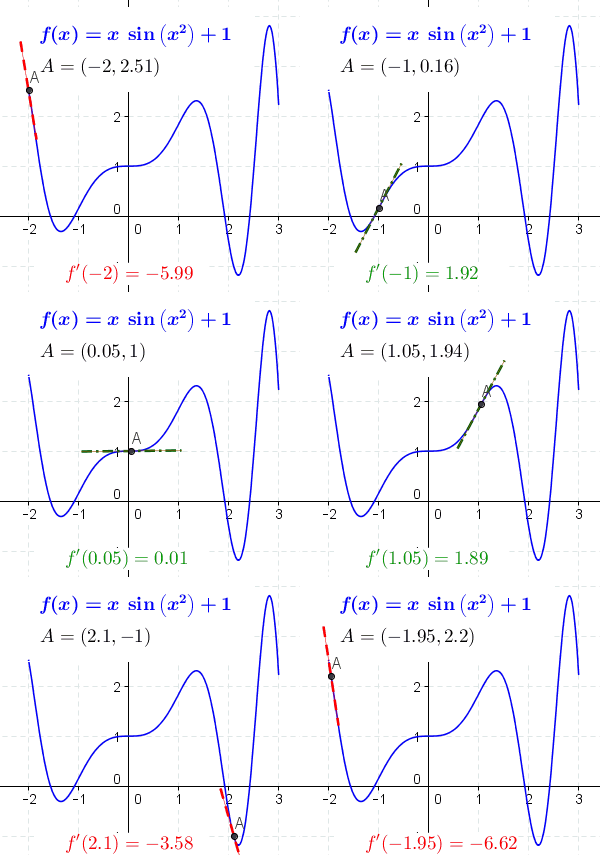
The following animation represents the different points of the first derivative of the function . At steep regions, the slope is also steep, and at shallow or flat regions, the slope is also shallow or flat.
Differentiating by Terms
The simplest form of differentiation is differentiating term by term. Informally, we multiply the power of that term with the coefficient and subtract from the power. In general :
Example
Note
Differentiate
Example
Note
Differentiate
Example
Note
Differentiate
For polynomial expressions with multiple terms, differentiate each term separately.
Note
The derivative of a constant is . Why ?, If :
Then you can rewrite the expression as :
Differentiate :
Example
Note
Differentiate
When possible, try to rewrite the expression in index form. We can use indices rules :
While not wrong, it's typically bad practice to have negative powers. Convert back to index form.
Example
Note