Fundamentals of Calculus (Leaving Cert Mathematics): Revision Notes
📚Revision Notes
Maximum and Minimum Turning Points
What are turning points?
Turning points are special locations on a curve where the function changes from increasing to decreasing, or vice versa. At these points, the tangent to the curve is horizontal, meaning it has zero slope.
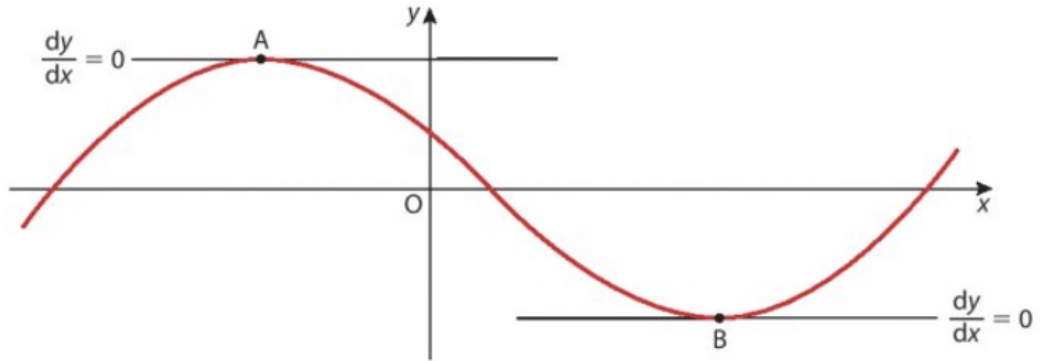
At points A and B shown above, the tangent lines are parallel to the x-axis, which means their slope equals zero. Point A represents a maximum turning point (or local maximum), while point B represents a minimum turning point (or local minimum).
Important
The key mathematical fact to remember:
At any turning point on a curve,
Finding turning points step-by-step
To locate the turning points of any function, follow this systematic approach:
Step 1: Find the first derivative
Step 2: Set and solve this equation to find the x-values
Step 3: Substitute these x-values back into the original function to find the corresponding y-values
Step 4: If there are multiple turning points, the one with the higher y-value is the maximum, and the one with the lower y-value is the minimum
Worked example 1: Finding a minimum turning point
Example
Worked Example: Finding a Minimum Turning Point
Let's find the turning point of .
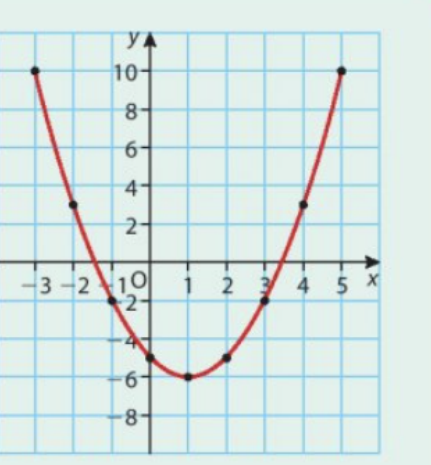
Step 1: Find the derivative
Step 2: Set the derivative equal to zero
Step 3: Find the y-coordinate When :
Therefore, the minimum turning point is
Worked example 2: Multiple turning points
Example
Worked Example: Finding Multiple Turning Points
Find the coordinates of the local maximum and minimum of .
Step 1: Find
Step 2: Set (dividing by 3) Therefore: and
Step 3: Find y-coordinates When : When :
Step 4: Identify which is maximum and minimum Since is higher than :
- is the maximum turning point
- is the minimum turning point
The second derivative test
The second derivative helps us determine whether a turning point is a maximum or minimum without needing to compare y-values.
For any function :
- The first derivative is or
- The second derivative is or
Important
The Second Derivative Test:
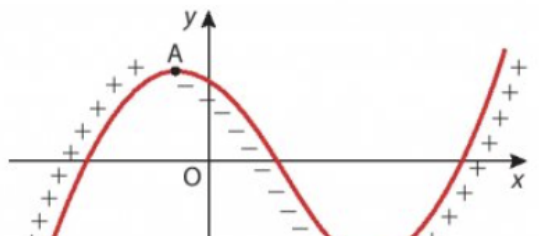
At a maximum turning point: and (negative)
At a minimum turning point: and (positive)
Note
Memory Aid: Think of it this way: at a maximum, the curve is "frowning" (∩ shape), so the second derivative is negative. At a minimum, the curve is "smiling" (∪ shape), so the second derivative is positive.
Worked example 3: Using the second derivative test
Example
Worked Example: Using the Second Derivative Test
Find the turning points of and determine their nature.
Step 1: Find the first derivative
Step 2: Find turning points Therefore: or
Step 3: Find y-coordinates When : → Point When : → Point
Step 4: Find the second derivative
Step 5: Apply the second derivative test At : (negative) Since the second derivative is negative, is a maximum turning point
At : (positive) Since the second derivative is positive, is a minimum turning point
Special case: Quadratic functions
Note
Quadratic Functions Special Case
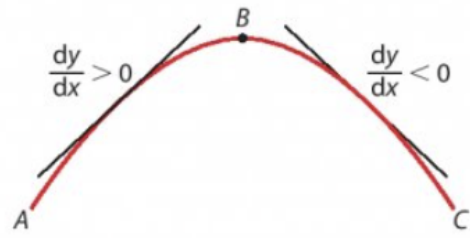
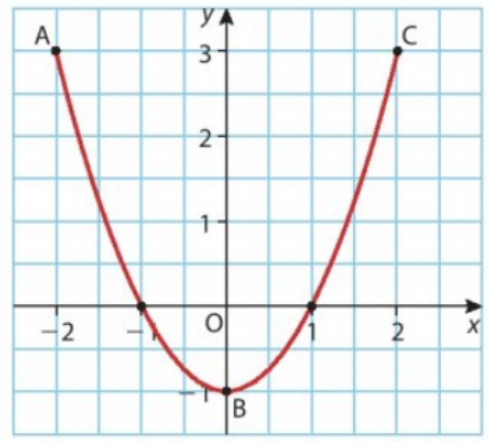
Quadratic functions of the form have exactly one turning point.
Important rule:
- If : the parabola opens upward (∪), so it has a minimum turning point
- If : the parabola opens downward (∩), so it has a maximum turning point
Increasing and decreasing functions
Understanding when a function increases or decreases is closely related to turning points.
When a curve is increasing: (positive slope)
When a curve is decreasing: (negative slope)
Example
Worked Example: Finding Where a Function Increases
For what values of x is the curve increasing?
Step 1: Find the derivative
Step 2: For the curve to be increasing, we need
Therefore, the curve is increasing when
Key formulas summary
| Concept | Formula | Meaning |
|---|---|---|
| Turning point condition | Slope is zero | |
| Maximum test | Second derivative negative | |
| Minimum test | Second derivative positive | |
| Increasing function | Positive slope | |
| Decreasing function | Negative slope |
Summary
Key Points to Remember:
- Turning points occur where - this is the fundamental condition
- Use the second derivative test to determine if a point is maximum () or minimum ()
- Quadratic functions () have one turning point: minimum if , maximum if
- The function increases when and decreases when
- Always substitute x-values back into the original function to find the complete coordinates of turning points