The Slope of a Curve (Leaving Cert Mathematics): Revision Notes
📚Revision Notes
The Slope of a Curve
Introduction - connecting slope to real-world situations
Understanding slope isn't just about abstract mathematics. In real life, we encounter slopes constantly when looking at rates of change. For example, when studying a distance-time graph, the slope of any section tells us the speed or rate of change of distance with respect to time.
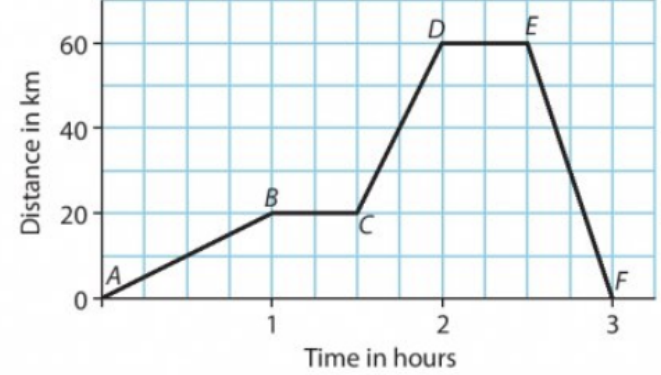
Looking at this graph, each section has a different slope, representing different speeds throughout the journey. This concept of changing slopes leads us naturally into understanding how the slope of a curve works.
What is the slope of a curve?
Unlike a straight line which has a constant slope, the slope of a curve changes at different points along the curve. This is because curves bend and change direction.
Important
Definition: The slope of a curve at any point is defined as the slope of the tangent line at that point.
A tangent line is a straight line that touches the curve at exactly one point and has the same slope as the curve at that point.
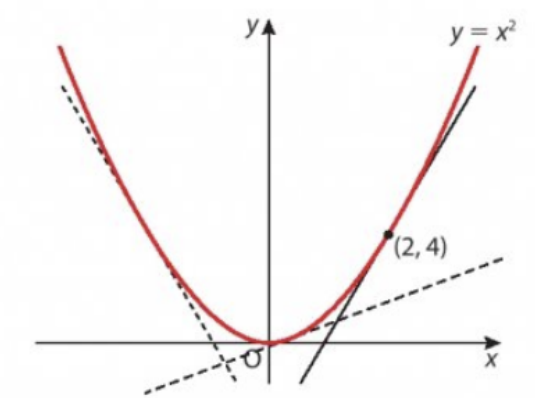
In this diagram showing the curve , we can see that the point lies on the curve. The slope of the curve at this point equals the slope of the tangent line drawn at . If drawn accurately, this slope would be .
The key insight is that different points on the curve will have different tangent lines, and therefore different slopes. This is why we need a systematic method to find the slope at any point.
The differentiation rule
To find the slope of a curve at any point, we use a process called differentiation. Instead of drawing tangent lines (which would be impractical and inaccurate), we use algebraic rules.
Important
The Power Rule for Differentiation:
- If , then
- If , then
In words: Multiply the coefficient of the variable by the power, then reduce the power by 1.
The symbol represents the derivative - it tells us the slope of the curve at any value of .
Step-by-step process for finding derivatives
Note
Let's work through the process using :
Step 1: Identify the power of
- In , the power is
Step 2: Apply the rule
- Multiply the coefficient by the power :
- Reduce the power by :
- Result:
What does mean? This means the slope changes depending on the x-value. At any point , the slope equals .
For example, at , the slope is , which matches what we stated earlier about the point .
Important terminology
Note
Differentiation is the process of finding the slope of a curve at any point .
When we have a function , we say we are "differentiating y with respect to x" to find .
The result is called the derived function or slope function, and can also be written as .
Worked example 1 - basic differentiation
Example
Worked Example: Basic Differentiation
Question: Differentiate each function with respect to :
(i)
(ii)
(iii)
Solution:
(i)
- becomes
- becomes
- becomes (constants disappear)
- Answer:
(ii)
- becomes
- becomes
- becomes
- Answer:
(iii)
- becomes
- becomes
- becomes
- becomes
- Answer:
Worked example 2 - finding the value of a derivative
Example
Worked Example: Finding Derivative Values
Question: If , find the value of at .
Solution:
Step 1: Find the derivative
Step 2: Substitute
Answer: at
This means the slope of the curve at the point where is (very steep and decreasing).
Functions with multiple terms
When a function contains more than one term, we differentiate each term separately. This makes the process manageable even for complex functions.
Note
Example: If
- Differentiate : gives
- Differentiate : gives
- Differentiate : gives
- Result:
Worked example 3 - step-by-step differentiation
Example
Worked Example: Function Notation
Question: A function is defined by . Find .
Solution:
Step 1: Find the derivative
Step 2: Substitute
Answer:
This means the slope of the tangent to the curve at the point where is .
Common exam tips
Important
Common Mistakes to Avoid:
- Always reduce the power by 1 - this is the most common error
- Constants disappear when differentiating (their derivative is )
- Linear terms (like ) become constants (like )
- Check your algebra when substituting values
- Remember the notation: and mean the same thing
Remember!
Summary
Key Points to Remember:
- The slope of a curve at any point equals the slope of the tangent line at that point
- Use the power rule: multiply by the power, then reduce the power by
- Differentiate each term separately for functions with multiple terms
- gives you a formula for the slope at any -value - substitute specific values to find actual slopes
- Constants disappear during differentiation - only terms with remain in the derivative