The Slope of a Line (Leaving Cert Mathematics): Revision Notes
📚Revision Notes
The Slope of a Line
What is slope?
Slope (also called gradient) measures how steep a line is. It tells us how much the y-value changes when the x-value increases by 1 unit.
In mathematics, we use slope to study rates of change - how one quantity varies with respect to another. This is a fundamental concept in calculus.
Note
Key definition: The slope of a line is the rate at which y changes with respect to x.
Calculating slope using rise over run
The most common way to find slope is using the rise over run method.
Important
Formula: Slope =
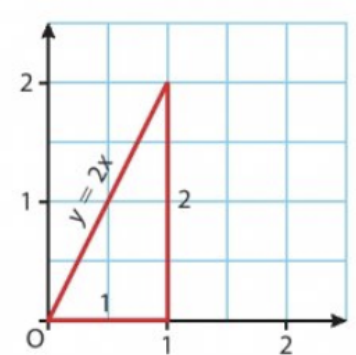
This diagram shows how we can use a right triangle to find the slope. When we move 1 unit right (run = 1) and 2 units up (rise = 2), the slope is .
Finding slope from linear equations
When a line is written in the form :
- m is the slope
- b is the y-intercept
Example
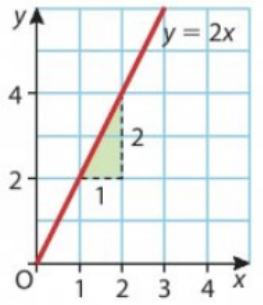
Worked Example 1: Finding slope from y = 2x
For the line :
- The slope is 2
- This means for every 1 unit increase in x, y increases by 2 units
Example
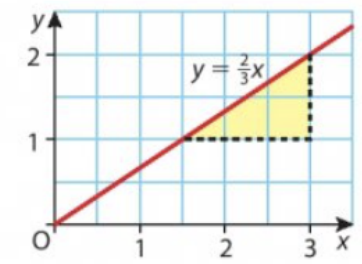
Worked Example 2: Interpreting fractional slope
Consider the line :
The slope is , which means:
- Rise = 2 units
- Run = 3 units
- Slope =
First differences and slope
For linear functions, we can find the slope by examining the first differences in a table of values.
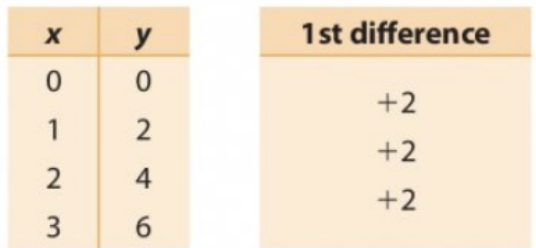
This table shows that when x increases by 1, y always increases by 2. The first difference is constant at +2, which equals the slope.
Important
Important rule: For linear functions, slope = first difference
Mathematical notation for slope
In calculus, we write slope using the notation (read as "dy by dx").
Note
Key relationship: (for linear functions)
Example
Worked Example 3: Slope in calculus notation
For different linear equations:
- →
- →
- →
General rule: For , the slope
Types of slopes
Positive slope
Lines that go upward from left to right have positive slopes.
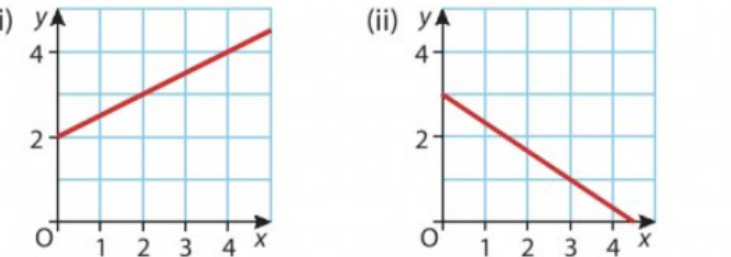
Graph (i) shows a line with positive slope - as x increases, y also increases.
Negative slope
Lines that go downward from left to right have negative slopes.
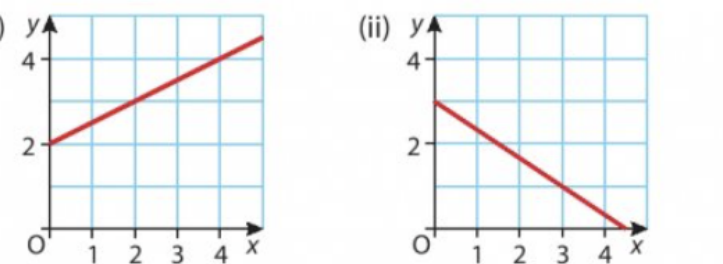
Graph (ii) shows a line with negative slope - as x increases, y decreases.
Zero slope
Horizontal lines have zero slope because y doesn't change as x changes.
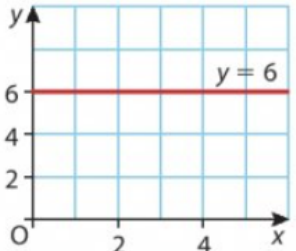
For the horizontal line :
- The slope is 0
- because there's no change in y
Important
Rule: If (where c is a constant), then
Example
Worked Example 4: Reading slopes from a graph
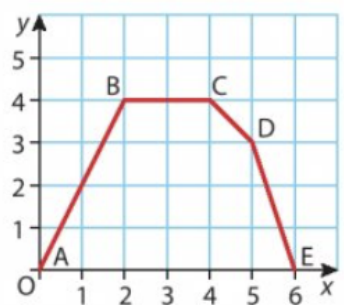
Looking at this piecewise function:
- From A to B: positive slope (line goes up)
- From B to C: zero slope (horizontal line)
- From C to D: negative slope (line goes down)
- From D to E: negative slope (line continues down)
Summary of key formulas
Note
Essential Formulas:
-
Basic slope formula: Slope =
-
From linear equation: If , then slope =
-
Calculus notation: Slope =
-
Constant function: If , then slope =
Summary
Key Points to Remember:
-
Slope measures the steepness of a line - it tells us the rate of change of y with respect to x
-
Use "rise over run" to calculate slope from a graph or two points
-
In linear equations , the coefficient m is always the slope
-
Positive slopes go up, negative slopes go down, and horizontal lines have zero slope
-
For linear functions, the slope equals the first difference and can be written as